How to Find Ideal Kaggle Competition Teammates: Team Formation Strategies and Collaboration Guide

A comprehensive guide to finding teammates and collaborating effectively in Kaggle competitions.
This article explores why teaming up is crucial for success in Kaggle competitions, covering the competitive advantages of complementary skills and shared resources. It provides practical advice on finding suitable teammates through platforms like Reddit, Kaggle forums, and Discord, while emphasizing the importance of goal alignment. The guide also outlines key collaboration strategies including clear role division, proper tooling, and open communication culture.
Introduction: Why You Need a Team for Kaggle Competitions
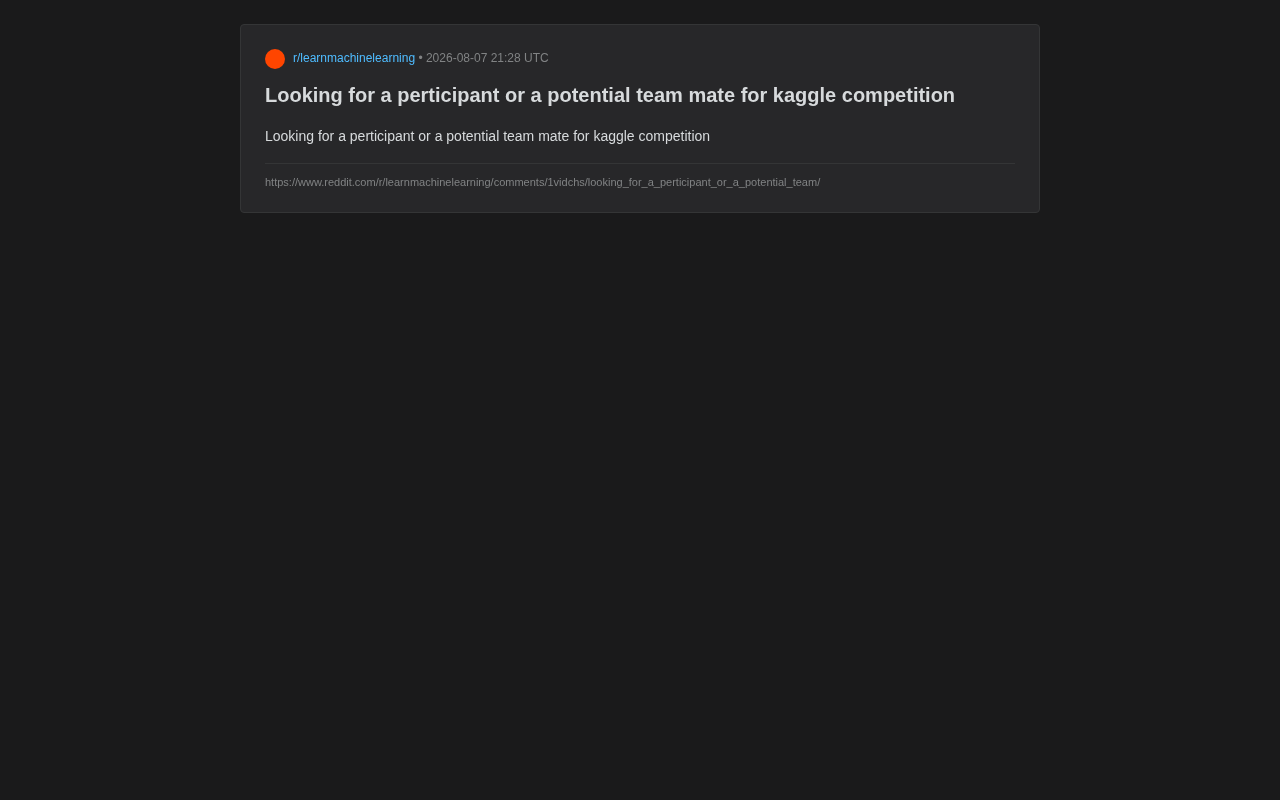
In Reddit's machine learning community, a brief help-seeking post resonated with many data science enthusiasts: a user was looking for a participant or potential teammate for an upcoming Kaggle competition. This seemingly ordinary request actually reflects a widespread pain point in the data science competition space — going solo often makes it difficult to stand out in top-tier competitions.
As the world's largest data science competition platform, Kaggle brings together millions of data scientists, machine learning engineers, and researchers from around the globe. Here, teaming up is not just a social activity — it's a strategic choice. This article dives deep into the value of forming teams for Kaggle competitions, methods for finding teammates, and strategies for effective collaboration.
Why Teaming Up Improves Kaggle Competition Performance
Competitive Advantage Through Complementary Skills
Kaggle competitions typically involve multiple technical stages: data cleaning, feature engineering, model selection, hyperparameter tuning, model ensembling, and more. It's nearly impossible for one person to excel at every stage. By forming a team, members can divide work according to their strengths — those skilled in feature engineering handle data mining, those proficient in deep learning design model architectures, and experienced members oversee ensemble strategies.
This skill complementarity often produces a "1+1>2" effect. In fact, the vast majority of top scores on Kaggle leaderboards are the result of team collaboration. While competing solo can develop well-rounded abilities, in fiercely competitive contests, a team's combined strength is the key to winning.
Efficient Sharing of Computational Resources and Time
Beyond skills, teaming up also effectively distributes computational resources and time costs. Modern machine learning competitions, especially those involving deep learning, often require substantial GPU power and experimentation time. Team members can try different approaches in parallel, quickly validate multiple ideas, and explore a broader solution space within the limited competition timeframe.
How to Find the Right Kaggle Teammates
Proactively Reach Out Through Community Platforms
Just as this Reddit user did, social media and tech communities are important channels for finding teammates. Here are several effective platforms:
- Reddit: Subreddits like r/MachineLearning, r/datascience, and r/kaggle are home to many active competition participants
- Kaggle Official Forums: The Discussion section of each competition usually has dedicated team formation threads
- Discord Servers: Many data science communities run dedicated competition channels
- LinkedIn and Twitter: Follow Kaggle Grandmasters and high-ranking competitors to discover potential collaborators
When posting team formation requests, it's recommended to clearly state the following:
- Target competition: Specify which competition you're joining and its type (tabular data, computer vision, NLP, etc.)
- Your skills: Honestly introduce your tech stack and areas of expertise
- Expected goals: Whether you're aiming for a medal, learning experience, or pushing for the top of the leaderboard
- Time commitment: How many hours per week you can invest
Align on Shared Goal Expectations
When looking for teammates, the most easily overlooked yet critically important factor is goal alignment. If one teammate wants to go all-in for a gold medal while another just wants to casually experience the process, friction is inevitable during collaboration. Therefore, thoroughly communicating expectations early in the team formation process can prevent many conflicts down the road.
Build Trust Through Smaller Competitions
Rather than jumping straight into high-difficulty competitions together, consider starting with Playground-level or beginner competitions to build rapport. This allows you to understand each other's work styles, communication efficiency, and technical proficiency in a low-pressure environment, laying a solid collaborative foundation for more challenging competitions ahead.
Key Strategies for Effective Team Collaboration
Establish Clear Roles and Workflows
Once the team is formed, clear division of labor is the foundation of efficient collaboration. Teams can leverage the following tools and processes:
- Use GitHub for code version control to avoid merge conflicts
- Share Kaggle Notebooks or Google Colab to synchronize experimental results
- Hold regular online meetings (1-2 times per week) to align on progress
- Maintain experiment log documents to track each submission's approach and score changes
Good engineering practices prevent redundant work and let the team focus their energy on truly valuable innovation.
Foster an Open Communication Culture
The essence of data science competitions is a continuous process of trial and error. Team members should be willing to share failed experiments, because knowing "what doesn't work" is just as important as knowing "what does work." A team atmosphere that encourages open discussion and embraces different perspectives often sparks unexpected innovative ideas.
Conclusion: A Growth Journey That Starts with Teaming Up
This Reddit user's brief help post reflects an important growth milestone in the data science learning path — transitioning from independent learning to collaborative practice. Participating in Kaggle competitions and finding like-minded teammates is not only a means to improve rankings but also an excellent opportunity to expand your network, learn from others' approaches, and accelerate personal growth.
For anyone committed to deepening their expertise in the machine learning field, having the courage to step outside your comfort zone and proactively seek collaborators is itself an attitude worth affirming. Regardless of the final results, the experience of team collaboration will become an invaluable asset in your career.
Related articles

OpenAI Partners with Shield: How the Astra Agent Revolutionizes IT Troubleshooting
OpenAI and Shield launch the Astra agent, which autonomously logs into computers and legacy systems to fix IT issues in real time, 35-40% faster than traditional models, with humans involved only when judgment is needed.

iPhone Duo Battery Life Tested: One Charge a Day Is Unavoidable, and the Large Screen Is the Culprit
iPhone Duo battery test: heavy use needs at least one charge a day, and about 30% remains after 6.5 hours of screen-on time. How often the large screen is unfolded is key; a MagSafe battery pack helps, and long-term degradation is also worth watching.

Kimi K3.1 Pro Open-Sourced: 2.8 Trillion Parameters Close In on Opus
Moonshot releases the open-source MoE model Kimi K3.1 Pro, with 2.8T total parameters and 104B activated, trailing Opus 5.5 by under 1 point on Terminal Bench 4.0.