How to Subscribe to ChatGPT Plus? Three Methods Compared with Security Risk Analysis

Security and cost comparison of three ChatGPT Plus subscription methods for users in China
This article compares three mainstream methods for Chinese users to subscribe to ChatGPT Plus: third-party proxy payments (convenient but high-risk for account security, bans, and code injection), direct international credit card payment (safest with best long-term value, highly recommended), and mobile app store subscriptions (secure but more expensive due to Apple Tax). The author recommends prioritizing security and choosing the direct credit card payment approach.
Introduction
As ChatGPT continues to upgrade its capabilities, more and more users want to upgrade from the free tier to Plus membership for full GPT-4o access, faster response speeds, and priority access to new features. GPT-4o is OpenAI's multimodal flagship model released in May 2024, where "o" stands for "omni." Compared to the previous GPT-4 Turbo, GPT-4o achieves unified architecture processing across text, voice, and image understanding, with response latency dramatically reduced to approximately 320 milliseconds—close to the natural reaction speed of human conversation. While free users can access GPT-4o on a limited basis, they face strict restrictions on message frequency, peak-hour availability, and advanced features (such as data analysis, file uploads, DALL·E image generation, custom GPTs, etc.). Plus members ($20/month) receive 5x the GPT-4o message quota compared to free users and get priority access to new features like Advanced Voice Mode and Canvas collaborative editing.
However, due to payment channel restrictions, users in China face significant obstacles when subscribing to Plus, which has given rise to various subscription solutions in the market. OpenAI has not yet officially launched services in mainland China, and its payment system processes transactions through Stripe, accepting only international credit cards (Visa, Mastercard, American Express, etc.) from supported regions. UnionPay-only cards issued by Chinese banks cannot be used for payment directly, and even dual-branded cards (such as UnionPay+Visa) may be declined due to Address Verification System (AVS) checks or IP-based risk control policies. Stripe's risk control system comprehensively evaluates the cardholder's region, IP address, device fingerprint, and other multi-dimensional information. If a mismatch between the payment environment and card registration location is detected, the transaction may be blocked. This technical barrier is the fundamental reason behind the emergence of various proxy payment services.
This article provides an objective analysis of the three mainstream methods for subscribing to ChatGPT Plus, breaking down the operational process, cost differences, and potential risks of each to help you make a more informed decision.
Overview of Three Mainstream ChatGPT Plus Subscription Methods
Currently, users in China have three main paths to upgrade to ChatGPT Plus:
- Third-party proxy payment websites: Complete the subscription through dedicated proxy platforms
- Direct payment with international credit cards: Pay on OpenAI's official website using Visa/Mastercard
- Mobile app store subscriptions: Subscribe through Apple App Store or Google Play
Each method has its pros and cons. Let's analyze them one by one.
Method 1: Third-Party Proxy Payment Websites (Highest Risk)
Process
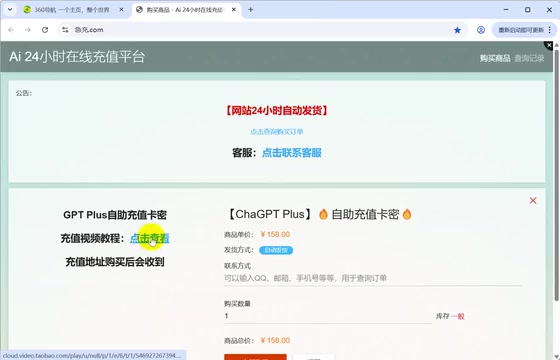
The basic workflow for third-party proxy payments is typically: Purchase a card code on the proxy website → Receive a redemption code → Paste the code on the designated page → The system automatically completes the subscription. The entire process is relatively simple and can be done on both mobile and desktop.
Taking a proxy platform as an example, the price is approximately 158 RMB/month, which is slightly higher than the official price of $20/month (roughly 145 RMB) but lower than the total cost of the credit card method.

Security Risk Warnings (Must Read)
It must be emphasized that third-party proxy payments carry multiple significant security risks:
- Account security risk: The proxy process may require providing account credentials or executing code on third-party pages, creating potential for credential leakage
- Account ban risk: OpenAI has detection mechanisms for abnormal payment behavior, and using unconventional channels may trigger risk controls, directly leading to account suspension. OpenAI employs a multi-layered risk control system that analyzes the credit card's BIN (Bank Identification Number, the first 6-8 digits) to determine the issuing bank and region, while cross-referencing the payment IP address and browser fingerprint against historical login records for consistency. If the same credit card pays for multiple accounts within a short period, or if an account's login IP frequently jumps between different countries, risk alerts may be triggered. Flagged accounts may face temporary restrictions or permanent bans, and OpenAI's appeal process is typically lengthy with low success rates.
- Financial risk: Proxy platforms lack regulatory oversight, making dispute resolution extremely difficult
- Code injection risk: Some proxy methods require users to "copy all code and paste to execute," which essentially means running scripts from unknown sources—a serious information security hazard. Specifically, these methods require users to paste and execute JavaScript code in the browser's Developer Tools Console (DevTools Console), which has full DOM access to the current page. Malicious scripts can read all cookies on the page (including Session Tokens), authentication information stored in LocalStorage, and can even simulate user actions to send requests. Attackers can achieve Session Hijacking through this method, taking over accounts without the user's knowledge. This attack technique is known as a "Self-XSS" social engineering attack in the security field, and major browsers display warning messages in the console reminding users not to paste code from unknown sources.
- No after-sales guarantee: While many platforms claim to offer "after-sales support," such services often lack legal enforceability

Method 2: Direct Payment with International Credit Card (Most Recommended)
Process
This is the standard payment method officially supported by OpenAI. The specific steps are:
- Apply for a credit card that supports international payments (Visa/Mastercard)
- Some users opt for virtual credit card services (such as Depay, Nobepay, etc.) as alternatives
- Bind the credit card directly on ChatGPT's subscription page to complete payment
How Virtual Credit Cards Work
Virtual Credit Cards are digital payment tools issued by fintech companies. Users can obtain a complete set of card number, expiration date, and CVV security code without holding a physical card. Platforms like Depay and Nobepay typically partner with overseas licensed banks or payment institutions, operating on a prepaid model—users first deposit funds (usually supporting USDT cryptocurrency or bank transfers) into their platform account, then allocate them to virtual cards for use. These cards are usually registered in the US or Europe, allowing them to pass Stripe's regional verification. It's worth noting that the virtual credit card industry has varying levels of regulatory oversight. When choosing, prioritize platforms with longer operating histories and better user reputations, and avoid storing excessive funds on a single card.
Cost and Pros/Cons Analysis
The total cost of using a credit card is indeed higher. Taking virtual credit cards as an example:
- Card issuance fee: approximately $10-20
- Monthly/management fee: charged by some platforms
- Top-up fees: typically 1%-3%
- Exchange rate spread: some currency conversion loss
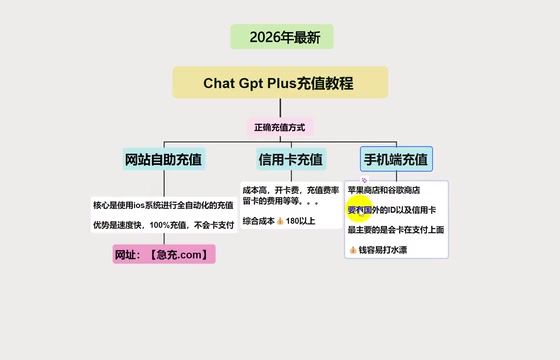
All things considered, the first month's cost may exceed 180 RMB. However, the core advantage of this method is security—you transact directly with OpenAI, your account information doesn't pass through any third party, and the risk of account suspension is minimal. Maintaining consistency and stability between your payment environment and usage environment is key to avoiding OpenAI's risk controls.
In the long run, subsequent subscription months only require the monthly fee plus minimal handling charges, so the per-month cost gradually decreases, making this actually the most cost-effective option over time.
Method 3: Mobile App Store Subscription (Safe but Expensive)
Prerequisites
Subscribing to ChatGPT Plus through the App Store (Apple) or Google Play (Android) requires meeting the following conditions:
- Having a US or other overseas region Apple ID / Google account
- Binding a local credit card or purchasing gift cards for the corresponding region
- Device must be able to access the corresponding app store normally
Pros and Cons Analysis
Advantages:
- Transactions through legitimate app stores with security guarantees
- Apple/Google's payment protection mechanisms are robust
- Subscription management is convenient with easy cancellation
Disadvantages:
- Apple charges approximately 30% "Apple Tax," making the actual payment significantly higher than the official website price. The so-called "Apple Tax" refers to the commission Apple charges on In-App Purchases (IAP) made through the App Store, with a standard rate of 30% (15% for small developers earning less than $1 million annually). This means ChatGPT Plus subscription prices in the App Store are typically adjusted to cover this cost. In the US App Store, for example, ChatGPT Plus is priced at $19.99/month, but OpenAI actually only receives about $14. This policy has been controversial for years—Epic Games' antitrust lawsuit against Apple and the EU's Digital Markets Act (DMA) implementation are both pushing for app store commission reform. For users, subscribing through the App Store offers Apple's refund protection and privacy security mechanisms, but does indeed incur additional platform costs.
- Gift card top-ups may encounter payment verification issues
- Maintaining an overseas account requires some technical knowledge
- Some users report difficulties completing the payment process
ChatGPT Plus Subscription Security Tips and Best Practices
Priority Ranking of the Three Methods
Considering both security and long-term cost, the recommended order is:
- Top choice: Direct international credit card payment — Safest, best long-term cost
- Second choice: Mobile app store — Platform-guaranteed security, but slightly higher cost
- Use with caution: Third-party proxy payment — Highest risk, not recommended as a long-term solution
Key Principles for Protecting Your Account
- Never enter your OpenAI account credentials on third-party pages
- Never execute unknown code or scripts in your browser—as discussed above, the browser console has extremely high page-level permissions, and Self-XSS attacks can steal session credentials without your awareness
- Be wary of proxy services with suspiciously low prices—low prices often indicate illegal methods such as stolen credit cards
- Enable two-factor authentication to add an extra layer of protection to your account. OpenAI supports TOTP (Time-based One-Time Password) two-factor authentication through authenticator apps (such as Google Authenticator, Authy, etc.). Even if your password is compromised, attackers cannot log in without the dynamic verification code
- Regularly check your account activity logs and change your password immediately upon detecting any anomalies
Conclusion
Upgrading to ChatGPT Plus does bring a significant improvement in user experience, but when choosing a subscription method, security should always come first. While third-party proxy payments may seem convenient and attractively priced, the underlying security risks cannot be ignored.
Investing a bit of time and effort to obtain an international credit card or set up an overseas app store account is the best approach for long-term, stable use of ChatGPT Plus. After all, saving a few dollars is far less important than the losses from account suspension or personal information leakage.
Related articles
 Tutorials
ChatGPT Plus Subscription Guide: Are GPT-5.5, image-2, and Codex Worth the Upgrade?
A detailed look at ChatGPT Plus features — GPT-5.5, image-2, and Codex — with a Plus vs Pro comparison and a complete step-by-step subscription guide for users outside the US.
 Tutorials
Harness AI Engineering in Practice: Using Claude Code to Master Enterprise-Level E-Commerce Development
Deep dive into Harness AI Engineering: master enterprise e-commerce development with Claude Code using the Rules, Skills, Wiki, and Changes framework.
 Tutorials
Cursor + Codex Dual-IDE Collaboration: A Practical Methodology for Open-Source Project Customization
A complete methodology for open-source project customization based on real-world experience, detailing the Cursor+Codex dual-IDE workflow, seven-stage process, MVP validation, and AI source code reading techniques.