How to Tell If an AI Model Is Truly "Uncensored": A Community Debate Worth Thinking About

"Uncensored" labels are overused — training data bias is the real invisible limit on AI image diversity.
In AI image generation communities, "uncensored" has become a ubiquitous but poorly defined label. A Reddit post using "can it generate diverse male figures?" as a litmus test argues that truly unrestricted generation should span the full spectrum of characters, styles, and scenes — not just produce certain sensitive content. The deeper technical issue is that many models' limitations stem not from explicit content filters, but from uneven training data distributions — a form of implicit censorship that standard uncensored fine-tuning cannot fix.
A Recurring Question About Standards
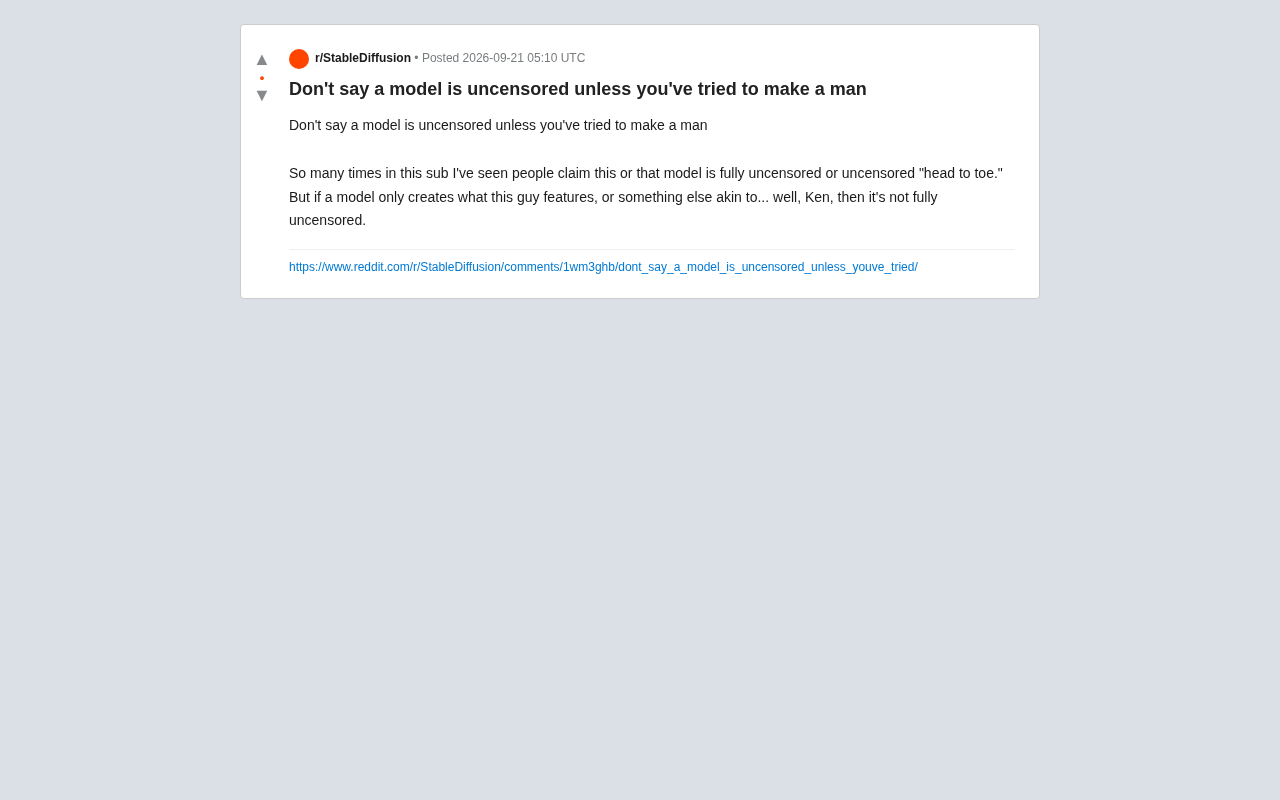
In the AI image generation community, "uncensored" has become one of the most frequently used benchmarks for evaluating a model's capabilities. A Reddit user recently posted about how the community is flooded with claims like "this model is completely uncensored" or "uncensored from top to bottom" — yet these assertions rarely come with rigorous verification.
The poster offered a somewhat tongue-in-cheek test: if a model can only generate certain specific types of content, or if the male figures it produces are all cookie-cutter and lack diversity (jokingly described as "Ken"-style generic figures), then it can't really be called "fully uncensored."
What Does "Uncensored" Actually Mean?
What reads as a joke actually touches on a long-standing ambiguity in the AI image generation space. When people say a model is "uncensored," they typically mean it won't refuse to generate certain sensitive or adult content. But this framing operates on a single dimension — whether the model is willing to generate a particular subject matter.
True "unrestricted" generation should encompass a much broader range of capabilities: Can the model handle diverse character types, varied body types, different scenes and artistic styles? If a model is open about certain content categories but produces highly homogeneous, detail-lacking results in others, its "freedom" is fundamentally incomplete.
The poster's core argument is this: judging whether a model is uncensored shouldn't just be about what "sensitive" content it can generate — it should be about whether it can cover the full spectrum of generation possibilities.
In the context of open-source AI communities (particularly platforms like Civitai and Hugging Face), the term "uncensored" has undergone considerable semantic drift. Originally, it was used to describe language models from which the content-refusal behaviors introduced during RLHF (Reinforcement Learning from Human Feedback) had been removed. The term was later borrowed into the image generation space, where it typically means a model hasn't loaded — or has bypassed — the NSFW Safety Checker. However, these two forms of "uncensoring" follow entirely different technical paths: the former involves alignment strategies at the level of model behavior, while the latter is simply toggling a post-processing filter in the inference pipeline. Conflating the two leads users to misjudge a model's actual capability boundaries — assuming that disabling the safety filter is equivalent to obtaining a fully capable, all-purpose generation model.
Training Data Bias: The Invisible "Censorship"
From a technical perspective, this phenomenon is really a problem of uneven training data distribution. Many generative models are trained on abundant data for certain image types, resulting in high output quality and diversity for those subjects — while other types are underrepresented, causing outputs to trend toward templated, generic results.
This kind of capability limitation caused by data distribution is essentially a form of "implicit censorship" — not enforced through rules or filters, but arising naturally from the model's capability boundaries. Users may assume that a model being willing to generate something is the same as it being able to generate it well, but these are two very different things.
Evaluating a model's true openness therefore requires a comprehensive set of test cases to probe its limits — rather than drawing conclusions from a handful of specific attempts.
In the training of image generation models, uneven data distribution is a particularly acute problem. Take mainstream diffusion models as an example: they learn the "text prompt → image" mapping from massive image-text pairs. If certain categories of figures (such as specific body types, ethnicities, or poses) are drastically underrepresented in the training set, the model will frequently "fall back" to the center of the distribution it knows best during inference — producing templated, homogeneous outputs even when the user's prompt explicitly requests diversity. This is fundamentally different from explicit content filtering rules (like NSFW filters): the latter is human-added refusal logic that can be fine-tuned or bypassed; the former is a capability ceiling encoded in the model's weights themselves, which cannot be overcome simply by adjusting prompts. The popular "uncensored fine-tunes" circulating in the community typically only address the former — removing the safety restriction layer — while doing nothing about the implicit biases baked in by training data. This is the root reason why many models marketed as "fully uncensored" still produce monotonous, uniform outputs.
What This Means for the Community
This post is a reminder for community members to bring more rigor to how they evaluate models. "Uncensored" is a label that's easy to misuse. Without a unified standard, different users running limited tests will reach wildly different conclusions.
For users who care about AI generative models, rather than taking "completely uncensored" marketing claims at face value, it's worth designing your own diverse test scenarios to thoroughly examine a model's actual performance across multiple dimensions — characters, styles, compositions, and more. Only through thorough testing can you make a reliable judgment about what a model is truly capable of.
Related articles

Reinforcement Learning Takes On Getting Over It: Distributed Training Strategies Behind 63% Progress
A developer uses deep reinforcement learning to tackle Getting Over It. The agent climbs from the bottom to 63% progress but gets stuck at the anvil. The project is open-sourced, using divide-and-conquer training and CPU-only training, seeking community collaboration to break the bottleneck.

Sigma FP2 Released: The World's Smallest Full-Frame Camera Gets Sensor and Screen Upgrades
Sigma launches the FP2 full-frame camera, retaining its smallest-and-lightest design with three key upgrades: improved sensor, articulating LCD screen, and longer battery life—built for portable video creators.

AAAI 2027 Phase 2 Decisions Imminent: Community Debates Review Fairness and Submission Ecosystem
AAAI 2027 phase 2 review results are imminent, with the Reddit community debating reviewer consistency and process transparency. This article examines pre-decision sentiment, structural tensions in top conference review, and practical strategies for authors.