How to Test an AI Support Agent Before Launch: Shadow Mode Is Just the First Step

Shadow mode is just the start—AI support pre-launch testing needs edge cases, handoff, multi-turn state, and observability.
The article explores how to test an AI support agent before launch, noting that shadow mode is a safe, zero-risk starting point but only validates how the AI answers, not its behavior when it can't. It proposes a pre-launch checklist covering adversarial edge cases and safe failure rates, handoff trigger logic and context transfer, multi-turn state retention, knowledge base boundaries and freshness, and tone and brand consistency. It also summarizes commonly regretted testing gaps: concurrency and latency, logging and observability, and user expectation management around AI identity disclosure. Testing should not be a one-time gate—offline evaluation and shadow mode should work in layers, and testing assets should continue to support regression and drift monitoring after launch.
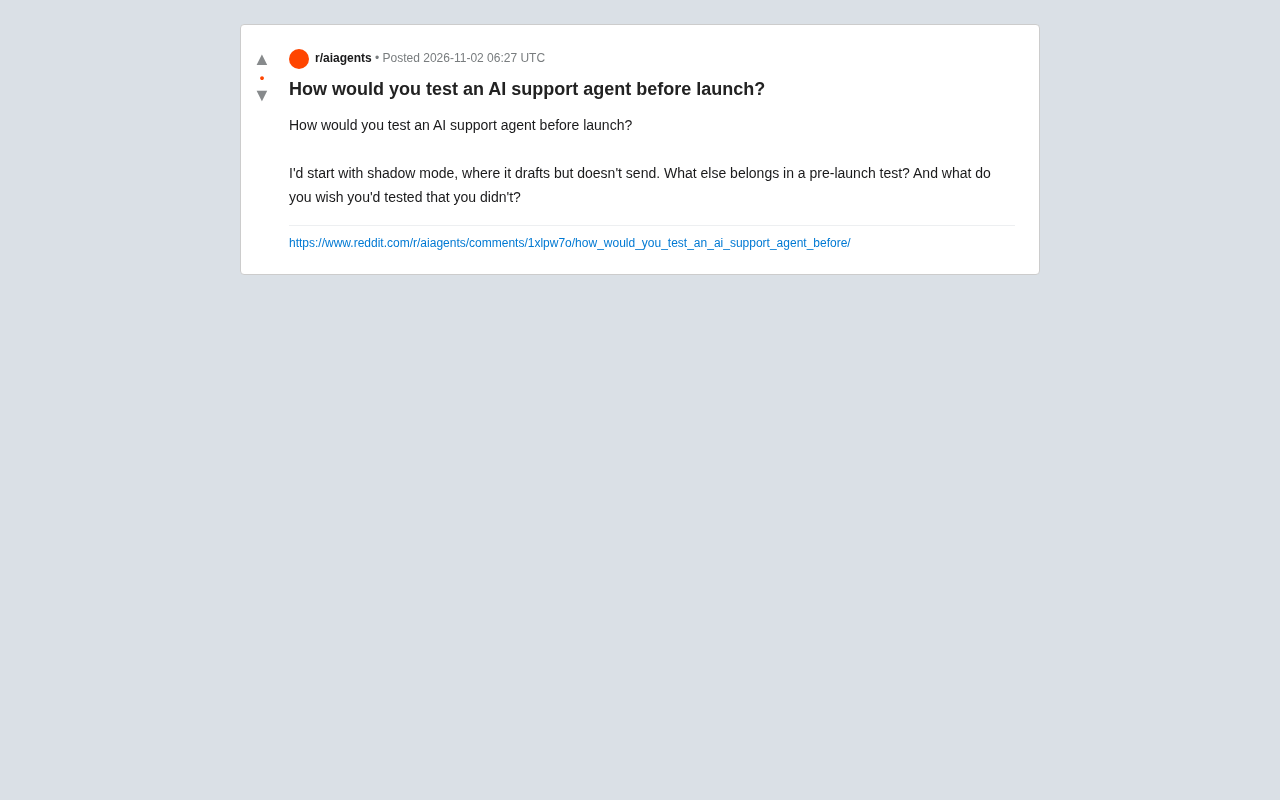
Launching an AI customer support agent — the most dangerous thing isn't that it occasionally gives a wrong answer, but that it sends that wrong answer directly to a customer with no supervision. A practitioner on Reddit posed a pointed question: How would you test an AI support agent before launch? Their starting point was "shadow mode" — letting the AI draft replies without actually sending them, then having a human review. This is a solid beginning, but far from the whole picture.
Why Shadow Mode Is a Necessary Starting Point
The core value of shadow mode is zero-risk observation. The AI generates replies under real traffic, but those replies are intercepted and judged for quality by a human. This exposes how the model performs against real user questions without worrying about misinformation reaching customers.
But shadow mode has an easily overlooked blind spot: it only tests "how the AI answers," not "what the AI does when it can't answer." A model that only generates polished answers may fabricate information when it hits a knowledge gap — and in shadow mode, if human reviewers only look at answer quality rather than confidence, this kind of risk is easily missed.
Shadow Mode is a validation approach widely used before an AI system officially serves external users. The model is connected to real production traffic and generates outputs through its normal logic, but those outputs are intercepted by the system and do not actually reach end users — instead they go into a human review queue or logging system. Unlike offline test sets, the biggest advantage of shadow mode is the realism of the input distribution: users' actual phrasing, typos, mixed intents, and sudden topics all appear naturally without manual construction. It is often paired with Canary Release — first using shadow mode to validate output quality, then releasing to a tiny percentage of traffic to observe online metrics. Note that shadow mode itself does not produce a user feedback loop, so it evaluates "whether the model output is acceptable" rather than "whether the user is satisfied." There is still a gap between the two, typically filled by subsequent A/B testing.
Pre-Launch Test Checklist: From Single-Turn Dialogue to System Resilience
Drawing on community discussion and hands-on experience, a complete pre-launch test should cover the following layers.
1. Adversarial Testing and an Edge Case Library
Don't test only with standard questions like "Where is my order?" You need to build a dedicated edge case library: multi-intent mixed questions, complaints with emotional phrasing, questions containing false premises (e.g., a user misremembering an order number), and questions entirely outside the knowledge base.
The key metric isn't "answer accuracy" but safe failure rate — when the AI is uncertain, can it gracefully hand off to a human or admit it doesn't know, rather than forcing out a plausible-sounding wrong answer?
Adversarial Testing originates from the machine learning security field and refers to deliberately constructing inputs that induce model errors in order to probe the system's robustness boundaries. In large language model scenarios, typical adversarial samples include prompt injection (attempting to make the model ignore system instructions), leading false premises, and "hallucination traps" that ask the model to confirm something that doesn't exist. A companion Edge Case Library is a labeled collection of high-difficulty test samples, usually managed by risk level and business scenario, versioned and used for regression testing. What the industry often calls "Red Teaming" can be seen as the organized form of adversarial testing — a dedicated team playing the attacker role to systematically find vulnerabilities. For AI customer support, red teaming often focuses not on making the model say something wrong, but on verifying whether it will bypass the handoff policy or leak internal information under pressure.
2. Testing Handoff Trigger Logic
This is the part many teams most regret not testing. Is the handoff between the AI agent and human agents smooth? Are the trigger conditions for handoff reasonable — triggered by confidence below a threshold, or by user dissatisfaction? Is context fully passed along during the handoff, or does the user have to explain the problem all over again?
A common failure mode: the AI gives a wrong answer before handing off, the user carries that wrong information into the human interaction, and the agent has to correct it before solving the problem — making the experience worse than simply waiting in queue.
Confidence Threshold is one of the core mechanisms for deciding whether the AI should hand off to a human. The model typically outputs a confidence score or equivalent signal for each answer (such as retrieval match score or generation probability), and when the score falls below a preset threshold, the system automatically escalates to a human agent. The difficulty lies in calibrating the threshold: set too high, and many conversations that could have been resolved automatically get handed off, increasing labor costs; set too low, and low-quality answers reach users. In practice, a Calibration Curve is often used to check whether the model's self-reported confidence matches its actual accuracy — an "overconfident" model will let wrong answers through even with a reasonable threshold. In addition, handoff should support triggering on multi-dimensional signals such as user sentiment, repeated question count, and keyword hits, rather than relying on a single score — this is the combined scenario that handoff logic testing needs to cover.
3. State Retention Across Multi-Turn Dialogue
Good single-turn Q&A performance doesn't mean multi-turn dialogue is reliable. Users add information, change requirements, and reference things said earlier in the conversation. Testing requires designing multi-turn scenario scripts to observe whether the AI can still accurately reference early context in the third or fourth turn, rather than treating each turn as a brand-new conversation.
4. Knowledge Base Boundaries and Freshness
AI customer support answer quality depends heavily on the coverage and freshness of the underlying knowledge base. Before launch, systematically test: policies that don't exist in the knowledge base, expired campaign rules, and multiple conflicting knowledge entries — how does the AI handle them?
Someone in the community mentioned a worrying phenomenon: the model tends to give any content in the knowledge base a tone of certainty, even when that entry is marked as expired. Testing should specifically verify whether the AI has freshness awareness, rather than treating all retrieved content the same.
5. Tone and Brand Consistency
Functional correctness is only the passing grade. Whether the AI agent's tone matches the brand voice, and whether it is appropriate in different emotional scenarios, also needs evaluation during pre-launch. A model that answers technical questions precisely may come across as cold or overly mechanical when a user is angry.
Lessons from Those Who "Wish They'd Tested It Sooner"
The original Reddit post asked a valuable question: What do you wish you had tested but didn't? From community feedback, the most frequent regrets cluster in a few areas.
First, concurrency and latency. Functional tests pass, but after launch, response times slow during peak hours, users abandon conversations after waiting too long, and conversion drops. Pre-launch testing needs to measure end-to-end latency under near-realistic load.
Second, logging and observability. If you discover after launch that you can't trace the full decision chain of a given conversation, troubleshooting becomes very difficult. During testing, verify that logs record the retrieved knowledge entries, the model's confidence signals, and the reasons for handoff triggers.
Third, managing user expectations. If the AI agent doesn't clearly state at the outset that it is an AI, users feel deceived when they find out later. This is a testing item at the experience-design level, but it is often dismissed as a "product issue" and skipped.
Testing Is Not a One-Time Gate
Shadow mode is a good starting point, but it is essentially the final check before launch, not the whole testing strategy. A more sensible approach splits pre-launch testing into two layers: offline evaluation runs batch scoring against the built edge case library for rapid iteration; shadow mode provides final validation with real traffic while collecting new problems the offline library didn't cover.
After launch, these testing assets should not be discarded. The edge case library can keep expanding and become the foundation for regression testing; shadow mode can shift to continuous sampling review, monitoring model drift under the real distribution. Quality management for AI customer support is an ongoing process, and pre-launch testing only establishes the baseline for that process.
Data Drift refers to the distribution of online input data deviating over time from the distribution at training or evaluation time, and is a major cause of performance degradation after AI systems launch. For AI customer support, drift can come from new phrasings introduced by new products, consultation peaks during promotion seasons, or concentrated questions triggered by external events. Relatedly, Concept Drift refers to a change in the mapping between inputs and correct outputs themselves — for example, after a return policy adjustment, the same question requires a different answer. Regression Testing in this context means periodically re-running the model against the accumulated edge case library to ensure new versions or knowledge base updates haven't broken existing capabilities. Converting shadow mode into continuous sampling review essentially establishes an online quality monitoring loop, enabling teams to detect drift early when metrics deteriorate and trigger iterations on the knowledge base or prompts.
One-line Summary
Shadow mode is just the start — pre-launch testing for AI customer support requires systematic testing of edge cases, handoff, multi-turn state, and observability.
Paragraph Summary
The article addresses the question of how to test an AI support agent before launch, noting that while shadow mode is a safe, zero-risk starting point, it only validates how the AI answers and does not cover its behavior when it can't answer. The author proposes a pre-launch test checklist covering adversarial edge case libraries and safe failure rates, handoff trigger logic and context transfer, state retention across multi-turn dialogue, knowledge base boundaries and freshness awareness, and tone and brand consistency. Drawing on community feedback, the article summarizes three commonly regretted testing gaps: concurrency and latency, logging and observability, and user expectation management around AI identity disclosure. Finally, it emphasizes that testing should not be a one-time gate — offline evaluation and shadow mode should work in layers, and testing assets should continue to be used for regression and drift monitoring after launch.
Related articles

Codex App Complete Guide: From Installation to Hands-On Practice — AI Automatically Organizes Files and Builds Reports
Codex App complete guide: install from the app store, configure everyday work mode, and use real coffee shop data to practice file organization, Excel reports, and visual dashboards. Learn Plan Mode and the little pet feature — master Codex's AI automation workflow in one episode.

Getting Started with Langfuse: Building a Financial Analysis Agent and Evaluation Platform
A Langfuse tutorial: explore the core capabilities and boundaries of this open-source AI Engineer platform, and learn how to build an enterprise-grade log tracing, evaluation, and observability platform for a Harness-architecture financial analysis multi-agent system, covering prompt management, token cost analysis, and integration with frameworks like LangChain.

AI Agents Under Attack: Cursor Backdoor and the Binance Heist
This week in AI security: a Claude code backdoor in Cursor Marketplace, Binance's $6.3B laptop breach, VaporPanda's AI agent attacks on 200+ orgs, Gitbook and Chainalysis breaches, Polymarket's $2.7M loss, and Claude writing a root exploit in 53 minutes. Learn the latest AI agent attack trends and security recommendations.