How to Truly Learn Python Libraries Like scikit-learn and PyTorch: A Methodology Guide
The key to learning Python libraries is building mental maps, letting projects drive learning, reading source code boundaries, and logging errors.
Addressing the common predicament of "watching tutorials but still not knowing how to use libraries," the article proposes a four-step learning method: first build a mental map to understand a library's core abstractions (like scikit-learn's Estimator or PyTorch's Tensor/autograd), then use a minimum viable project to drive learning while allowing yourself to get stuck, then read test cases and exception-handling code to build intuition for library boundaries, and finally maintain an error log and knowledge cards. The article also gives focused advice for scikit-learn, PyTorch, and sentence-transformers respectively, emphasizing that shifting from "input-driven" to "output-driven" is the watershed for truly learning these libraries.
Why Do You Still Not Know How to Use These Libraries After Watching So Many Tutorials?
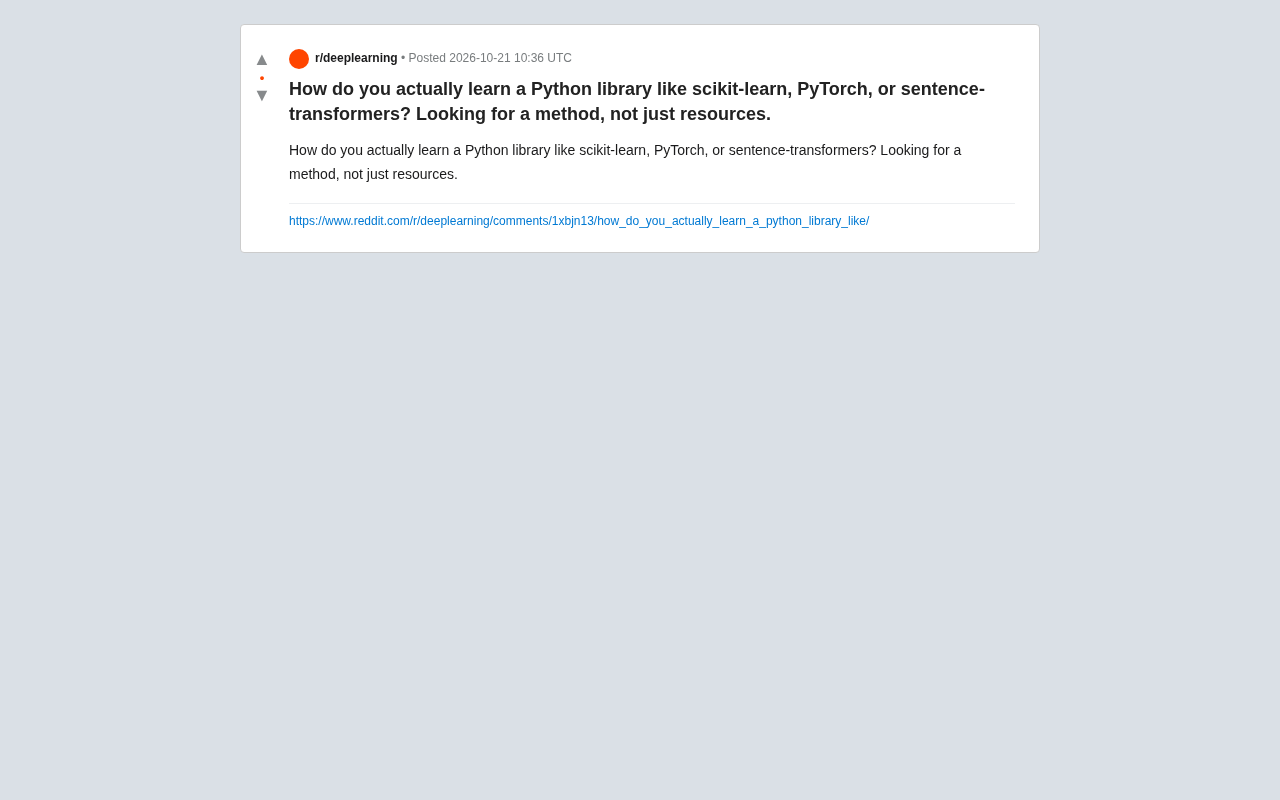
In Reddit's machine learning community, a user raised a question that hits a raw nerve: How do you actually learn Python libraries like scikit-learn, PyTorch, and sentence-transformers? He emphasized that what he needed was "a method, not just resources."
This actually points to a common predicament: we bookmark countless tutorials, videos, and documentation, yet still find ourselves at a loss when facing real problems. The issue isn't a lack of resources—it's the absence of a path to transform "knowing" into "knowing how to use."
The Pitfalls of Common Learning Paths
Most people's learning path is: find an introductory book or video course → type along with the code → get the example running → assume they've learned it.
But this approach has two fatal flaws. First, example code is often carefully designed to avoid all pitfalls, while real data is full of missing values, dimension mismatches, and memory overflows. Second, passively following tutorials fails to build an understanding of a library's design philosophy. For instance, scikit-learn's consistent fit/transform/predict interface, PyTorch's dynamic computation graph and automatic differentiation mechanism, sentence-transformers' encapsulation logic for pretrained models—these are the keys that determine whether you can use them flexibly.
An Actionable Learning Methodology
Step 1: Build a "Mental Map" Instead of Reading Line by Line
When you get a new library, don't rush to look at the code. Spend half an hour browsing the table of contents of the official documentation to figure out what categories of problems this library solves and how its core modules are divided. Take scikit-learn as an example: its documentation is organized by tasks like "supervised learning," "unsupervised learning," and "model evaluation," which itself hints at its design logic.
Then read the "Quick Start" section of the official tutorial, but the goal isn't to memorize APIs—it's to answer one question: What is the most core abstraction of this library? For PyTorch, the answer is Tensor and autograd; for scikit-learn, the answer is the Estimator interface.
The Estimator interface is the unified contract for all models, preprocessors, and pipelines in scikit-learn. Any object that implements fit (learns parameters from data), transform (transforms data, used for preprocessing/dimensionality reduction), or predict (predicts, used for models) methods conforms to the Estimator protocol. This consistency allows meta-tools like Pipeline and GridSearchCV to operate on any component indiscriminately, and it's the fundamental reason scikit-learn is "plug-and-play." Once you understand this, when you see a new class, you only need to determine which type of Estimator it belongs to (supervised/unsupervised, transformer/predictor) to infer how it's called, without memorizing APIs.
Step 2: Let a "Minimum Viable Project" Drive Your Learning
Don't wait until you've finished learning to start using—let a project force your learning. Pick a data problem you genuinely care about—even a small one, like predicting housing prices or doing sentiment classification on text. Then complete it using the target library.
The key to this process is allowing yourself to get stuck. When you're handling missing values and don't know whether to use SimpleImputer or IterativeImputer, go check the documentation, search, read the source code—this "problem-driven" memory is far deeper than passive reading. An experienced practitioner in a similar discussion mentioned that his way of learning sentence-transformers was to first get a semantic search demo running, then deliberately modify parameters and observe output changes, thereby understanding the relationship between embedding dimensions, normalization, and similarity computation.
Embedding is the representation that maps discrete objects (like words, sentences, images) into dense real-valued vectors. In sentence-transformers, the model encodes a sentence into a fixed-dimension vector (e.g., 384 or 768 dimensions), and semantically similar sentences are closer in vector space. Normalization scales vectors to unit length, making cosine similarity equivalent to the dot product, which facilitates computation and comparison. Similarity computation typically uses cosine similarity to measure the directional consistency of two vectors (range [-1,1]), and is the foundation for tasks like semantic search and clustering. Understanding the relationship among these three—encoding into vectors, normalization, and computing similarity—is the key to using sentence-transformers.
Step 3: Read the "Non-Core" Parts of the Source Code
This is a counterintuitive but extremely effective strategy. Most people only read the implementation of core functions, but what truly helps you understand a library's design boundaries is test cases and exception-handling code. scikit-learn's test files demonstrate inputs for various edge cases, and the source code of PyTorch's torch.utils.data lets you understand DataLoader's iteration logic. You don't need to understand all of this code—the goal is to build an intuition for "under what circumstances this library will fail."
Step 4: Maintain an "Error Log" and Knowledge Cards
Every time you encounter an error or confusion, record three things: the error message, the root cause, and the correct approach. Maintain this with a simple Markdown file or note-taking tool. After a few weeks, you'll find that many "pitfalls" recur. This accumulation method fits your actual usage scenarios better than any cheat sheet.
Differentiated Advice for Three Types of Libraries
scikit-learn: Focus on understanding the unified Estimator API and the Pipeline mechanism. Learning to use Pipeline to chain preprocessing and models is the first step toward engineering.
PyTorch: First thoroughly understand Tensor operations and automatic differentiation, then move on to nn.Module. Don't copy a training loop template right away—try writing the simplest linear regression training process from scratch to understand the collaboration between loss.backward() and optimizer.step().
sentence-transformers: This library has a higher level of abstraction, and the focus is on understanding the choice of pretrained models, pooling strategies, and similarity computation methods. It's recommended to start with the basic usage of SentenceTransformer, then gradually go deeper into the datasets and losses modules for fine-tuning.
Pipeline is a container in scikit-learn for chaining multiple processing steps. It encapsulates preprocessing (such as standardization and missing value imputation) and the final model as a whole, exposing only a unified fit/predict interface externally. Using Pipeline avoids data leakage between training and test sets (because fit is only called on training data) and allows cross-validation and grid search to automatically apply to the entire workflow. A typical usage is Pipeline([('scaler', StandardScaler()), ('clf', SVC())]), after which you simply call fit and predict on the pipeline.
Automatic differentiation (autograd) is PyTorch's core mechanism: during forward computation, PyTorch dynamically records all operations on Tensors, building a computation graph; when loss.backward() is called, it backpropagates along this graph, automatically computing the partial derivatives of each tensor that requires gradients and accumulating them into the .grad attribute. optimizer.step() then updates parameters based on these gradients. A typical training loop is: optimizer.zero_grad() clears old gradients → forward computation yields loss → loss.backward() computes gradients → optimizer.step() updates parameters. Understanding this order of collaboration is the foundation for debugging the training process.
The Watershed from "Can Write" to "Can Use"
Back to the Reddit user's question: the core of the method isn't a list of resources—it's actively creating problems and solving them. Following tutorials is "input-driven," while doing projects is "output-driven," and only the latter builds transferable skills.
When you can write a complete workflow including data cleaning, feature engineering, model training, and evaluation without consulting documentation, that's when you've truly learned these libraries. And there's no shortcut to this process—but there is a method.
One-line Summary
Related articles

RAG Getting Started in Practice: From Principles to Building an Enterprise Knowledge Base
Bilibili RAG course highlights: from retrieval-augmented generation principles, document chunking and vectorization, to five accuracy factors and enterprise knowledge base boundaries, with fine-tuning vs RAG selection advice.

AI Model Selection Guide: DeepSeek vs. Qwen3 in Practice
How should AI developers choose models? Based on a Bilibili tutorial, this article breaks down the Function Calling differences between DeepSeek V3 and R1, Qwen3's programmatic thinking mode switching and agent capabilities, and outlines a multi-model learning path and practical selection logic.

Anchoring, Loss Aversion, and Nudges: 5 Psychological Tactics Retailers Use to Make You Spend
Behavioral economics reveals how retailers use anchoring, framing, loss aversion, and nudge theory to manipulate your spending decisions. This article breaks down 5 common psychological tactics and offers counterstrategies like slowing down decisions and setting your own anchors to see through the pricing design behind discounts.