How Undergraduates Without Research Advisors Can Start Independent Research

A complete guide for undergraduates to start independent research without advisors, labs, or institutional resources.
This article provides a systematic roadmap for undergraduates who lack research advisors and lab access to begin independent research. It covers starting with paper reproduction, leveraging free resources like arXiv, Google Colab, and Hugging Face to build a virtual lab, finding remote mentors, engaging with open-source communities, and following a gradual publication path from blog posts to workshop papers and beyond.
Introduction: Research Is No Longer Exclusive to Elite Universities
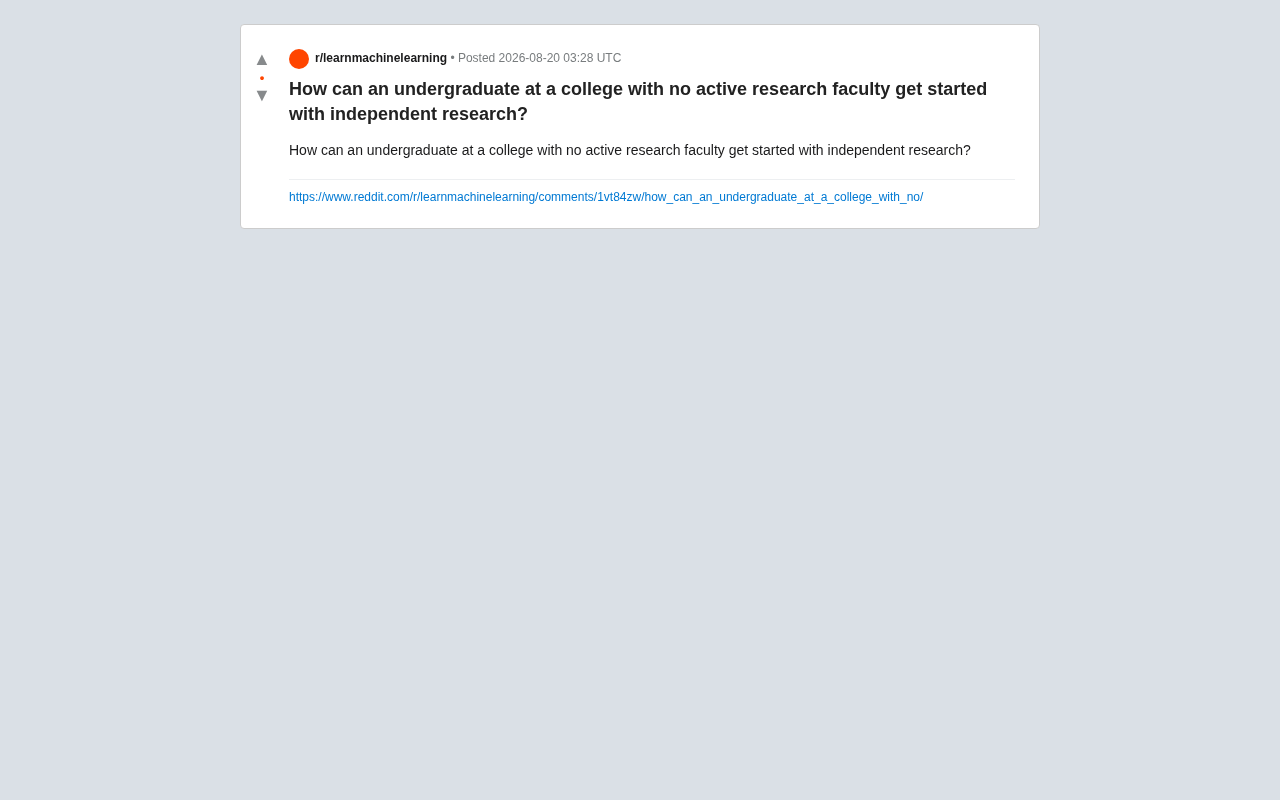
On Reddit, an undergraduate at an institution lacking active research faculty posed a highly representative question: "Without a research advisor, without a lab, without resources — how do I start doing independent research?"
Behind this question lies a shared predicament faced by countless students at ordinary universities. Conventional wisdom holds that academic research is the exclusive domain of top universities and senior professors. But in today's world — where open-source tools are abundant, pretrained models are readily accessible, and computing power can be rented on demand — the barrier to independent research is being lowered to an unprecedented degree. This article systematically outlines how a "lone wolf" undergraduate can break into independent research, especially in fields like AI and computer science.
Redefining "Research": You Can Do Science Without an Advisor
What Is Research Really About?
Many people mistakenly believe research requires a lab and a professor. In reality, the essence of research is posing an unsolved question and systematically exploring answers. In computer science, especially machine learning, a vast amount of groundbreaking work can be done on a laptop with a GPU — or even started using free computing resources from Google Colab or Kaggle.
It's worth elaborating here on why GPUs (Graphics Processing Units) have become the core hardware for deep learning. Neural network training is fundamentally large-scale matrix computation, and GPUs are inherently designed for parallel processing — a consumer-grade GPU can simultaneously execute thousands of computational threads, making it tens or even hundreds of times faster than a traditional CPU. Google Colab is essentially a free cloud-based Jupyter Notebook environment provided by Google that allocates data-center-grade GPUs like the NVIDIA Tesla T4 to users through virtualization, meaning anyone with a Google account can access professional-level deep learning compute power. This was unimaginable just five years ago — back then, training a medium-scale model often required thousands of dollars in hardware investment.
Not having an advisor means you lose direct guidance and feedback, but you also gain complete freedom in choosing your research topic. The key is establishing a self-supervised research discipline: set clear weekly goals, maintain experiment logs, and regularly review failure causes. This self-management ability is called "research maturity" in academia, and it doesn't inherently depend on external guidance — it's a meta-skill that can be cultivated through deliberate practice.
From "Reproducing Papers" to "Proposing Innovations"
For independent researchers starting from scratch, the most pragmatic starting point isn't originality — it's reproduction. Pick a classic paper that interests you (such as ResNet, Transformer, or a specific application) and try to reproduce its core results from scratch.
ResNet (Residual Network), mentioned here, is a deep learning architecture proposed in 2015 by Kaiming He and colleagues at Microsoft Research. By introducing "skip connections," it solved the vanishing gradient problem in deep network training, making it possible to train networks with over 100 layers, and won the ImageNet competition that year. Transformer, on the other hand, is an architecture proposed by Google in the 2017 paper Attention Is All You Need. It completely abandoned traditional recurrent structures, relying solely on "self-attention" to process sequential data, and later became the foundational architecture for large language models like GPT and BERT. The value of reproducing such classic papers lies in the fact that their results have been extensively validated, so you can clearly determine whether your implementation is correct; moreover, the design philosophies embedded in these architectures continue to influence cutting-edge research today.
The reproduction process exposes engineering details omitted from papers, forcing you to truly understand every aspect of the method. In fact, paper reproduction (reproducibility) is itself a highly valued endeavor in academia. Multiple surveys in recent years have shown that over 70% of researchers have tried and failed to reproduce others' papers. This "reproducibility crisis" means that high-quality reproduction work has inherent academic value — some top conferences (like NeurIPS) have even established dedicated "Reproducibility Challenges" to encourage such work.
Once you can reliably reproduce results, try making small modifications on top of them — swap the dataset, adjust a module, test a hypothesis — and this often becomes the embryo of an independent research project. This "incremental innovation" is a fully recognized research paradigm in academia; many highly-cited papers' core contributions are nothing more than clever improvements to existing methods or validation in new scenarios.
Leverage Open Resources to Build Your "Virtual Lab"
Accessing Papers and Code
Without a lab, the internet is your lab. Here are the most essential free resources:
-
arXiv: Provides free access to virtually all cutting-edge papers. arXiv is a preprint server operated by Cornell University, founded in 1991. Originally serving the physics community, it later expanded to computer science, mathematics, statistics, and more. Unlike traditional journal publishing with review cycles lasting months, papers on arXiv typically become publicly accessible within 1-2 days of submission, making it the de facto primary publication platform in AI. Nearly all significant deep learning breakthroughs — from GAN to GPT — first appeared on arXiv.
-
Papers with Code: Directly links papers to their open-source implementations for quick hands-on access. This platform, maintained by Meta AI, not only provides paper-code mappings but also maintains leaderboards across various benchmark datasets, letting you quickly understand the current state-of-the-art methods and their performance metrics in any research direction.
-
GitHub open-source projects: The best engineering textbooks and code references.
Develop the habit of reading one paper abstract per day, manage your literature with Zotero or Notion, and gradually build your own knowledge map in a specific sub-field. Zotero is a free, open-source reference management tool that supports one-click browser capture of paper metadata, automatic PDF organization, citation formatting, and allows you to build a personal knowledge base through tags and folders. For independent researchers, the importance of systematic literature management cannot be overstated — when you've accumulated hundreds of papers, efficient retrieval and knowledge association become virtually impossible without management tools.
Free Computing Power and Tool Platforms
Computing power was once the biggest barrier to independent research, but it has been significantly alleviated:
-
Google Colab: Offers free T4-level GPUs. The NVIDIA Tesla T4 is a Turing-architecture inference-optimized GPU with 16GB of VRAM and 65 TFLOPS of FP16 compute. While it's not the most powerful training card, it's perfectly adequate for small-to-medium experiments (like fine-tuning BERT, training medium-scale CNNs, or running reinforcement learning experiments). The paid version (Colab Pro) upgrades to A100 and stronger GPUs for only about $10/month — exceptional value.
-
Kaggle Notebooks: Provides dozens of hours of GPU quota per week. As the world's largest data science competition platform, Kaggle's notebook environment offers free P100 GPUs (approximately 30 hours per week) and TPU quotas, with numerous public datasets built in — ideal for rapid experimentation.
-
Hugging Face: Hosts massive pretrained models and datasets, eliminating the need to train from scratch. Hugging Face has evolved into the "GitHub of AI," with its Model Hub hosting over 500,000 pretrained models spanning NLP, computer vision, speech processing, and virtually every AI subfield. Its core Transformers library provides a unified API that lets you load and fine-tune state-of-the-art models in just a few lines of code. This "standing on the shoulders of giants" research approach dramatically lowers the entry cost for independent researchers — you no longer need to train a large model from scratch but can directly adapt pretrained weights for downstream tasks.
-
Cloud provider student programs: Multiple cloud services offer free compute credits for students. For example, Google Cloud offers $300 in free trial credits, AWS provides similar support through its Educate program, and Azure offers students $100 in annual credits. While these credits are limited, combined with sensible experiment planning, they can support the computational needs of multiple research projects.
Establish a Reproducible Workflow
From day one, prioritize engineering best practices: use Git for version control, isolate dependencies with virtual environments, and systematically log experiment parameters and results (tools like Weights & Biases can help).
The context for this advice is that academia is experiencing a severe "reproducibility crisis." A 2016 Nature survey found that over 70% of researchers couldn't reproduce others' experimental results, and over 50% couldn't even reproduce their own past results. In machine learning, this problem is particularly acute — tiny differences in random seeds, hyperparameter settings, or data preprocessing can lead to drastically different outcomes. Weights & Biases (W&B) is an experiment tracking platform that automatically logs hyperparameters, loss curves, evaluation metrics, system resource usage, and more for each training run, with support for visual comparison across experiments. It's free for academic use and has been adopted by many top labs. Similar tools include MLflow and Neptune.ai.
Good engineering habits not only make research reproducible but also serve as crucial credentials when presenting yourself to potential advisors or employers. A well-organized, thoroughly documented, reproducible GitHub repository is often far more persuasive than text descriptions on a resume.
Breaking Out of Isolation: How to Join the Research Community
Proactively Seek Remote Research Mentors
Not having a local advisor doesn't mean having no advisor at all. Many professors welcome students from other institutions expressing interest in collaboration via email — provided your email is specific, sincere, and ideally accompanied by reproduction work or preliminary ideas you've already completed.
Remote research collaboration became a normalized mode of operation in academia after COVID-19. Multiple studies show that the number of cross-institutional collaborative papers increased significantly during the pandemic, and many professors adapted to remote student mentoring. Platforms specifically facilitating remote research pairing have also emerged, such as online versions of Research Experiences for Undergraduates (REU) and Undergraduate Research Opportunities Programmes. Additionally, some prominent AI researchers (such as Sebastian Raschka and Lilian Weng) have publicly stated they welcome contact from students with non-traditional backgrounds.
Key elements of a high-response-rate email:
- Share your insights or questions about a specific paper by the professor
- Demonstrate related work you've already completed (e.g., reproduction results, code links)
- Clearly state the time you can commit and your expectations
- Avoid mass-sent template emails
According to multiple professors who've shared on academic forums, they receive large volumes of collaboration request emails daily, the vast majority being obvious template mass-mailings. Emails that demonstrate deep understanding of the professor's specific work and include substantive preliminary results can achieve response rates over 10 times higher than generic emails.
Participate in Open-Source Projects and Online Communities
GitHub open-source projects, Discord research communities, and Reddit's r/MachineLearning are all excellent channels for connecting with peers. Contributing code to open-source projects, asking high-quality questions in communities, and participating in Kaggle competitions can all help you gradually build your personal reputation — and even lead you to collaborators willing to work with you.
The academic and career value of open-source contributions in AI should not be underestimated. Many core contributors to mainstream frameworks like PyTorch, TensorFlow, and scikit-learn started as ordinary community developers. A documented open-source contribution record — whether fixing bugs, adding features, or improving documentation — demonstrates both technical competence and collaborative spirit. Programs like Google Summer of Code (GSoC) specifically fund students to participate in open-source development, providing stipends and invaluable experience working alongside senior developers. In job applications and graduate school admissions, an active GitHub profile often makes a stronger impression on reviewers than GPA alone.
Enter Through Competitions and Open Challenges
Kaggle competitions, hackathons, and open research challenges published by various organizations provide structured practice scenarios for independent researchers. These activities typically have well-defined problem statements and evaluation criteria, helping you hone research skills under real constraints while producing results that are more easily recognized externally.
Total prize money across Kaggle competitions has accumulated to tens of millions of dollars, but more importantly, multiple Kaggle Grandmasters (the platform's highest rank) have leveraged their competition results to directly secure research positions at top companies or PhD admissions at elite schools. Furthermore, top conferences like NeurIPS and ICML host annual competition tracks, where these academic competitions often directly correspond to cutting-edge research problems, and participating solutions frequently evolve into formal academic papers.
Documenting Your Research Outcomes
Writing and Public Sharing
The value of research is ultimately measured by whether others can understand and verify it. Even preliminary results should be written up as technical blog posts, GitHub READMEs, or even organized into preprints published on arXiv. The writing process helps you identify logical gaps, while public sharing may attract unexpected feedback and collaboration opportunities.
Preprint culture holds a unique position in computer science. Unlike fields such as biomedicine, the primary publication channels in CS are top conferences (not journals), and publishing preprints on arXiv has virtually no barrier — you can make your work visible to the entire world without peer review. This creates a unique "publish first, refine later" ecosystem. Many works that later won best paper awards initially appeared as preprints on arXiv and were continuously improved based on community feedback. For independent researchers, this means you can make your work public at any stage to gather feedback, rather than waiting until it's "perfect" to share with the world.
A Gradual Path to Publication
Don't aim for top conference papers right away. A reasonable trajectory is:
- Reproduce a classic paper and verify core results
- Conduct small-scale improvement experiments on top of your reproduction
- Write a technical blog summarizing your findings
- Submit to a workshop or publish a preprint on arXiv
- Gradually aim for formal academic conferences
Here it's helpful to explain the hierarchical structure of academic publishing. In AI/machine learning, publication venues roughly break down into the following tiers: Workshop papers (typically affiliated with major conferences, relatively lenient review standards, 4-6 page short papers) → Regional or second-tier conferences → Top conferences (such as NeurIPS, ICML, ICLR, CVPR, ACL, etc., with acceptance rates typically around 20-25%) → Oral/spotlight presentations at top conferences (acceptance rates around 1-5%). Workshops are the most accessible starting platform for independent researchers: they have short review cycles, flexible format requirements, and reviewers focus more on novelty of ideas rather than completeness of experiments. After acceptance, you can still submit an extended version to the main conference. Many successful researchers, looking back on their publication history, find that their first accepted paper was a workshop paper.
Each step represents accumulated credentials that will eventually converge into a compelling research portfolio.
Conclusion: Your Environment Is a Constraint, Never an Endpoint
The predicament of that Reddit poster is fundamentally a problem of resource inequality. But in today's world of highly open information, lacking an on-campus research environment is no longer an insurmountable barrier. What's truly scarce is sustained self-motivation, systematic methodology, and the courage to proactively break out of your bubble.
For any undergraduate in a "research desert," perhaps the best advice is: just start doing it. Pick a question you're genuinely curious about, begin with reproduction, arm yourself with open resources, proactively connect with communities, and document every bit of progress. When you have tangible work in hand, opportunities will naturally gravitate toward you.
Key Takeaways
Related articles

DIY Air Purifier: Building a Silent CR Box with PC Fans and an Aluminum Frame
Learn how to build a quiet Corsi-Rosenthal air purifier using PC case fans and an aluminum frame, covering fan selection, PWM speed control, and cost analysis.

Universality of Gradient Descent Training: Does Neural Network Architecture Choice Really Matter?
Exploring the universal approximation capability of gradient descent training, analyzing the relationship between neural network architecture choice and learnability, from UAT to NTK theory.

From AI to Large Models: Understanding the Conceptual Landscape and Technological Evolution of Artificial Intelligence
Understand how AI, machine learning, deep learning, large models, and generative AI relate to each other. From Deep Blue to ChatGPT, learn how Transformer architecture gave rise to LLMs.