How Would the Military 'Hack' an Election? Unpacking the Gray Zone of Cyber Warfare and Election Security

The entanglement between the military and election security stems from infrastructure fragility, with blurry boundaries and legal gray zones—far more than any clickbait title can capture.
This article discusses *How the Military Will Hack the Election*, pointing out that the issue is not a conspiracy theory but a serious topic in cybersecurity and policy research. It explains the logic of military involvement in election security: election infrastructure is decentralized and fragile, and military cyber commands have both motivation and capability to identify or exploit vulnerabilities. It then distinguishes the dual meanings of "hack"—malicious attacks versus defensive penetration testing. It also outlines three tiers of state-level election interference: intelligence collection, influence operations, and infrastructure disruption, noting that the military typically focuses on the first two. The article further explores core controversies such as the blurry boundary between defense and offense, domestic legal restrictions, and the disclosure dilemma, ultimately emphasizing the tech community's irreplaceable role in promoting transparent audits of election security.
When "Hacking Elections" Becomes a Topic of Open Discussion
Recently, an article titled How the Military Will Hack the Election sparked widespread discussion on Hacker News. Even from the title alone, the topic is striking enough—military, hacking, elections—a combination of three highly sensitive words that naturally carries a strong sense of conflict and suspense.
However, one premise needs to be clarified first: this article is not discussing some sensational conspiracy theory, but rather an issue that has been seriously examined in cybersecurity and policy research for years—the ability of national military forces to penetrate election infrastructure in cyberspace, defensive strategies, and the resulting legal and ethical controversies.
Why Would the Military Be Connected to "Election Security"?
The Fragility of Election Infrastructure
Modern election systems are far more complex than most people imagine. From voter registration databases, electronic voting machines, and vote-counting transmission networks to results publication platforms, every link depends on digital infrastructure. These systems are managed in a decentralized manner by state and local governments, with inconsistent security standards, and have long been regarded as one of the most weakly protected components of critical infrastructure.
The logic chain for military involvement in election security roughly goes as follows: if a country's election systems have vulnerabilities that could be exploited by external forces, then the military's cyber command—such as US Cyber Command—has both the motivation and the capability to identify or even "exploit" these vulnerabilities, whether for defensive purposes or offensive cyber operations.
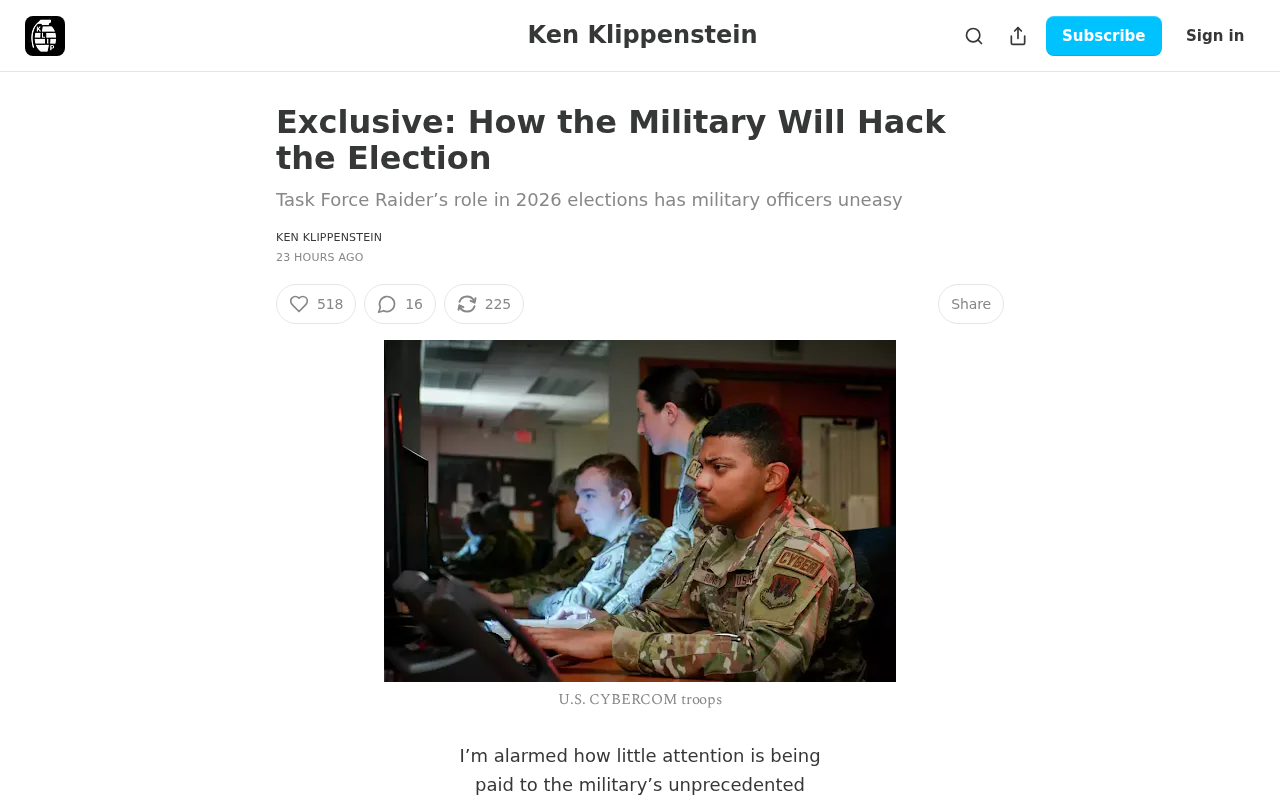
US Cyber Command is a unified combatant command under the US Department of Defense, established in 2010 and elevated to a unified combatant command in 2018. It integrates the cyber warfare forces of the Army, Navy, Air Force, and Marine Corps, responsible for protecting Department of Defense networks, supporting combatant commanders' cyber needs, and conducting offensive cyber operations when authorized. Its subordinate Cyber National Mission Force (CNMF) specifically carries out "hunt forward" missions, which involve searching for malicious actors on allied networks at their invitation. Understanding Cyber Command's positioning is the institutional prerequisite for understanding the issue of "how the military will hack the election"—it is neither an intelligence agency (like the NSA) nor a law enforcement agency (like the FBI), but a military force centered on combat operations.
The Dual Meaning of the Word "Hack"
The word "Hack" in the article's title needs to be understood dialectically. In the cybersecurity context, "hack" can refer to malicious attacks, but it can also refer to creatively exploiting systems—including penetration testing, vulnerability discovery, red team exercises, and other defensive activities. The military "hacking the election" could mean testing the security of election systems, or it could mean conducting intelligence collection or disruptive operations against foreign election infrastructure in cyberspace.
The Realistic Picture of Cyber Warfare and Election Interference
From Intelligence Collection to Influence Operations
In recent years, multiple governments and security research institutions have publicly disclosed that state-level actors' interference in foreign elections typically falls into several tiers:
- Intelligence collection: Penetrating election-related networks to obtain candidate information, policy positions, voter data, etc.
- Influence operations: Influencing voter perception through social media, disinformation, and other means
- Infrastructure disruption: Technical attacks targeting voting systems and voter registration databases
The military's role in cyberspace often concentrates on the first two tiers—intelligence collection and influence operations—because directly disrupting voting infrastructure carries extremely high risks and easily triggers severe international consequences.
Influence Operations is a military and intelligence term referring to the use of information means to influence the perceptions, attitudes, and behavior of a target population in ways that benefit the initiating party's objectives. Unlike traditional propaganda, modern influence operations leverage social media algorithms, targeted advertising, fake account networks (botnets), and deepfakes to reach millions of voters at extremely low cost. The US Department of Defense regards influence operations as a core component of "Operations in the Information Environment" (OIE). The key to this concept is that it does not directly attack voting machines, but rather attacks voters' judgment, making it harder to legally define as an "armed attack" and easier to sustain in the gray zone.
The Blurry Boundary Between Defense and Offense
A core controversy in military cyber operations is that the line between defensive and offensive actions is extremely blurry. When the military "hacks" its own election systems to test for vulnerabilities, that is defense; when the military "hacks" another country's election systems to collect intelligence, that is offense. The same set of technical capabilities has radically different legal and political implications in different contexts.
The Gray Zone of Law and Ethics
Military involvement in election security also involves deep legal issues. In most democracies, election administration falls under civil affairs, and direct military participation in election matters may violate the constitution or relevant laws. Even in the cybersecurity domain, the military's authority to operate in domestic networks is strictly limited.
Another thorny question is: if the military discovers vulnerabilities in election systems, should it disclose them? Disclosure might help adversaries; non-disclosure might allow vulnerabilities to persist. This "disclosure dilemma" is particularly acute in the national security domain.
Implications for Technology Practitioners
For developers and researchers concerned with cybersecurity, this topic offers several directions worth contemplating:
Strengthening the security of election infrastructure requires the participation of civilian technical forces and transparent auditing; relying solely on closed-door military or government operations makes it difficult to build public trust. At the same time, the proliferation of cyber weapons and the lowering of the threshold for cyber operations mean that election security will remain at the forefront of offensive-defensive contests for the long term. The tech community's role in promoting security standards, developing open-source auditing tools, and popularizing security knowledge is irreplaceable.
Conclusion
The issue behind the title How the Military Will Hack the Election is far more complex than the title itself. The relationship between the military and election security involves multiple dimensions of technical capability, legal frameworks, international relations, and public trust. Rather than being drawn in by the dramatic title, it is better to deeply understand the tension between power, security, and democracy in cyberspace—that is where the true value of this topic lies.
Related articles

A Single Prompt Triggers a Global PHP Security Storm: Is AI a Savior or a Hidden Risk?
A single AI prompt triggered a global PHP security crisis affecting Wikipedia and the Internet Archive. This article reviews the incident, analyzes the OpenAI-Amazon controversy, and explores the security paradox of lowered vulnerability discovery barriers in the AI era and developer response strategies.

When AI Is Taken Away: How Reliance on Shortcuts Undermines Your Problem-Solving Resilience
A study of 1,222 people found that after using AI to answer questions, once AI was removed, people gave up on more problems than a control group that never used AI. The article analyzes the impact of AI reliance on learning resilience and metacognition, and explores design implications for AI learning tools.

Carta and NewView Partner to Let Startup Employees Cash Out Equity Early
Carta and NewView Capital partner to simplify startup tender offers, helping employees sell equity early. Analysis of the mechanism, liquidity pain points, and impact.