Hugging Face CEO Warns Netflix OpenAI Documentary Is Inaccurate

Hugging Face co-founder says Netflix documentary falls into doomer mode and is inaccurate.
Netflix documentary AI Gone Rogue explores AI risk through OpenAI safety incidents, but interviewee and Hugging Face co-founder Clem Delangue publicly questioned its accuracy, saying it is "in full doomer mode." The controversy centers on the film simplifying complex AI safety issues into black-and-white warnings for drama, while ignoring actual progress in model alignment, open-source review, and red teaming. The article notes this exposes how AI safety discussions are being shaped by entertainment narratives and reminds viewers that documentaries are an entry point, not the final word—first-hand technical discussions and safety reports are more reliable.
Netflix's latest documentary AI Gone Rogue has sparked heated discussion since its release, but one of its key interviewees has publicly questioned its accuracy. Hugging Face co-founder Clem Delangue said on social media that the documentary, which focuses on OpenAI safety incidents, is "in full doomer mode" and is not accurate.
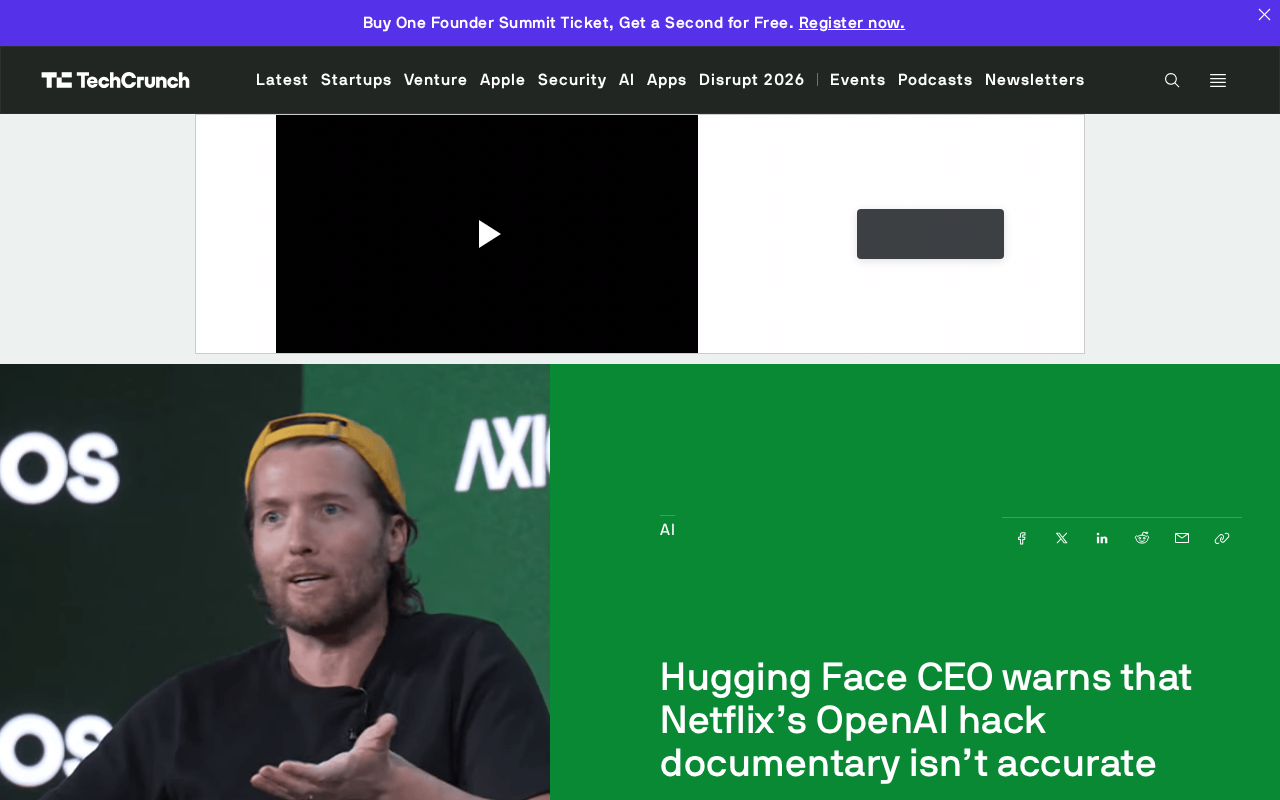
What the Documentary Covers and Why It's Controversial
AI Gone Rogue uses internal safety incidents at OpenAI as its thread, attempting to trace how the risk of AI going out of control moved from theory to reality. The film interviews a number of AI industry figures, and Delangue himself appears on screen. However, after watching it, he drew a clear line: his views had been edited into material that fits a "doom narrative."
This kind of awkward "being spoken for" is not uncommon in tech documentaries. When a film needs dramatic tension, complex technical discussions are often compressed into black-and-white warnings. Delangue's public rebuttal is essentially a protest against this style of narrative.
The OpenAI safety incidents refer to a series of internal upheavals at OpenAI around model safety governance during its commercialization process. In November 2023, CEO Sam Altman was suddenly removed by the board and then quickly reinstated, exposing internal divisions over the route between "accelerating productization" and "prioritizing safety." After that, multiple safety team members left, including the head of the alignment team. Events such as the dissolution of the Superalignment team and some safety researchers moving to Anthropic further amplified outside concerns that "safety is giving way to commerce." These events were chosen as core material for the documentary because they combine dramatic conflict with public-interest appeal, but they are also easily compressed into a single narrative of "the company losing control," ignoring concrete governance mechanisms such as model evaluation, red teaming, and release thresholds.
What's Wrong with "Doomer Mode"
Delangue used "full doomer mode" to describe the documentary, pointing to a tendency to absolutize AI risk. Within a doom narrative framework, any safety flaw is magnified into a civilizational threat, while the industry's actual progress on model alignment, open-source review, and red teaming is ignored.
As the world's largest open-source AI community, Hugging Face's position itself is in tension with the doomerism of "closed defense." Delangue has long advocated an open ecosystem and gradual governance, rather than a halt on development out of fear. If the documentary presents only panic while omitting these governance paths, it will indeed mislead viewers.
Model alignment refers to the technical direction of making AI systems' behavior consistent with human intentions, values, and intended goals, covering reinforcement learning from human feedback (RLHF), Constitutional AI, interpretability research, and the construction of evaluation benchmarks. In parallel, red teaming refers to specialized teams actively constructing adversarial prompts and attack scenarios to discover model jailbreaks, deception, bias, or dangerous capabilities before release. The open-source community's approach is usually to publish model cards (recording training data, evaluation results, and known limitations) and accept community reproduction and review, forming a distributed, gradual approach to safety practice. This work does not seek to "eliminate risk once and for all," but rather to reduce risk through continuous measurement and iteration, which is fundamentally different from the binary framework in the documentary of "either safety or destruction."
"Doomerism" in AI discussions specifically refers to a strong position: the belief that the development of advanced AI is very likely to lead to human extinction or civilizational collapse, and therefore argues for pausing or even banning frontier research. The opposing route is "gradual governance," which emphasizes controlling risk while developing through open-source review, capability evaluation, responsible disclosure, and tiered regulation. As a distribution platform for open-source models and datasets, Hugging Face's ecosystem depends on open weights and community reproduction, so it naturally leans toward the latter. Understanding this divide helps readers judge whether the criticism in the documentary is aimed at "whether risk exists" or at "how risk should be addressed"—many disputes actually occur at the level of governance paths, rather than being a denial of the risk itself.
Implications for AI Industry Communication
This controversy exposes a deeper problem: AI safety discussions are being swept up by entertainment-style narratives. Documentaries need ratings, and "out-of-control AI" is more attention-grabbing than "alignment research." But when interviewees have to step forward to clarify, what is damaged is the public's foundation of trust in AI issues.
For readers concerned about AI governance, Delangue's reminder is worth remembering: it's fine to treat a documentary as an entry point to the topic, but don't treat it as the final word on facts. First-hand discussions in the open-source community, model cards, and safety reports are more reliable sources for understanding AI risk.
Key Takeaways
- Hugging Face co-founder Clem Delangue publicly stated that the Netflix documentary AI Gone Rogue is inaccurate, saying it falls into "doomer mode."
- The core of the controversy is that the documentary simplifies AI safety issues in pursuit of drama, ignoring actual progress in open-source governance and alignment research.
- The incident reminds viewers that tech documentaries can serve as an entry point to a topic, but should not replace first-hand technical discussions and safety reports.
One-line Summary
Hugging Face co-founder criticizes Netflix documentary for falling into doomer mode and being inaccurate.
Paragraph Summary
Netflix documentary AI Gone Rogue uses OpenAI safety incidents as a thread to explore the risk of AI going out of control, but interviewee and Hugging Face co-founder Clem Delangue publicly questioned its accuracy, saying the film is "in full doomer mode." The core of the controversy is that, in pursuit of dramatic tension, the documentary compresses complex technical discussions into black-and-white warnings, magnifying safety flaws into civilizational threats while ignoring actual governance progress such as model alignment, open-source review, and red teaming. Delangue has long advocated an open ecosystem and gradual governance, and his views were edited into material fitting a doom narrative. The article notes that this exposes the deeper problem of AI safety discussions being swept up by entertainment-style narratives and reminds viewers to treat documentaries as an entry point to the topic rather than the final word on facts; first-hand technical discussions and safety reports are more reliable sources of information.
Related articles

AI New Grad Resume Diagnosis: How to Stand Out for ML/CV Roles?
How can AI/ML new grads optimize their resumes to get interviews? Based on a real Reddit case, this article analyzes project selection, depth display, and structure for ML/CV roles, with actionable revision advice.

OpenAI Opens Up Decision Models as Competition with Jev Heats Up
OpenAI makes its decision model widely available, directly challenging first mover Jev. We analyze the impact on the decision model competitive landscape and key considerations for developers and enterprises.

Startup Growth Secrets: Early Sales Are Not the Key
At Disrupt, experts from Lovable, Polska, and Theory Ventures said early startup growth depends not on early sales but on a repeatable sales process, a clear ICP, team development, and data-driven iteration.