Hugging Face Open-Source Agent Ecosystem Explained: From Local Deployment to AI-Automated Training

Hugging Face builds an open-source Agent ecosystem enabling AI-automated model training and deployment
Hugging Face showcased its open-source Agent ecosystem at the AI Engineer conference. The talk highlighted that open-source models now match closed-source performance while offering transparency and controllability advantages. Hugging Face launched a Skills system enabling Agents to automatically train, deploy, and process data through conversation. Combined with multiple local deployment options, MCP protocol integration, and Agent Traces forming a data flywheel, this is fundamentally changing how AI engineers work.
At the recent AI Engineer conference, Merve from the Hugging Face open-source team delivered a brilliant talk on the open-source Agent ecosystem. She presented an exciting vision: through a series of new features and Skills on the Hugging Face Hub, developers can have AI Agents automatically handle complex tasks like model training, deployment, and data processing — operations that would have seemed like science fiction just a few years ago.
Open-Source Models Have Caught Up with Closed-Source: No Longer Second-Class Citizens
Merve opened her talk by dispelling a long-standing misconception: that open-source models are inferior to closed-source ones. Citing data from the Artificial Intelligence Index, she pointed out that open-source models (marked in green) have caught up with closed-source models (marked in black) in performance. The Artificial Intelligence Index is a comprehensive annual report published by Stanford University's Human-Centered Artificial Intelligence Institute (HAI), tracking technical progress, economic impact, and policy developments in AI — it's widely recognized as an authoritative reference in the industry. Taking the latest GLM 5.1 as an example, this model developed by Zhipu AI employs a Mixture of Experts (MoE) architecture that significantly reduces inference costs while maintaining high performance. It excels across multiple benchmarks, even ranking first on programming benchmarks like SWE Bench. SWE Bench, created by a Princeton University research team, extracts software engineering tasks from real GitHub open-source projects, requiring models to understand codebase context and generate correct patch fixes — it's considered one of the most convincing tests for measuring AI programming capability.
The advantages of open-source models extend beyond performance to transparency and controllability. Merve specifically mentioned that some closed-source models have recently been found to quietly degrade in performance — if everything were open-source, this simply couldn't happen without users knowing. Additionally, open-source models support quantization compression, fine-tuning customization, and deployment to edge devices and browsers, fundamentally protecting user data privacy. Quantization compression is a technique that converts model parameters from high-precision floating-point numbers (such as 16-bit FP16) to low-precision representations (such as 4-bit INT4), shrinking model size to one-quarter or even smaller while dramatically reducing memory requirements and inference latency, at the cost of only minimal accuracy loss. Edge deployment means models run directly on end-user devices without uploading data to the cloud, ensuring privacy security at the architectural level.
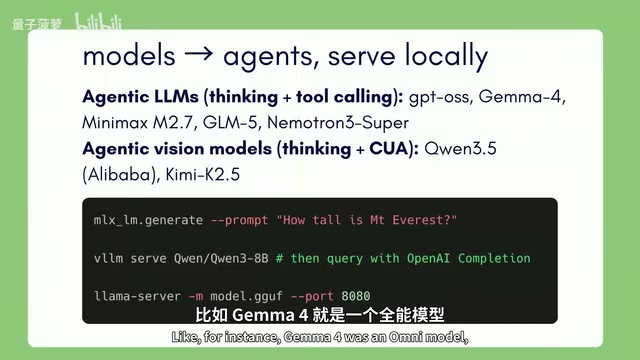
A notable trend: more and more models ship with vision capabilities on day one. Gemma 4, Qwen 2.5, Kimi K2.5, and others are all Vision Language Models (VLMs). Merve predicts that all mainstream models will come with built-in vision capabilities at launch in the future. The core architecture of Vision Language Models typically consists of a vision encoder (such as ViT), a language model, and a projection layer connecting the two. Early VLMs like CLIP could only do image-text matching, while the new generation can perform complex visual reasoning, document understanding, and GUI operations. This is significant for Agent applications — vision LMs can serve as computer-use Agents, understanding screenshot content and knowing where to click. Specifically, computer-use Agents need to "see" screenshots, identify the positions of UI elements like buttons and input fields, then generate precise mouse click and keyboard input commands — essentially converting visual understanding into executable action sequences.
Local Agent Deployment: Multiple Options to Choose From
For developers wanting to run AI Agents locally, the Hugging Face ecosystem offers a rich selection of deployment options.
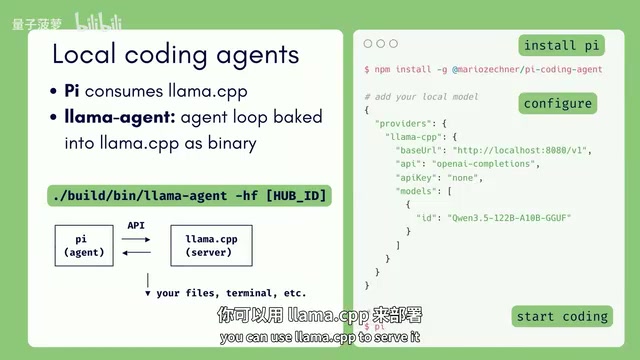
Plandex (Pi) and LLama Agents
One of Merve's recommended solutions is Pi, praised for its extremely simple setup. Developers can make remote calls through Hugging Face Inference Providers or serve locally with LLama CPP, which Pi consumes directly. Hugging Face Inference Providers is a unified inference API offered by the Hub, allowing developers to call models hosted on different backends (such as AWS, Google Cloud, Together AI, etc.) through the same interface without worrying about underlying infrastructure differences. Meanwhile, llama.cpp is an open-source project developed by Georgi Gerganov that implements LLM inference in pure C/C++ without depending on Python or GPU driver frameworks. It runs efficiently on CPUs, Apple Silicon, NVIDIA GPUs, and even Android devices, spawning a vast local inference ecosystem including LM Studio and Ollama. Another standout option is LLama Agents — as a built-in binary of LLama CPP, it can launch an Agent directly given just a model ID from the Hugging Face Hub.
Hermes Agents: The Most Full-Featured Open-Source Solution
Merve made no attempt to hide her preference for Hermes Agents during the talk. Compared to open-source Claude alternatives, Hermes goes further in areas like memory management. Its setup wizard guides you through all configuration — enter your keys, integrate with Slack or WhatsApp, and you're ready to go.
An interesting real-world example: when Merve encountered an issue integrating with Slack, she had GLM 5.1 fix it through the Hermes Agent, and the model successfully resolved the problem. This demonstrates the practical utility of open-source models in Agent scenarios.
Model Selection and Hardware Compatibility
The Hugging Face Hub provides powerful model filtering capabilities. Under the "Other" tab in the Apps category, you can find models supported by all local deployment tools including LM Studio, Ollama, and LLama CPP.

Model repository pages now display hardware compatibility information for the GGUF format. GGUF (GPT-Generated Unified Format) is a model format created by the llama.cpp project, optimized for CPU and consumer-grade GPU inference. It supports multiple quantization levels (from Q2_K to Q8_0) and has become the de facto standard format for local deployment. For example, Gemma 4's large model quantized to 4-bit can fit into a 24GB L4 GPU. The "Use this model" button in the upper right corner of the page provides installation and launch commands for the corresponding local tools — just a few lines of code to get running.
Skills System: Letting Agents Automatically Train Models
This was the most exciting part of the entire talk. Hugging Face has launched a Skills system that enables coding Agents to directly manage Hub repositories, launch training jobs, build demos, and more.
LLM Trainer Skill: Conversational Model Training
The LLM Trainer Skill supports not only large language models but also vision language model training. Merve demonstrated a complete workflow: she typed "Help me train Qwen2-VL using the LLaVA Instruct Mix dataset" in Claude Code, and the Agent immediately went to work:
- Automatic resource calculation: The Agent computes required GPU memory, batch size, and other parameters in the background
- Interactive confirmation: Asks the user which GPU instance to choose, validation split ratios, and other key questions
- Remote training launch: Starts the training job on Hugging Face infrastructure
- Automatic model upload: The trained model appears directly on the Hub upon completion
For a six-year veteran of model training, Merve admitted this still feels like science fiction. Traditional model training workflows require manually writing training scripts, configuring distributed training environments, debugging hyperparameters, handling data format compatibility, and countless other tedious tasks. The Skills system encapsulates this professional knowledge into Agent-callable skills, dramatically lowering the barrier to entry. These skills aren't limited to LLMs — she recently released training skills for object detectors and segmentation models that automatically handle details like annotation format conversions (such as between COCO format [x, y, width, height] and Pascal VOC format [xmin, ymin, xmax, ymax]).
Benchmarks and OCR Skills
The newly launched Benchmark dataset feature makes model selection more scientific. Click the Benchmark button at the bottom left of dataset pages to view rankings for popular benchmarks like SWE Bench Pro, Humanities Last Exam, and AIME. AIME (American Invitational Mathematics Examination) has been widely adopted in recent years to evaluate AI models' mathematical reasoning abilities, as its problems require multi-step reasoning and creative thinking far beyond simple arithmetic.
Going further, you can directly ask the Agent "What's the best model for OCR tasks?" — it will not only provide recommendations but also offer fine-tuning suggestions based on your needs (such as requiring a smaller model).
MCP Integration and Real-World Examples

The Hugging Face Hub now provides an MCP Server that connects the Hub directly into your LLM workflow. MCP (Model Context Protocol) is a standardized protocol open-sourced by Anthropic in late 2024, designed to solve the connection problem between LLMs and external tools and data sources. Before MCP, every AI application needed custom integration code for each external service, creating M×N complexity. MCP adopts a client-server architecture with unified interfaces for tool calls, resource access, and prompt templates, reducing complexity to M+N. Through the MCP protocol, you can search models, datasets, and Spaces (which Merve calls "the App Store for AI"), and directly query applications within Spaces.
Hugging Face Spaces is a platform for hosting AI applications where developers can deploy interactive demos using Gradio, Streamlit, or Docker. It currently hosts over 400,000 applications spanning image generation, speech synthesis, document processing, and more. Every Space can be called via API by other applications or Agents — this is precisely why Merve compares it to "the App Store for AI."
A vivid example: Merve typed "Generate an image of baklava made of yarn" in the Agent, which automatically called the Qwen Image generation model hosted on the Hub and returned the generated result. To use more Spaces features, you need to enable the "dynamic spaces" option in MCP settings.
Real-World Case: Using Agents to OCR 30,000 Papers
Merve's colleague Nils used this ecosystem to complete a real project: OCR processing for 30,000 papers on Hugging Face Papers. OCR (Optical Character Recognition) faces special challenges in academic paper scenarios — papers contain large amounts of mathematical formulas, tables, charts, and multi-column layouts that traditional OCR tools often struggle to handle accurately. The entire workflow was driven entirely by prompts:
- Select the best OCR model (Chandra OCR) through benchmark datasets
- Have the Agent write the processing script
- The Agent automatically calculates required instance specs and running costs
- Launch batch processing on Hugging Face infrastructure
- Store results in the newly launched Bucket service (similar to S3 but cheaper and faster)
The Bucket service is Hugging Face's new object storage solution optimized for AI workloads, supporting larger single-file uploads, faster cross-region transfers, and pricing below mainstream cloud storage services — particularly useful for storing large-scale processing results, training datasets, and model checkpoints.
Summary and Outlook
Hugging Face is building a complete open-source Agent ecosystem, lowering barriers at every stage from model selection, local deployment, and remote inference to automated training. The Agent Traces feature lets you record and reuse Agent execution trajectories, and even use this trajectory data to train new models, creating a positive feedback loop. Agent Traces are structured logs recording an Agent's complete execution process, including the reasoning at each step, tool calls, intermediate results, and final output. The value of this trajectory data extends far beyond debugging: it can serve as high-quality training data for fine-tuning smaller, more efficient specialized Agent models. This creates a "data flywheel" — Agents execute tasks producing trajectory data, trajectory data trains better models, better models execute more complex tasks, producing higher-quality trajectory data. This positive feedback loop is a unique advantage of the open-source ecosystem over closed-source alternatives, because every step of the process is transparent and reproducible.
The golden age of open-source AI is arriving — not only have model capabilities caught up with closed-source alternatives, but toolchain maturity is also rapidly improving. When you can train a model with a single sentence to an Agent, the way AI engineers work is undergoing a fundamental transformation.
Related articles
 Tech Frontiers
A Rare Quiet Day in AI: Recursive Self-Improvement Stirs Beneath the Surface
A rare quiet day in AI sees multiple sources go silent simultaneously. Behind the calm, Recursive Self-Improvement (RSI) research continues. What this means for the industry.
 Tech Frontiers
Reve 2 vs. Ideogram 4: A Deep Dive into Layout Control in AI Image Generation
A deep comparison of Reve 2 and Ideogram 4's layout control capabilities, covering technical approaches, real-world use cases, and industry trends for designers and creators.
 Tech Frontiers
In the Weights: Check Your Influence Score in the AI World
In the Weights is an AI influence search engine that quantifies your presence in the AI world with a score. Explore how it evaluates practitioners and what it means for digital identity.