Humalike x GTA RP: AI NPCs That Remember, React, and Act on Their Own

Humalike brings memory, personality, and autonomous action to GTA RP NPCs, now live on Poland's largest RP server.
Humalike's collaboration with GTA RP breaks decades of scripted NPC logic by giving characters memory, personality, and voice. The standout feature is autonomous action — NPCs no longer wait for player triggers but make decisions based on environment and goals, making virtual worlds feel alive. Already deployed on Poland's largest RP server and open to others, Humalike aims to be reusable AI infrastructure for games. Key open questions remain around voice latency, memory consistency, and compute costs at scale.
Game NPCs (non-player characters) have long been little more than a collection of fixed dialogue lines — walk up to them, and they repeat the same line no matter what you've done or how the world has changed. The collaboration between Humalike and GTA RP (Grand Theft Auto roleplay servers) aims to shatter this decades-old scripted logic. Ranking second on Product Hunt on its launch day, the product is built around one core idea: making NPCs truly alive.
NPCs with Memory, Personality, and a Voice
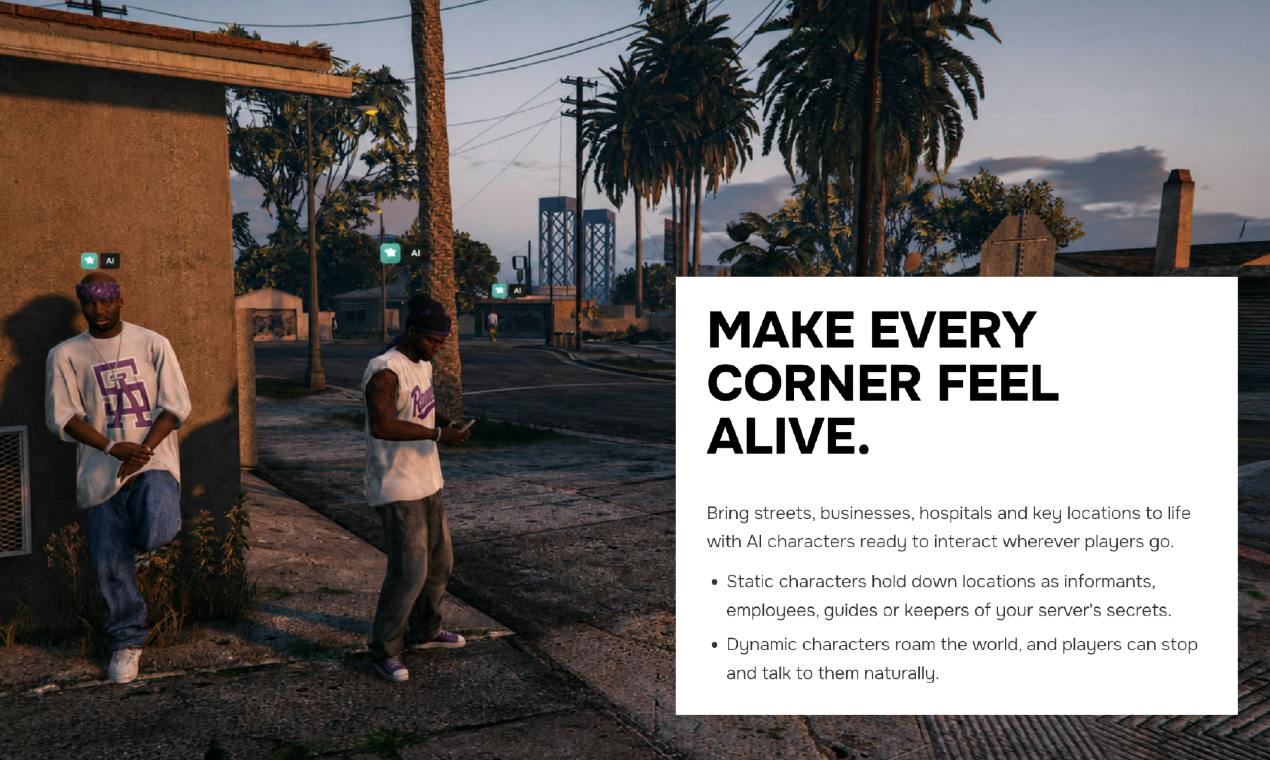
Humalike positions itself as building an "AI society" — not just a single intelligent character. According to the official Product Hunt listing, players can create characters with memory, personality, and voice. These NPCs can recognize players, form relationships, and react to everything happening around them.
The combination of these three elements is what makes it compelling. Memory means an NPC remembers your past interactions — whether you helped or betrayed it last time will shape how it treats you now. Personality ensures that different characters respond differently to the same situation. Voice takes the interaction beyond plain text, making it feel closer to a real conversation. Together, these transform NPCs from background props into continuous, evolving presences.
More Than Dialogue — Autonomous Action
The most noteworthy aspect of this project is buried in its tagline: "talk, remember & act on their own." The first two capabilities have become less rare in AI NPC exploration over the past couple of years. The real challenge lies in the third.
"Acting on their own" means NPCs no longer passively wait for player-triggered events — they can make decisions based on their environment and their own goals. In an open-world roleplay setting like GTA RP, this capability is especially significant. It gives the entire virtual world a sense of life that keeps running even when no one is pulling the strings. When NPCs can form relationships with each other and react to one another, players are no longer entering a static stage — they're stepping into a continuously evolving society.
Autonomous action is typically implemented through an "Agent" architecture at the technical level — AI characters maintain a goal state, perceive environmental inputs, and use a planning module to determine their next action, rather than relying on pre-written behavior trees or scripted triggers. The fundamental difference from traditional game AI is that behavior is reasoned at runtime, not enumerated exhaustively at design time. What makes GTA RP particularly unique is that it's essentially a multiplayer social experiment — players take on various social roles, and the "meaning" of the world is built from accumulated relationships and events. In this environment, an NPC's autonomous actions must not only make sense within a single interaction, but also maintain character consistency across hours or even days — placing far greater demands on long-term memory storage and retrieval than single-turn dialogue ever would.
Live on Poland's Largest RP Server
It's worth noting that Humalike isn't stuck at the concept demo stage. The team has explicitly stated that the system is already live on "Poland's largest roleplay server," and is now open for other servers to integrate.
This is a meaningful signal for evaluating the product's maturity. GTA RP communities have extremely high standards for immersion — players invest significant time in maintaining fixed characters and building virtual lives. Successfully deploying in such a real, active, and discerning community means Humalike has crossed the pure-demo threshold and entered genuine user validation territory. The strategy of opening access to third-party servers also signals an ambition to build reusable infrastructure, rather than a closed feature locked to a single game.
GTA RP (roleplay) servers are multiplayer mod communities built on Grand Theft Auto V, where players use frameworks like FiveM to take on roles as police officers, criminals, merchants, and more — following strict immersion rules (such as bans on "breaking character"). These communities are extremely active; some top-tier servers host thousands of simultaneous players, and the player base has near-zero tolerance for anything that breaks narrative immersion — any interaction that violates character logic is quickly noticed and criticized. This is precisely why successfully deploying on Poland's largest RP server is meaningful: it means Humalike's system has at least passed the initial bar set by this high-standard community, with NPC response quality and stability sufficient to avoid breaking the immersive experience.
What It Means — and What Remains to Be Seen
Humalike's product categories span developer tools, artificial intelligence, and gaming — a positioning that itself reveals its ambition: to become a foundational capability provider for injecting AI life into game worlds.
From an industry perspective, AI NPCs have long been considered one of the most imaginative applications of generative AI in gaming. Traditional dialogue trees are expensive to maintain and feel rigid in practice, while AI characters with memory and autonomy could theoretically deliver a massive boost to immersion and replayability in open-world games.
That said, the information available on Product Hunt also leaves plenty of open questions. How does voice interaction hold up in terms of latency and real-time performance? How long can NPC "memory" persist, and will contradictions emerge over time? What does the compute cost and server load look like when large numbers of AI characters are online simultaneously? These are the questions that will determine whether Humalike can go from "impressive demo" to "sustainable experience." The current community traction — 135 upvotes and 6 comments — shows it's generating interest, but a more comprehensive assessment will have to wait until it rolls out across more servers.
For developers and players tracking real-world AI applications, Humalike offers a concrete case study to watch: when the four pieces of memory, personality, voice, and autonomous action come together, what does a game character actually become?
Related articles

Gemini 4 Argon Hands-On: AI Builds Board Games, Constructs Temples, and Trains Robots Autonomously
Gemini 4 Argon hands-on roundup: AI autonomously builds a desk racetrack and temple in Blender, writes a ray tracing engine, trains a humanoid robot to sink 7 shots, plus API pricing and developer access.

The Magic Octagonal Coin: Why Only 9% of People Can Predict Its Flip?
Only 9% of people can correctly predict the Magic Octagon coin flip. This article explains its spatial rotation mechanism, common cognitive pitfalls, and a new hypothesis based on Relevance Theory, exploring the limits of human spatial reasoning.

Sam Altman: AI Is Entering the Era of Scientific Discovery — Math Breakthroughs Will Replicate in Biology and Energy
Sam Altman says AI is entering the era of scientific discovery — math breakthroughs will replicate in biology, materials science, and energy to help develop new drugs and energy sources.