Hunyuan Hy4 Released, ChatGPT Family Plan Leaked: AI Evening News Highlights

Hunyuan Hy4 released, ChatGPT family plan leaked, DeepSeek discusses open source; AI enters a stage of comprehensive competition.
This AI evening news covers multiple threads: models, business, tools, and compute. Tencent's Hunyuan Hy4 officially launched after preview, adding native vision and computer operation capabilities for the first time, with open weights coming soon; Libre AI released world action model Libre 0, achieving a 36% success rate on 60 robot tasks, higher than GPT-6 Astra's about 5%. On the business side, ChatGPT web code shows five family plan prices, suggesting OpenAI may explore family subscriptions; DeepSeek's Gao Xi says open source is to accelerate AGI, with time rather than other companies as the competitor; enterprise AI deployment spending rose to about $177 billion within a year, with Anthropic accounting for 55% of enterprise API spending. On tools and compute, Workers.io uses fault injection to accelerate code verification, the new VLLM version reduces decoding latency, and Oracle canceled a roughly $7 billion compute lease with Tencent. On personnel, the Cloud Code head departed, and the Anthropic IPO rumor was clarified.
AI product iterations and commercial explorations are emerging densely within the same time window. From the official release of Tencent's Hunyuan Hy4, to family plan pricing surfacing in ChatGPT's web code, to DeepSeek research engineer Gao Xi discussing the relationship between open source and AGI at the Wuzhen Internet Conference, the information density of this AI evening news is worth unpacking.
Models & Products: Hunyuan Hy4 Lands, Multimodal Capabilities Become Standard
Tencent's Hunyuan Hy4 has been officially released, ending its preview phase and adding native vision and computer operation capabilities for the first time. The model has landed on Design Arena, and officials say open weights will be coming soon, with Hunyuan Hy4 Flash to follow. According to user shares, from November 4 to 15, Hunyuan Hy4 on WorkBody and CodeBody offers daily free quotas, with higher quotas for subscribers.
The addition of native vision and computer operation capabilities means the model no longer just processes text but is extending toward "seeing and operating." This aligns with the industry-wide trend: competition in model capabilities is shifting from language understanding to perception and interaction with real environments.
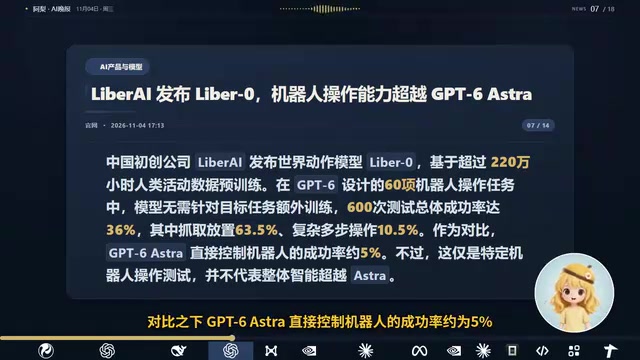
In the same period, Chinese startup Libre AI released the world action model Libre 0. In 60 robot operation tasks designed by GPT-6, the model achieved an overall success rate of 36% across 600 tests without additional training for target tasks. By comparison, GPT-6 Astra's success rate in directly controlling robots was about 5%. Broken down, pick-and-place success rate was 63.5%, and complex multi-step operations were 10.5%. This set of data shows that specialized world action models still have clear advantages in specific robot operation scenarios, but complex multi-step tasks remain difficult.
Native vision and computer operation capabilities refer to the model's ability to directly integrate understanding of visual inputs such as images and videos at the architectural level, rather than splicing through an external visual encoder; computer operation capability refers to the model's ability to parse screen screenshots, locate UI elements, and output operation instructions such as mouse clicks and keyboard input, typically like OpenAI's Operator or Anthropic's Computer Use. The technical difficulties of such capabilities lie in the precision of visual localization, long-horizon planning of operation sequences, and real-time feedback processing of dynamic interface states, usually requiring specialized UI grounding data and reinforcement learning training.
World Action Model is a class of models oriented toward embodied intelligence that simultaneously models environment dynamics (world model) and robot action policies (action model), enabling robots to rehearse action consequences in internal simulations before execution. Compared with traditional end-to-end policies, such models can leverage large-scale unlabeled video pretraining and then fine-tune with a small amount of robot data, thereby improving generalization to new tasks. Libre 0 achieving a 36% success rate on 60 tasks without additional training for target tasks precisely demonstrates the transfer advantage of this paradigm; but complex multi-step operations at only 10.5% shows that long-horizon planning remains the core bottleneck of world action models.
Business & Ecosystem: Subscription Tiers, Open Source Stance, and Capital Trends
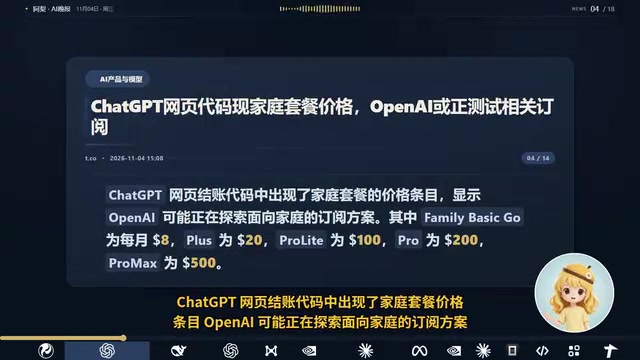
Family plan price entries have appeared in ChatGPT's web checkout code, and OpenAI may be exploring subscription plans for families. The code lists five monthly tiers: Basic at $8, Plus at $20, ProLite at $100, Pro at $200, and ProMax at $500. The emergence of a family plan means OpenAI is beginning to consider expanding paid coverage by household in addition to individual subscriptions.
On the open source route, DeepSeekAd research engineer Gao Xi said at the Wuzhen Internet Conference that open source AI technology is meant to bring AGI sooner. He believes technical barriers may maintain short-term leadership but will also hinder AGI development, and that DeepSeek's competitor is time rather than other large model companies. He also emphasized that what matters is letting AGI quickly benefit all of humanity. This statement echoes DeepSeek's consistent open source strategy.
On the capital side, Manlo Ventures reported that enterprise AI deployment spending rose from $33 billion to about $177 billion within a year, 5.4 times the original; Agent traffic grew 37 times, accounting for about 80% of Token usage. Among enterprise large model API spending, Anthropic's share rose to 55%, with Anthropic and OpenAI combined accounting for 86%, while Google fell to 9%. This set of data outlines the concentrated landscape of the enterprise market.
Meta disclosed on its earnings call that its AI consumer product Muse launched in the US and Canada about 6 weeks ago, with over 10 million people having completed setup, an average order value of about $200, and about 25% of setup users active daily, with shopping being the most popular use. Zuckerberg said Muse has ranked first on the App Store almost every day.
Agent traffic accounting for about 80% of Token usage is key to understanding the structure of enterprise AI spending. Agent here refers to AI agents that can autonomously call tools, plan over multiple turns, and execute tasks; a single task often requires dozens to hundreds of model calls (loops of planning, tool calling, result validation, etc.), so Token consumption is far higher than single-turn dialogue. Enterprise AI spending rising from $33 billion to $177 billion and Agent traffic growing 37 times are mutually causal: agentification synchronously raises API call frequency and complexity, and also explains why the API share of leading model vendors would rapidly concentrate toward Anthropic and OpenAI.
Developer Tools & Compute: Efficiency Optimization and Supply Chain Variables
On the developer tools side, OpenCode's Lianchuang Dex said the inference team found a way to provide $300 worth of DeepSeek service for $10, then added that team members were very drunk at the time and joked that the team consisted of only one person and a few viewers watching the livestream. This statement appears to be a meme, and there is currently no evidence that OpenCode achieved a 30x cost optimization.
Founder Chai released Workers.io on November 3 to accelerate code verification in AI programming. It runs simulations on the entire system including dependencies, and through millions of fault injections before launch, it discovers costly failures that may be exposed in production in advance. VLLM released V0.33.0, reducing decoding latency on GB300 by 1.5% to 2x; the new version supports partial decoding of Reflection Beam 1.0 and Step 5 Preview models, and the speed of generating the first token is also improved; AMD ROCm 10.0 becomes the default version and adds AWSFA images.
The compute supply chain has seen variables. According to the UK Financial Times, Oracle canceled a roughly $7 billion Southeast Asia compute leasing agreement with Tencent, involving 100,000 advanced AI chips. The deal was originally planned for a 5-year term, and the original post said the compute was originally used to train the Hunyuan large model; the cancellation is related to pressure from the Trump administration and requests by Guangdong provincial officials to support domestic chips. Rules for overseas leased compute still allow it.
Fault Injection is an active reliability testing method: artificially introducing faults such as delays, abnormal returns, dependency timeouts, and resource exhaustion during system operation to observe whether the system can correctly degrade or recover. Workers.io extends it to simulation environments containing complete dependencies, executing millions of injections before launch, with the goal of exposing costly failures during the development phase that only occur sporadically in production. For large model applications, such testing is especially necessary because Agent chains are long and have many external dependencies, and single-point failures can easily be amplified by cascading.
Personnel & Rumors: Cloud Code Head Departs, Anthropic IPO Rumor Clarified
Kat Wu, one of the Cloud Code product heads, announced leaving Anthropic, with last Friday being her last day at Anthropic. She had worked with Boris Cherney to push Cloud Code from an internal tool to market, and also participated in building Cowork and Tag. Less than two weeks earlier, two other developers also announced departures; none of the three disclosed full reasons, and there is no evidence that the departures are related.

Rumors appeared on social media that Anthropic had canceled its IPO plan, and then another account said Dario stated the IPO is proceeding in an orderly manner and that legal responsibility will be pursued against rumor mongers in accordance with the law.

NVIDIA introduced progress in deploying physical AI and agentic AI with partners in cities, ports, and communities around the world, with applications involving transportation infrastructure planning and public services. Cases include a citizen service agent in Spain answering resident inquiries and a visual agent reducing traffic delays; a digital twin system can simulate 15 years of urban forest growth in 10 minutes.
From model capabilities to commercial subscriptions, from open source stances to the compute supply chain, the common thread of this round of developments is: AI competition is shifting from single-model performance to a comprehensive contest of product form, ecosystem positioning, and infrastructure.
Related articles

How Accurate Are Sci-Fi's Predictions About AI?
How accurate are sci-fi's predictions about AI? Drawing on a Hacker News discussion, this article analyzes sci-fi's foresight and blind spots in AI development, arguing its true value lies in inspiring thought rather than precise prediction.

SwarmEvolve: Latent-Space Agent Swarms Accelerate Evolutionary Search
SwarmEvolve lets hundreds of low-cost agents swarm-reason in latent space, sharing info via KV caches to achieve fast evolutionary search for math and science problems—reaching in a median of 3–8 minutes the best scores other frameworks need 60 minutes for.

trainlint: Static Checks Catch ML Training Bugs That Don't Crash
trainlint is a static analysis tool that finds ML training bugs that don't throw errors, including data leakage, leftover eval mode, and softmax/CrossEntropyLoss conflicts across 14 categories. This article covers its principles, validation results, and limitations.