HydraFusion Explained: How GitHub Copilot's Multi-Model Orchestration Cuts Costs by 67%
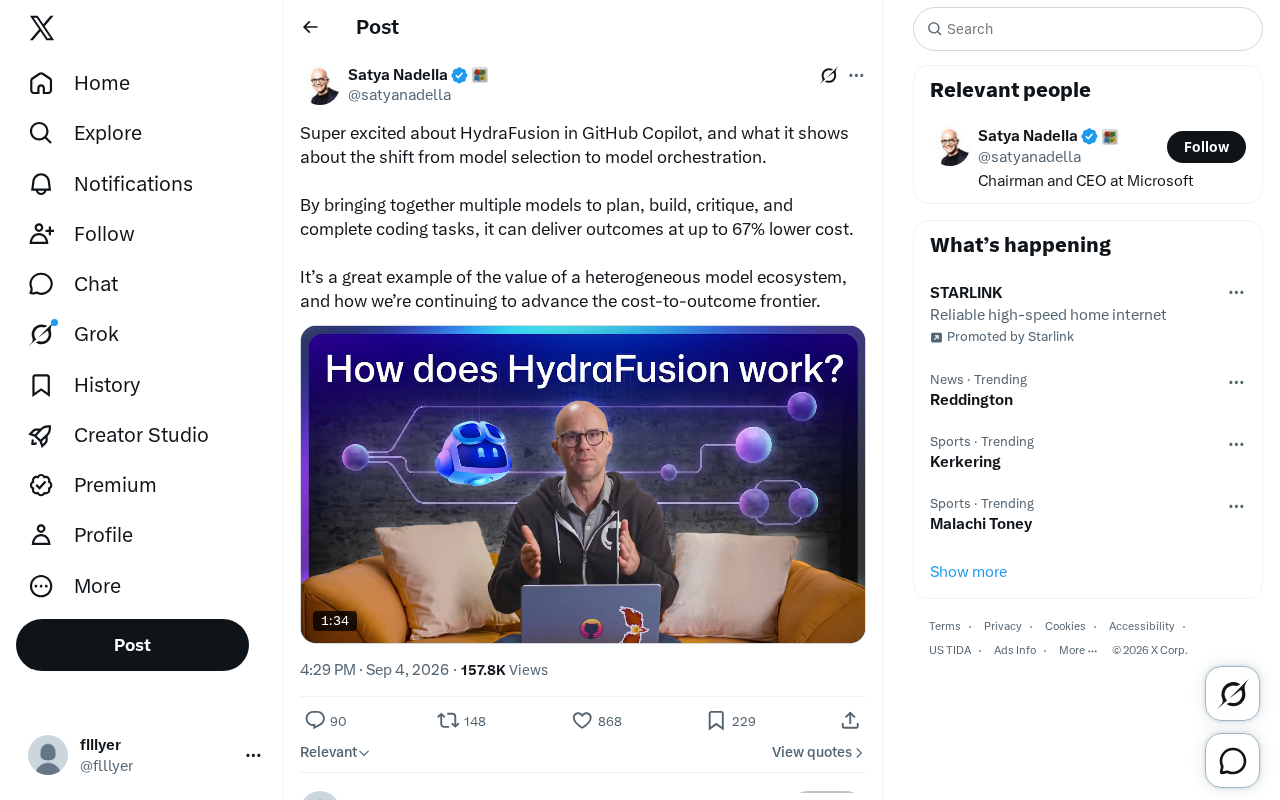
GitHub Copilot's HydraFusion orchestrates multiple AI models to cut costs by 67% without sacrificing quality.
GitHub Copilot's HydraFusion introduces multi-model orchestration to AI programming assistants, replacing the traditional single-model approach. By decomposing tasks into Plan, Build, Critique, and Complete stages — each handled by the most cost-effective model — it achieves up to 67% cost reduction while maintaining or improving output quality. This signals a broader industry shift where competitive advantage moves from model selection to intelligent model orchestration.
Introduction: Programming Assistants Enter the Multi-Model Collaboration Era
Recently, GitHub Copilot's launch of HydraFusion has attracted widespread attention. This technology is not just a product feature update — it represents a significant paradigm shift at the AI application architecture level: moving from single model selection to multi-model orchestration.
According to the relevant technical leads, HydraFusion can reduce costs by up to 67% by coordinating multiple models to collaboratively complete programming tasks, all while maintaining or even improving output quality. Behind this number lies the entire AI ecosystem's continuous push toward the "cost-to-outcome frontier."
Notably, GitHub Copilot has been the world's most influential AI programming assistant since it was first released as a technical preview in 2021. It was initially built on OpenAI's Codex model and later progressively integrated more powerful language models like GPT-4. By 2024, it had surpassed one million paid users and was deeply embedded in mainstream IDEs like VS Code and JetBrains. Before HydraFusion, Copilot's model strategy largely followed a "single model upgrade" approach — replacing older models with more powerful ones. The emergence of HydraFusion marks a fundamental shift in this strategy and signals that AI programming assistants have officially entered the multi-model collaboration era.
What Is Model Orchestration? Core Concepts Explained
From "Pick the Best Model" to "Make Multiple Models Collaborate"
For a long time, the core decision in AI applications was "which model to choose." Developers would weigh options among GPT, Claude, Gemini, and other models, trying to find the one that best balanced cost, speed, and quality. This approach is essentially single-point optimization.
But as the model ecosystem has diversified, people have gradually realized that no single model performs optimally across all subtasks. A model that excels at planning may not be great at writing code, and a model that's great at writing code may not excel at code review. This is where model orchestration comes in — instead of agonizing over choosing one "all-rounder," you organize multiple models with different strengths into a "team."
The technical implementation of model orchestration involves several key components. First is the Task Decomposer, which needs to understand user intent and break complex tasks into independently processable subtasks. Next is the Model Router, which selects the optimal model based on subtask characteristics — such as complexity, required capability types, and latency requirements. Routing decisions can be based on rule engines or accomplished using small classification models. Finally, there's the Result Aggregator, responsible for integrating outputs from multiple models into a coherent final result. In industry practice, similar architectures have appeared in platforms focused on multi-model scheduling, such as Martian's Model Router and Unify.ai. OpenAI itself has also introduced internal model routing mechanisms in ChatGPT, automatically selecting models of different capability levels based on question complexity.
HydraFusion's Four-Step Collaboration Workflow
The core idea behind HydraFusion is to decompose programming tasks into multiple stages and dispatch the most suitable model for each:
- Plan: A model skilled in logical reasoning breaks down the task and designs the implementation path;
- Build: A model with strong code generation capabilities handles the actual coding;
- Critique: A model with review capabilities inspects the generated results and identifies potential issues;
- Complete: Integrates outputs from the preceding stages and delivers the final result.
This "Plan-Build-Critique-Complete" closed loop isn't designed from scratch — it's an AI-native mapping of mature software engineering practices. In traditional software development, "Plan" corresponds to the system design phase led by architects or Tech Leads, "Build" corresponds to coding by development engineers, and "Critique" corresponds to the Code Review process — which is a mandatory quality assurance step at companies like Google and Microsoft. Research shows that Code Review catches approximately 60% of code defects. Translating this human collaboration paradigm into inter-model collaboration essentially means the AI system has internalized software engineering best practices. This approach is highly aligned with the emerging "AI Agent workflow" philosophy — replacing single large model calls with structured multi-step processes, allowing each stage to use the most cost-effective model.
Why Can HydraFusion Cut Costs by 67%?
Unlocking the Value of a Heterogeneous Model Ecosystem
The key to dramatic cost reduction lies in the intelligent utilization of a heterogeneous model ecosystem.
In traditional single-model approaches, the same (usually the most powerful and most expensive) model handles everything, regardless of whether a task is simple or complex. This means that many simple subtasks are paying for expensive inference compute, resulting in significant resource waste.
Under the orchestration model, the system can assign simple planning or formatting tasks to lighter, cheaper models, and only invoke powerful models at critical stages that truly require high capability. Through this "allocate on demand" strategy, overall compute costs are significantly compressed, achieving up to 67% cost reduction.
To understand the feasibility of this number, you need to understand the current price gradient in the large model market. Taking the 2024–2025 market as an example, the API call price for GPT-4o is approximately $2.5–5 per million input tokens, while GPT-4o-mini costs only about $0.15 — a difference of ten to several dozen times. Meanwhile, Claude 3.5 Sonnet excels at code generation tasks, Gemini has advantages in long-context understanding, and various open-source models (such as Llama and DeepSeek-Coder) can achieve near-commercial model performance on specific tasks. This ecosystem structure of "differentiated capabilities + tiered pricing" provides a natural economic arbitrage opportunity for model orchestration — completing 80% of simple subtasks at $0.15 while only investing in expensive compute for the 20% of critical stages, naturally resulting in a dramatic overall cost reduction.
Cost and Quality Are No Longer a Zero-Sum Game
Interestingly, reducing costs doesn't come at the expense of quality. Multi-model collaboration can actually improve output quality through the "Critique" stage — one model generates, another finds errors, creating a system of checks and balances.
This is precisely what "pushing the cost-to-outcome frontier" means. The "cost-to-outcome frontier" borrows the concept of the Production Possibility Frontier from economics. In the AI application context, it describes the optimal trade-off curve between cost investment and output quality under given technological conditions. Traditionally, achieving higher quality AI output required using more expensive models or more computational resources — moving along the existing frontier curve. The value of model orchestration lies in shifting the frontier itself — achieving higher quality at the same cost, or lower cost at the same quality, through architectural innovation. This mirrors the logic in the chip industry, where architectural innovation (rather than simply advancing process nodes) improves performance-per-watt ratios. Model orchestration aims to break the traditional trade-off where cost and quality are inversely related, using smarter architectural design to optimize both cost and output simultaneously.
Broader Implications of Model Orchestration for the AI Industry
Competitive Advantage Shifts from "Which Model" to "How You Orchestrate Models"
The significance of HydraFusion extends beyond GitHub Copilot itself. It sends a clear signal to the entire industry: the differentiating competitive advantage of future AI applications will increasingly reside in the orchestration layer, not in the underlying models themselves.
As foundation models from various providers converge in capability and become accessible via APIs, whoever can more intelligently combine and schedule these models will establish advantages in cost and user experience. This also explains why more and more AI products are emphasizing capabilities like "Agent orchestration" and "multi-model routing."
In fact, the rise of model orchestration is a key component of the AI Agent wave. Since 2024, the AI industry has seen a clear shift from "single-call" to "multi-step Agent workflows." Frameworks like LangChain, LangGraph, CrewAI, and AutoGen provide infrastructure for multi-Agent collaboration. Anthropic's Model Context Protocol (MCP) aims to standardize interactions between models and external tools. In the enterprise market, products like Salesforce's Agentforce and ServiceNow's AI Agents are also embedding multi-model orchestration into business processes. It's fair to say that model orchestration is rapidly evolving from a technical concept to industrial-grade infrastructure, and HydraFusion is the landmark implementation of this trend in the developer tools space.
Practical Impact on Developers and Enterprises
For developers, this means AI programming assistants will become smarter and more economical, providing a better assistance experience without increasing costs.
For enterprises, model orchestration offers a practical cost-reduction path — no need to wait for cheaper super-models to emerge; instead, architectural-level optimization can immediately extract more value from the existing model ecosystem. This approach is especially suited for scenarios with high AI call volumes and cost sensitivity, such as large-scale codebase maintenance, automated test generation, and technical documentation writing. Enterprise technology decisions will also shift from "betting on a single model vendor" to "building flexible multi-model scheduling capabilities," which offers significant advantages in vendor negotiation, risk diversification, and adaptability to technological iteration.
Conclusion
HydraFusion is a landmark case of AI applications moving from "model selection" to "model orchestration." It demonstrates a trend that is taking shape: true technological progress comes not only from more powerful individual models, but also from the wisdom of how we organize and coordinate them.
As the heterogeneous model ecosystem continues to grow richer, we will likely see more orchestration systems like this one, continuously pushing the boundaries of what's possible between cost and output. Just as advances in software engineering depend not only on faster hardware but also on better architectures and methodologies — the next leap in AI applications may well be hidden within the word "orchestration."
Related articles
Vercel AI SDK TUI: A New Option for Terminal-Based AI Interaction
Vercel AI SDK introduces @ai-sdk/tui for terminal AI interactions, bringing streaming output, tool calling, and AI conversations to the command line.

Microsoft Copilot Copyright Lawsuit: 8.2 Million Conversations Reveal the Truth About AI Content Copying
Microsoft discloses 8.2M Copilot conversations in NYT copyright lawsuit, claiming AI rarely copies news content. Explore the key data, legal disputes, and implications for the AI industry.
Can AI Design Circuit Boards? A Deep Dive into the Realities and Limitations of AI in PCB Design
Can AI design circuit boards? This deep dive examines AI's real capabilities and limitations in PCB design, covering component selection, layout, routing, and human-AI collaboration.