"I Said No, but Apple Said Yes": A Debate Over User Consent
When users say no but systems say yes — how software design systematically undermines user consent.
A Hacker News post titled "I said no and Apple said yes" sparked broader discussion about user consent being systematically undermined in digital products. The article identifies three common culprits: privacy settings auto-resetting after updates, default-on data collection features, and dark pattern designs that hide the "decline" option. Apple, which has long marketed privacy as a core brand value, faces particular scrutiny. The piece calls on developers to treat persisted user choices, transparent defaults, and symmetrical interaction design as baseline principles — not just marketing talking points.
The Worry Behind a Single Sentence
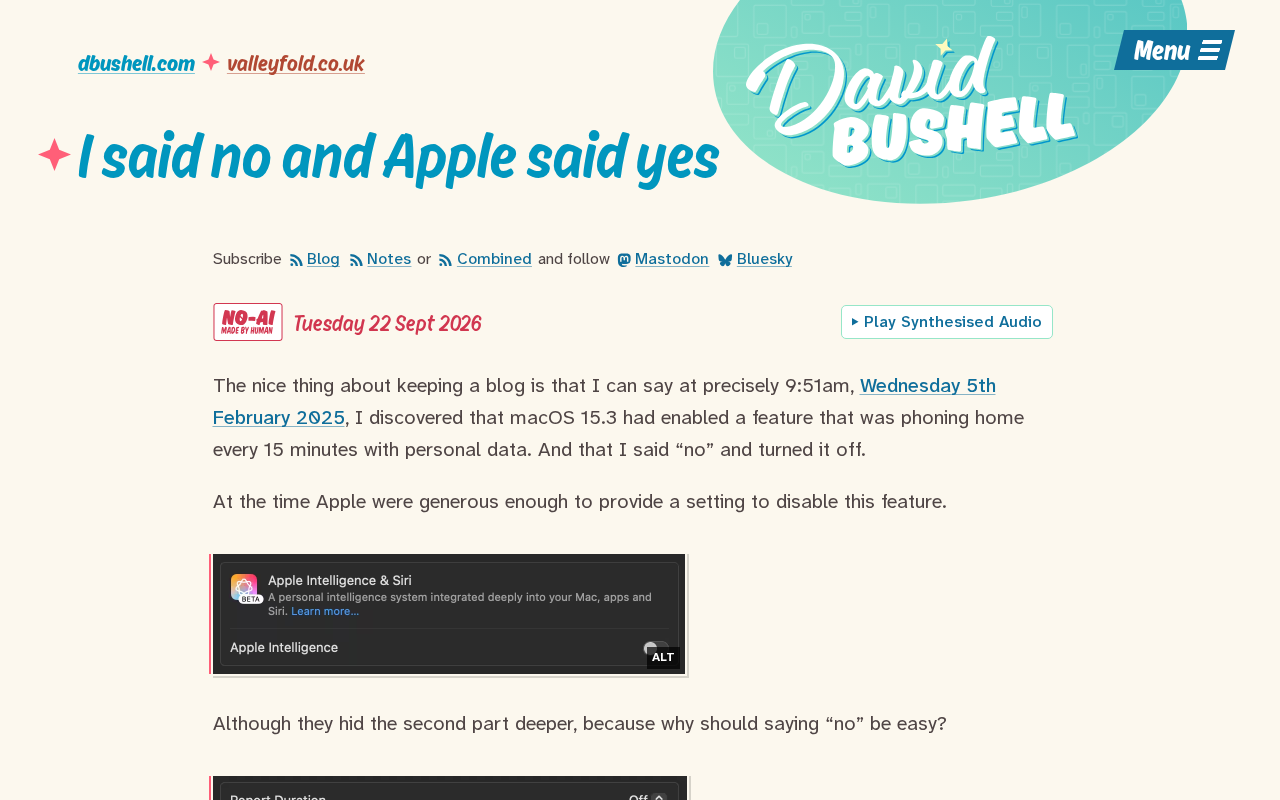
"I said no and Apple said yes" — this headline, which sparked discussion on Hacker News, points to an increasingly sensitive topic in today's tech industry: when a user explicitly expresses refusal, the platform or system unilaterally makes a "yes" decision on their behalf.
This kind of thing is far from rare. Whether it's a data-sharing setting that quietly re-enables itself after a system update, or a feature that's switched on by default, users' intent to say "no" is routinely overridden during software iterations or through interface design choices. The reason this post resonated with so many people is precisely because it touches on a shared experience: I clearly made a choice — so why did the outcome end up being the opposite?
It's worth noting that because the original Hacker News post had limited information (8 upvotes, 1 comment), this article is more of a broader analysis of the phenomenon rather than a complete reconstruction of any specific incident.
Why User Consent Keeps Getting Undermined
In software product design, "consent" should be a clear, revocable, and respected action. In practice, however, users' refusals are frequently weakened in several ways:
Updates That Reset Your Choices
The most common scenario: after a system or app update, certain privacy or feature settings are "restored to defaults." The user's previous refusal isn't persisted, and after the update, the setting is back to being enabled. For ordinary users, it's nearly impossible to go through every toggle after every update.
The Default-On Design Philosophy
Many features adopt an "on by default, manually turn off" strategy. This exploits user inertia — most people won't actively disable a feature that's already running. While it technically offers a choice, the default value itself is a form of steering.
Hidden Paths to Refusal
In some interaction designs, the "agree" button is prominently displayed while the "decline" option is de-emphasized, buried, or requires multiple steps to find. This kind of interface design — known as a "dark pattern" — fundamentally undermines the user's ability to say no.
The concept of Dark Patterns was formally introduced by UX designer Harry Brignull in 2010, referring specifically to interface patterns deliberately designed to trick or manipulate users. Common types include: hiding the unsubscribe button where it's nearly impossible to find, using "confirmshaming" to make the refusal option read as self-negating (e.g., "No, I don't want to save money"), and pre-checking add-on services during checkout. The EU's Digital Services Act (DSA) and General Data Protection Regulation (GDPR) have explicitly classified certain dark patterns as violations, punishable by fines of up to 4% of global revenue. The U.S. Federal Trade Commission (FTC) also published a report in 2022 identifying dark patterns as unfair or deceptive business practices. This context means that the problem of "users saying no while systems say yes" is not just an ethical issue — in certain jurisdictions, it already carries clear legal consequences.
Apple's Privacy Promise vs. Reality
Apple has long positioned "privacy" as one of its core selling points — from App Tracking Transparency (ATT) to various privacy labels, all emphasizing that "users control their own data." This is precisely why a headline like "I said no and Apple said yes" carries such discussion value — it directly challenges the brand image Apple takes the most pride in.
If a company that markets itself on privacy still exhibits behavior that overrides user choices in certain areas, it serves as a reminder: privacy protection cannot remain at the level of marketing language. It must be reflected in every settings item, every update, and every default value. User trust is built on the premise that "my choices will actually be carried out."
Apple's App Tracking Transparency (ATT) framework launched with iOS 14.5 in 2021, requiring all apps to display a permission prompt before tracking user behavior across other apps. After the policy rolled out, industry data showed that globally, 75% to 85% of users chose to opt out of tracking — dealing a multi-billion-dollar revenue blow to platforms like Meta (Facebook's parent company) that depend on targeted advertising. However, critics point out that Apple's own first-party data collection is not subject to the ATT framework — Apple can track user behavior within its own app ecosystem for its advertising business (Apple Search Ads). This asymmetry has been questioned multiple times by researchers and regulators. This "strict for others, lenient for itself" double standard is the deep structural source of the ongoing debate around the gap between Apple's privacy promises and reality.
From an Individual Case to an Industry-Wide Problem
This post may not have generated much discussion, but the issue it reflects is universal. As software systems grow increasingly complex and updates increasingly frequent, users' actual control over their own devices and data may actually be declining.
For developers and product teams, respecting the user's "no" should be a non-negotiable baseline principle:
- Persist user choices: Don't reset privacy decisions users have explicitly made just because of a version update.
- Transparent defaults: Default states should be as conservative as possible, especially when data collection is involved.
- Symmetrical interaction design: "Agree" and "decline" should have equal visibility and ease of access.
- Auditable change logs: Let users see when and why a given setting was changed.
Conclusion
"I said no and Apple said yes" is a statement laced with frustration — even anger. But behind it lies a long-unresolved question of the digital age: in the relationship between humans and systems, how much weight does the user's will actually carry?
Whether it's Apple or any other platform, genuine respect for privacy doesn't lie in promotional slogans. It lies in whether the system truly listens in the moment a user says "no." That's a question worth continuing to ask for everyone who cares about tech ethics and product design.
Related articles

A Single Prompt Triggers a Global PHP Security Storm: Is AI a Savior or a Hidden Risk?
A single AI prompt triggered a global PHP security crisis affecting Wikipedia and the Internet Archive. This article reviews the incident, analyzes the OpenAI-Amazon controversy, and explores the security paradox of lowered vulnerability discovery barriers in the AI era and developer response strategies.

When AI Is Taken Away: How Reliance on Shortcuts Undermines Your Problem-Solving Resilience
A study of 1,222 people found that after using AI to answer questions, once AI was removed, people gave up on more problems than a control group that never used AI. The article analyzes the impact of AI reliance on learning resilience and metacognition, and explores design implications for AI learning tools.

Carta and NewView Partner to Let Startup Employees Cash Out Equity Early
Carta and NewView Capital partner to simplify startup tender offers, helping employees sell equity early. Analysis of the mechanism, liquidity pain points, and impact.