ICE Agents at the Door: The Free Speech Crisis in the Age of AI Surveillance

How AI surveillance links online criticism to real identities—and threatens free speech in the digital age.
When ICE agents tracked online critic David Streever to his hotel, it exposed how AI-driven surveillance connects online speech to offline identity. This article examines data broker loopholes, stylometry, the chilling effect on free speech, and the privacy challenges facing citizens and the tech industry in the AI era.
A Phone Call From the Hotel Front Desk
Just hours after checking into a New York City hotel—fresh off a vacation in Finland with his daughter—David Streever was woken by a call from the front desk: someone was looking for him. And during the time he'd been out of the country, a series of events he knew nothing about had quietly unfolded.
According to the original reporting, agents from U.S. Immigration and Customs Enforcement (ICE) had begun paying "house visits" to individuals who had posted critical remarks online. Established in 2003, ICE is an agency under the Department of Homeland Security, whose original mandate focused on immigration enforcement and combating transnational crime. Since the mid-2010s, however, the agency began purchasing commercial data broker services on a massive scale, spanning license plate recognition databases, phone location data, and social media monitoring tools. According to a report by the American Civil Liberties Union (ACLU), ICE has signed contracts worth hundreds of millions of dollars with data companies such as Palantir and Thomson Reuters, building comprehensive intelligence platforms capable of cross-database searches of individuals' information. This has expanded its operational reach far beyond traditional immigration enforcement, gradually evolving into a broad-spectrum digital tracking apparatus targeting specific groups.
The phenomenon quickly drew widespread attention: how exactly do law enforcement agencies locate these online critics? In an era of ever-more-pervasive digital surveillance, are ordinary people's online statements being systematically tracked?
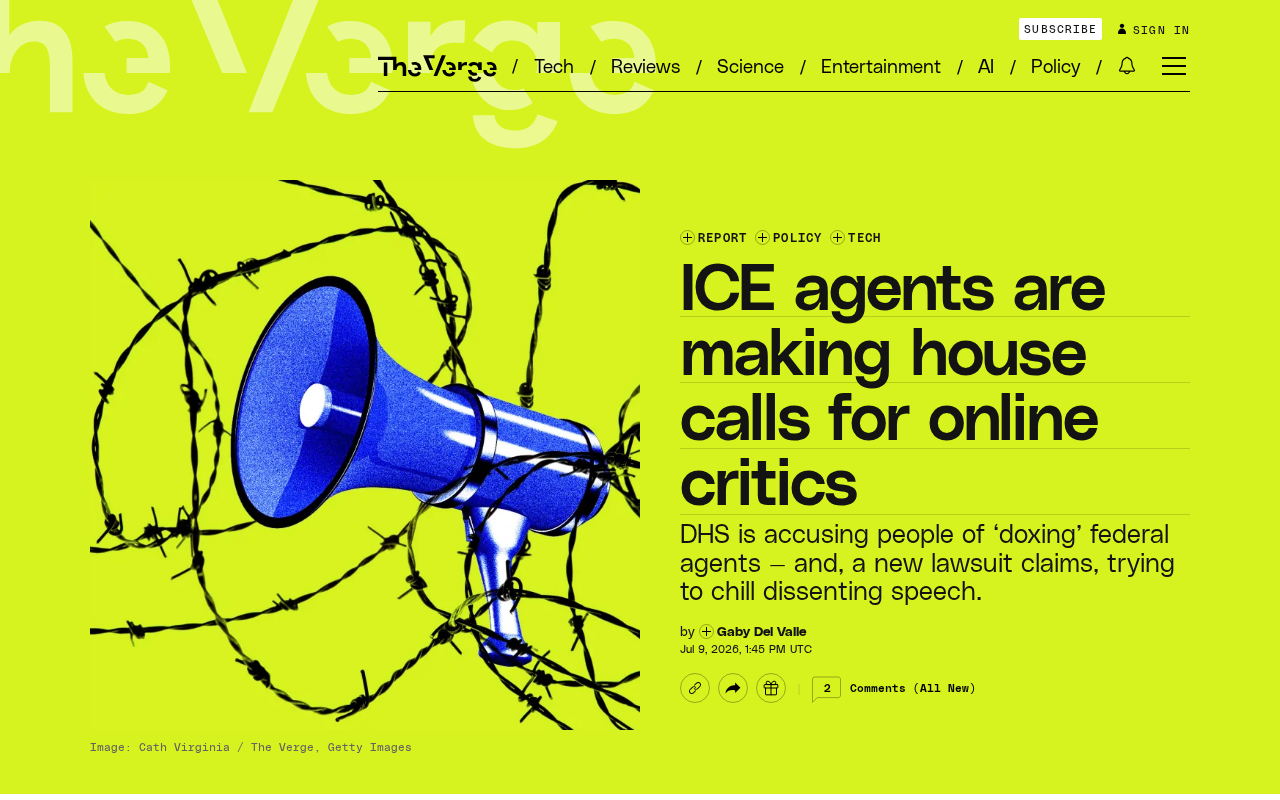
From Online Speech to a Knock at the Door: How the Tracking Chain Works
At the heart of this incident is a complete tracking chain extending from virtual space into real life. When someone posts criticism of a government agency on social media or a forum, these public digital footprints can become the starting point for identification and localization.
How Digital Footprints Are Precisely Linked
Modern identity recognition technology has made it easier than ever to associate anonymous or semi-anonymous online accounts with real identities. Usernames, registration emails, IP addresses, posting time patterns, and even writing style can all become key clues for piecing together a real identity.
Among these, writing style analysis (stylometry) deserves particular attention. Historically used for literary attribution (such as disputes over the authenticity of Shakespeare's works), the technique has grown far more powerful in the digital age when combined with machine learning: algorithms can build an individual "style fingerprint" from hundreds of feature dimensions, including sentence length, punctuation habits, high-frequency vocabulary, and grammatical structure preferences. Research shows that even when users deliberately disguise their writing style, systems can still identify the same author across accounts with over 80% accuracy. This means that even if someone registers multiple "anonymous" accounts, their consistent patterns of expression themselves constitute a traceable digital trace.
When these fragments of information are aggregated and analyzed, a specific person—including their home address, travel records, and hotel check-in information—can surface as a result.
The most unsettling detail in the Streever case is that law enforcement was able to know precisely that he had just returned from overseas and which hotel he'd checked into. This indicates that the underlying information integration capability far exceeds mere social media monitoring, likely involving cross-referencing of multiple sources such as immigration records and hotel booking data.
The realization of this capability is inseparable from the data broker industry. Data brokers are commercial entities that specialize in collecting, aggregating, and selling personal information. There are currently around 4,000 such companies in the United States, drawing information from dozens of sources—public records, consumer behavior data, airline passenger manifests, and more—to form detailed profiles covering hundreds of millions of people. Government agencies use commercial procurement to bypass data acquisition procedures that would otherwise require court authorization, creating a significant legal loophole—one that academics call the "data broker loophole." A 2022 U.S. Senate investigation revealed that multiple federal agencies, including ICE, had obtained citizens' location data through data brokers without warrants, sparking widespread legal and ethical controversy.
AI and Automated Surveillance: The Force Behind Tracking at Scale
While the original reporting focuses on the enforcement action itself, the technological trend reflected behind this phenomenon is equally worth pondering. Manually reviewing massive volumes of online speech one entry at a time is nearly impossible—but AI-driven automated tools are making such large-scale surveillance a reality.
The Technical Loop From Content Screening to Identity Correlation
Modern social media monitoring systems typically employ a multi-layered natural language processing (NLP) pipeline architecture: the first layer handles keyword filtering and entity recognition, responsible for extracting posts involving specific people, organizations, or events from massive volumes of content; the second layer consists of sentiment analysis and stance detection models, fine-tuned from pretrained large language models such as BERT and RoBERTa, capable of distinguishing criticism, sarcasm, and neutral expression; the third layer performs network graph analysis, identifying opinion leaders and dissemination networks by tracking interactions between accounts (retweets, @mentions, shared follows). This system can process millions of posts within seconds and automatically generate a prioritized "watch list." Notably, such systems still exhibit significant misjudgment rates when handling non-English content, cultural metaphors, and ironic contexts—meaning the risk of systematically harming ordinary citizens cannot be ignored either.
Machine learning models can classify and rank content, pushing "high-interest" targets to human review. Facial recognition, writing style analysis, and other technologies then further bind virtual accounts to real individuals with precision.
This technology stack was initially applied to counterterrorism, crime-fighting, and similar scenarios. But when it is used to track ordinary citizens who hold critical views of the government, its boundary and ethical problems immediately come to the fore. The "neutrality" of technology becomes a false premise here—the tool itself is neither good nor evil, but the manner of its use determines its social consequences.
The Deep Tension Between Free Speech and Technological Surveillance
This incident touches on an increasingly sharp issue: against the backdrop of rapidly advancing AI surveillance capabilities, how can citizens' freedom of speech be genuinely safeguarded?
The Chilling Effect: Invisible Self-Censorship
When people realize that online criticism may invite an in-person "visit" from law enforcement, the most immediate consequence is the "chilling effect"—out of self-protection, the public proactively curtails its expression, deliberately avoiding views that might be seen as "sensitive." This self-censorship erodes the space for public discussion in ways that are covert and lasting.
The chilling effect is not an abstract concept; multiple empirical studies have corroborated it. A 2015 study by Stanford Law School found that after the Snowden revelations exposed the NSA surveillance program, page views of terrorism-related Wikipedia entries dropped sharply by 30%. A PEN America survey of writers found that 34% of respondents said they had self-censored certain creative topics out of fear of surveillance. From a behavioral economics perspective, this effect is asymmetric: the actual coverage of surveillance may be far smaller than the public's subjective perception, yet even the subjective feeling of "being watched" is enough to systematically compress the space for free expression. This mechanism means the social cost of digital surveillance far exceeds the number of cases it directly intervenes in.
The Regulatory Vacuum Behind Data Integration
Even more concerning is that such surveillance often operates in a legal gray zone. Immigration data, hotel information, and social media content fall under different data jurisdictions, but when they are integrated into a tracking operation against an individual, existing privacy protection frameworks often prove inadequate. Who has the right to access this data? Under what conditions can it be integrated and used across domains? These questions still lack clear institutional answers.
Practical Implications for the Tech Industry
For AI and technology practitioners, this incident is a genuine wake-up call. Every leap in technological capability comes with new social responsibility.
Companies developing surveillance and identification tools need to seriously assess the scenarios in which their technology could be misused, and embed necessary constraints and audit mechanisms at the product design stage. Platform operators, meanwhile, continue to face the real challenge of how to protect user data and effectively resist improper data requests.
For ordinary users, this incident also prompts us to re-examine our own digital footprint management—from separating registration information and strengthening privacy settings, to a basic awareness of where personal data flows, and understanding the reality that writing style itself can constitute a traceable identifier. All of these are becoming increasingly impossible to ignore.
Conclusion
David Streever's experience, beginning with a single call from the front desk, lifts the curtain on a sobering side of the digital surveillance era. When online criticism can turn into a knock at the door, the balance between technological progress and civil rights becomes an issue society as a whole must confront directly. AI should not become a tool for suppressing dissent. How to draw a reasonable boundary between the expansion of technological capability and the protection of individual freedom will be an unavoidable core challenge for future digital governance.
Key Takeaways
Related articles
Reverse Engineering + AI Agents: The T…
Reverse Engineering + AI Agents: The Technical Truth Behind Cloning Adobe Apps in Weeks
A developer used AI Coding Agents for reverse engineering to build 7 open-source Adobe alternatives in weeks. We explore how it works, the MCP Server that hit 100K stars in 6 days, and the real technical and legal limits.

MCP Protocol Explained: How AI Agents Connect to External Tools
What is MCP (Model Context Protocol)? From APIs and Function Calling to MCP's three-layer architecture, this article explains how AI Agents connect to external tools like calendars and email, and reveals two major security risks—prompt injection and tool poisoning—along with four protection principles.

iPhone Duo Hands-On: Is the $2,000 Small-Screen Foldable Worth It?
YouTube's Allison shares her iPhone Duo hands-on: dual-screen multitasking doubles efficiency, great video viewing, nice matte finish—but thick body, small outer screen, and a $2,000 luxury price.