ICLR Submissions Surpass 60,000, Reddit Buzzes Over "Honest" Vibe Research

A Reddit hot post uses an "honest" ICLR submission to satirize Vibe Research and the quality anxiety behind the submission explosion at top conferences.
A screenshot of an ICLR submission labeled "honest" sparked heated discussion on the Reddit machine learning forum, with the poster using "Vibe research" to mock the current phenomenon of research lacking solid experimental and theoretical support, pieced together with intuition and packaging. The article notes that ICLR received over 60,000 submissions this time, more than twenty times the approximately 2,600 in 2020, putting pressure on review capacity and quality. Community reactions are complex: both self-deprecation about having produced "vibe research" oneself, and reflection on an academic evaluation system that rewards quantity over quality. The article argues that the function of top conferences as quality filters is facing structural challenges; individual researchers need to maintain depth and honesty, while the community must find a long-term balance between scale expansion and quality control.
Introduction: A Screenshot That Struck a Chord in Academia
Recently, a post on the Reddit machine learning forum sparked widespread discussion. The title was simple: "How many of you have seen this honest ICLR submission?" The image was a screenshot of an ICLR submission tagged "[D]". The poster added just one remark: "Vibe research. No wonder ICLR received over 60,000 submissions this time."
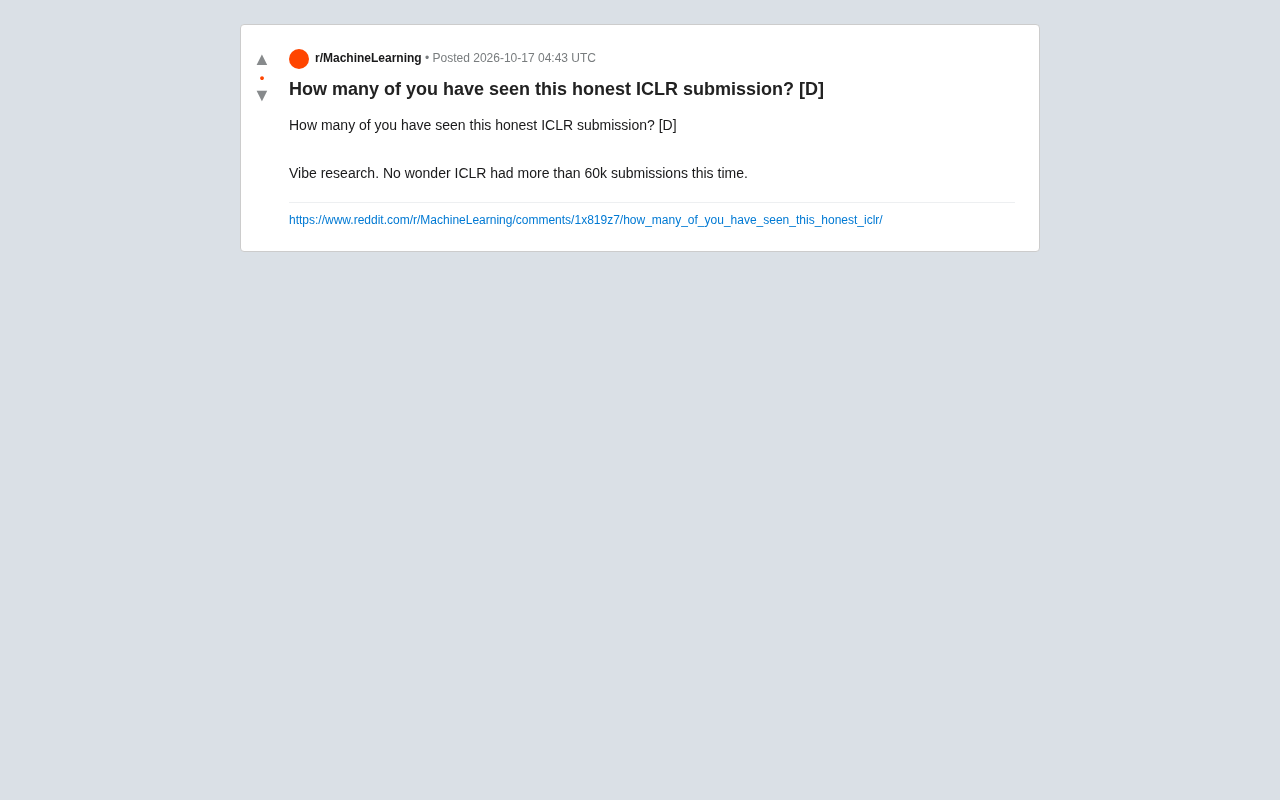
"Vibe research" is a recently popular sardonic term referring to research work that lacks solid experimental or theoretical support and is pieced together purely based on "feel" and "intuition." The reason this post went viral is precisely that it struck a common chord among many researchers: in today's era of exploding submissions to top conferences, both reviewers and authors feel the tension between quality and quantity.
The "Arms Race" Behind 60,000+ Submissions
According to data mentioned in the Reddit post, ICLR received over 60,000 submissions this time. This number was almost unimaginable just a few years ago. For comparison, ICLR 2020 received about 2,600 submissions—a more than twentyfold increase in just a few years. This exponential growth is not unique to ICLR; top conferences like NeurIPS and ICML are facing similar trends.
The reasons for this growth are multifaceted: the lowered barrier to AI research, the proliferation of open-source tools, and the "publish or perish" academic evaluation system. But what the poster and commenters care more about is the other side—when submissions far exceed review capacity, can review quality still be guaranteed? An "honest" submission that borders on self-deprecation may be precisely a projection of this anxiety.
ICLR (International Conference on Learning Representations) is one of the top conferences in deep learning, known for its "open review" (OpenReview) mechanism: all submissions, review comments, and author responses are public throughout the process, and anyone can browse and comment. This mechanism was intended to enhance review transparency, but it also exposes the "quality stratification" of submissions more directly to public view—a poor-quality submission could be screenshotted and circulated, becoming community gossip. In addition, ICLR's submission window is relatively fixed and has no strict submission cap, which encourages researchers to adopt a "broad net" submission strategy, further driving up the total volume. Understanding this background helps clarify that "60,000 submissions" is not just a numbers issue but also the result of the interplay between review mechanisms and academic incentives.
What Is "Vibe Research"?
The term "vibe research" was mentioned repeatedly in the post's comments, but there is no strict definition. From the context, it roughly points to several phenomena:
- Idea first, experiments to fill the gap: Start with a cool-sounding idea, then use a small number of experiments or cherry-picked results to support it.
- Packaging over substance: The abstract and introduction are written in flowery language, but the core contribution doesn't hold up to scrutiny.
- Bandwagon jumping: Doing whatever direction is hot, lacking deep thinking about the essence of the problem.
The post's title uses the word "honest," suggesting that this submission may in some way candidly acknowledge its own research limitations or opportunism. Although the screenshot content was not fully disclosed, the poster and commenters clearly read a resonance in it—on the high-speed academic production line, honesty has instead become a scarce commodity.
"Cherry-picked results" refers to researchers selecting only those results from multiple experiments that support their hypotheses and look best, while hiding non-significant or contrary results. This is methodologically known as selective reporting, which systematically exaggerates the actual effectiveness of a method and is also one of the important causes of the "reproducibility crisis" in machine learning. Related practices include "p-hacking" and "benchmark overfitting": the former involves repeatedly adjusting experimental settings until statistical significance appears, while the latter involves repeatedly tuning parameters for a specific evaluation set, making the model perform well on the leaderboard but generalize poorly in real-world scenarios. Recognizing these phenomena is a key clue for judging whether a study qualifies as "vibe research."
Community Reaction: Self-Deprecation, Anxiety, and Reflection
From the Reddit discussion, community sentiment is complex. Some respond with self-deprecation, admitting they too have produced "vibe research"; others express concern about the academic ecosystem, believing that the submission explosion is diluting the signal value of top conferences.
Some comments also point out that "vibe research" cannot be simply blamed on individual authors. When graduation, job hunting, and grant applications are all tied to paper counts, pursuing "quick and dirty" output is a rational choice. What truly needs reflection is the evaluation mechanism itself: if the system rewards quantity rather than quality, then "honest" submissions instead appear out of place.
Implications for the AI Research Ecosystem
Although this Reddit post is just a lighthearted rant, it touches on structural issues in the AI research ecosystem. Surpassing 60,000 submissions is a signal: the function of top conferences as quality filters is under pressure. In recent years, conferences like ICLR have begun trying to adjust review processes, introduce more reviewers, and even discuss submission caps, but the fundamental contradiction remains unresolved.
For individual researchers, the popularity of "vibe research" is a warning: when everyone is accelerating, maintaining depth and honesty requires extra composure. For the community, how to find a balance between scale expansion and quality control will be a long-term challenge.
Conclusion
A screenshot and a quip sparking such widespread discussion shows that it voices what many people want to say but haven't. ICLR surpassing 60,000 submissions may just be a number, but the fact that an "honest" submission is circulated as a spectacle is itself worthy of deep reflection by the entire AI research community.
One-line Summary
A Reddit hot post uses an "honest" ICLR submission to satirize Vibe Research and the quality anxiety behind the submission explosion at top conferences.
Paragraph Summary
A screenshot of an ICLR submission labeled "honest" sparked heated discussion on the Reddit machine learning forum, with the poster using "Vibe research" to mock the current phenomenon of research lacking solid experimental and theoretical support, pieced together with intuition and packaging. The article notes that ICLR received over 60,000 submissions this time, more than twenty times the approximately 2,600 in 2020, putting pressure on review capacity and quality. Community reactions are complex: both self-deprecation about having produced "vibe research" oneself, and reflection on an academic evaluation system that rewards quantity over quality. The article argues that the function of top conferences as quality filters is facing structural challenges; individual researchers need to maintain depth and honesty, while the community must find a long-term balance between scale expansion and quality control.
Related articles

Trump's Request to Rename the Atlantic Rejected by Google; 1Password Lets AI Agents Log In Securely
The Vergecast roundup: Trump's request to rename the Atlantic the 'Trump Ocean' was politely declined by Google's CEO; 1Password's new feature lets AI agents log into accounts without touching passwords; OPPO launches the world's first 200-megapixel phone, the Find X10 Pro Max. All three point to the boundaries of tech authorization and trust.

The Truth About American College Party Culture: The Risks Schools Won't Admit
Behind American college party culture, the administration's "don't ask, don't tell" attitude is amplifying freshman risks. This article analyzes how the pandemic strengthened Greek dominance, freshmen's difficulty accessing safety information, and the chain reactions caused by a culture of denial.

OpenAI Reportedly Raising $30B at $1.25T Valuation Ahead of IPO
OpenAI is planning a $30B funding round at a possible $1.25T valuation, paving the way for an IPO. If completed, it would set a private company valuation record. This article analyzes the funding size, pre-IPO logic, and industry signals.