IDA Pro + MCP in Action: AI-Assisted Reverse Engineering of a Music App's Signature Algorithm

How to reverse-engineer a music app's signature algorithm using IDA Pro combined with AI via MCP.
This article walks through a complete AI-assisted reverse engineering workflow targeting a music app's Sign signature algorithm. It covers setting up HTTPS traffic capture, identifying key API endpoints and signature parameters, and using IDA Pro with MCP (Model Context Protocol) to analyze native .so binaries and reconstruct the signing logic — all within a legal, research-focused context.
Introduction: How AI Is Reshaping Reverse Engineering
Traditional reverse engineering demands deep expertise in assembly language, cryptographic algorithms, and debugging tools — a process that can easily consume days or even weeks. As large language models continue to advance, AI-assisted reverse engineering approaches like IDA Pro combined with MCP (Model Context Protocol) are dramatically lowering the barrier to entry in this field.
This article uses the Sign signature algorithm of a music app as a case study, walking through the complete technical workflow from traffic capture and request identification to binary-level reverse analysis. It's worth noting upfront: this content is intended solely for security research and technical learning. Any reverse engineering should be conducted within legal and compliant boundaries — never use these techniques to infringe on copyrights or disrupt platform operations.
Step 1: Set Up a Traffic Capture Environment to Understand Network Communication
Every reverse engineering engagement starts the same way: understanding how the target app communicates over the network. Traffic capture is the indispensable first step.
Prepare the Target App and a Controlled Runtime Environment
Obtain the target app's .apk installer from an app store and deploy it on an Android emulator or a rooted physical device. Choosing a controlled runtime environment is critical — whether you use an emulator or a rooted device, the goal is to gain full visibility into the app's network traffic.
Configure an HTTPS Proxy and Trust the CA Certificate
Popular traffic capture tools like Charles intercept HTTPS traffic using a man-in-the-middle proxy approach. Successfully setting this up requires two key steps:
- Import and trust the CA root certificate: Install the capture tool's root certificate into the device's system trust store. Without this, HTTPS handshakes will fail due to certificate verification errors, and traffic will remain encrypted.
- Point the proxy to your machine's IP: Find your local network IP (e.g.,
10.0.5.9) and configure the phone's WiFi HTTP proxy settings to point to that address and the corresponding port.
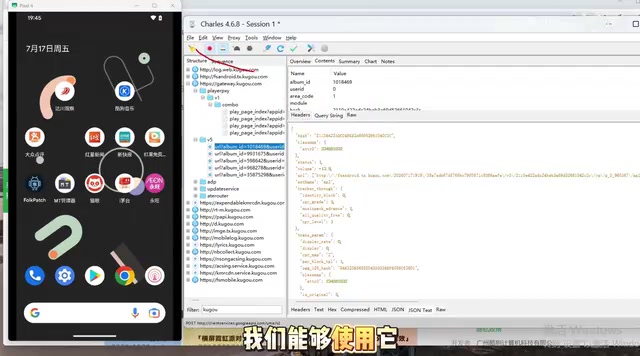
Once this is configured, all network requests from the app will be routed through the proxy tool, giving you full real-time visibility into traffic.
Step 2: Identify Key Endpoints and Signature Parameters
With the capture environment ready, you can start analyzing the app's API behavior.
Filtering Target Endpoints from High-Volume Traffic
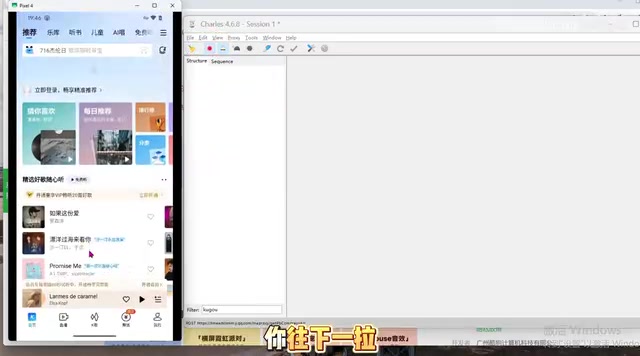
As you interact with the app — browsing playlists, tapping play — the proxy tool captures a continuous stream of network requests. By comparing which requests are triggered by different actions, you can progressively isolate the endpoints that carry the core business data. This is the essence of the "target identification" phase in reverse engineering.
Locating the Real Audio Resource URL
When a song plays, the app sends a resource request to the server. The response contains the actual audio file URL (typically ending in .mgg, .mp3, or similar formats), along with metadata like song ID and playback duration in the request parameters.
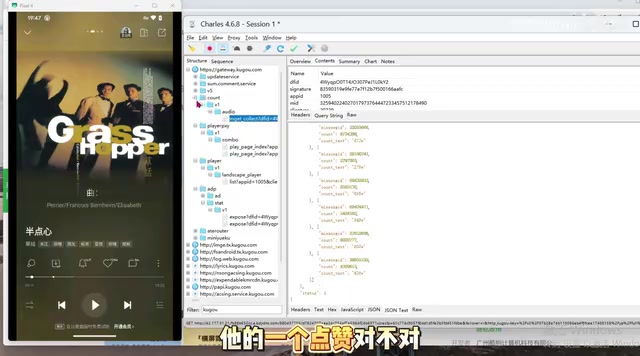
Pay close attention to the Sign signature field that often appears among these request parameters. Signature mechanisms are a common platform defense against API abuse — the server validates the request signature, and only requests that pass verification receive valid data. To reconstruct the signature generation logic, you need to go deeper: into the app's binary code.
Step 3: Reverse the Signature Algorithm with IDA Pro + MCP
When traffic analysis reveals that key parameters are being signed or encrypted, network-level inspection alone can't reconstruct the generation logic. This is where you bring in IDA Pro to disassemble the app's native layer (.so files).
Understanding Binary Data at Its Core
Whether it's audio, images, or video, everything at the lowest level is a binary stream. The audio data in a response packet is encoded data stored in binary form, which can be decoded and parsed using the appropriate tools.
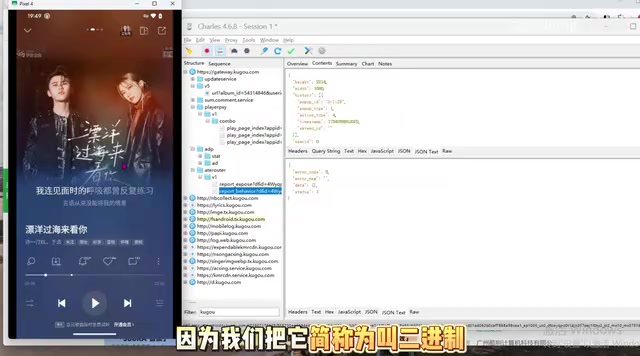
This understanding is foundational to reverse engineering — the discipline is, at its core, about interpreting binary data and reconstructing the logic embedded in binary code.
How MCP Multiplies IDA Pro's Analytical Power
In a traditional workflow, locating and reconstructing a Sign algorithm requires manually tracing function call chains in IDA Pro, reading assembly instructions line by line, and using experience to infer how cryptographic primitives like MD5, HMAC, or AES are combined. The skill requirements are steep.
By introducing MCP (Model Context Protocol), large language models can interact directly with IDA Pro's analysis output, delivering efficiency gains in three key areas:
- Code comprehension assistance: AI can read disassembled output and decompiled pseudo-C code, quickly mapping out function call logic.
- Algorithm pattern recognition: AI can leverage contextual features to identify cryptographic algorithm patterns, reducing manual trial-and-error.
- Code generation: AI can produce working implementations of reconstructed signature algorithms, accelerating proof-of-concept (PoC) development.
This human-AI collaboration model has the potential to compress reverse engineering work that would normally take days down to a matter of hours — and that's the core value proposition of AI-assisted reverse engineering.
A Technical Reflection: Capability Boundaries and Responsibility
The democratization of AI-assisted reverse engineering is a double-edged sword.
On the positive side, it lowers the barrier for security research, vulnerability discovery, and compatibility analysis, enabling more developers to understand how software works at a fundamental level — which is ultimately good for the overall security landscape.
On the other side, signature algorithms and copyright protection mechanisms exist for legitimate reasons. Using reverse engineering techniques to bypass VIP access controls or bulk-download paid content constitutes a genuine infringement of the legal rights of both content platforms and creators, and carries clear legal risk.
The techniques described in this article are appropriate for the following compliant use cases:
- Personal study of assembly language and reverse engineering principles
- Security researchers conducting authorized, compliant vulnerability analysis
- Enterprises performing security hardening and risk assessment on their own apps
Conclusion
The combination of IDA Pro and MCP represents a new direction for reverse engineering in the AI era: large language models are becoming intelligent analytical assistants for security researchers, helping people understand the complex world of binary code more efficiently.
But technology itself is always neutral. What determines its ultimate value is the intent and ethical awareness of the people who use it. Mastering reverse engineering skills while upholding legal and moral boundaries is what allows this technology to genuinely serve the goal of a safer digital ecosystem.
Related articles

FlipPrice: An Open-Source Pricing Copilot for Vintage Resellers
FlipPrice is an open-source pricing copilot for vintage resellers: snap a photo, fill a few fields, and get a listing draft, fair price range, and net take-home after fees — with local open-source inference and zero per-item cost.

Alguard: Building a Dual-Layer Trust Defense for AI Agent Shopping
Alguard, an Amazon Developer Hackathon project, designs a dual-layer trust architecture for Alexa+ agent shopping. Through physical isolation between an MCP server and a human approval channel, it replaces prompt defenses with structural constraints to block unauthorized purchases caused by prompt injection.

Food Poisoning: Causes, Symptoms, Treatment, and Prevention Explained
Food poisoning is caused by bacteria, viruses, parasites, or toxins contaminating food, with common symptoms including vomiting, diarrhea, and dehydration. This article explains the causes, symptoms, treatment, and prevention of food poisoning to help you safeguard food safety.