Idlen: Turning AI Wait Time into Ad Space — Developers Can Earn While They Code

Idlen converts AI coding wait time into native ad slots, giving developers 70% of the revenue.
Idlen is a native ad network that targets the idle "wait time" baked into AI coding tools. As assistants like Cursor and Copilot become standard, developers' workflows are filled with fragmented waiting — Idlen turns those gaps into ad slots and returns 70% of revenue to developers. It uses a "one network, three doors" model: coders install an extension to earn passively; tool vendors target by tech stack (React/Python/AWS); chat app developers integrate via three lines of code. The team promises never to read prompts. Core challenges include two-sided cold-start, verifiable privacy guarantees, and whether real eCPM levels can back up the "earn while you work" pitch.
Developers spend a lot of time waiting for AI to generate results. Those few seconds — or tens of seconds — while a model is "thinking" might seem like dead time, but a new product called Idlen has set its sights on exactly that window. It turns the wait into an ad slot and lets developers take a cut.
Idlen recently launched on Product Hunt, earning 75 upvotes and 8 comments, ranking 14th on its debut day. It spans four categories — Chrome Extensions, Advertising, Developer Tools, and Artificial Intelligence — landing squarely in the current boom of AI coding tools.
An Overlooked Gap: AI's "Thinking Time"
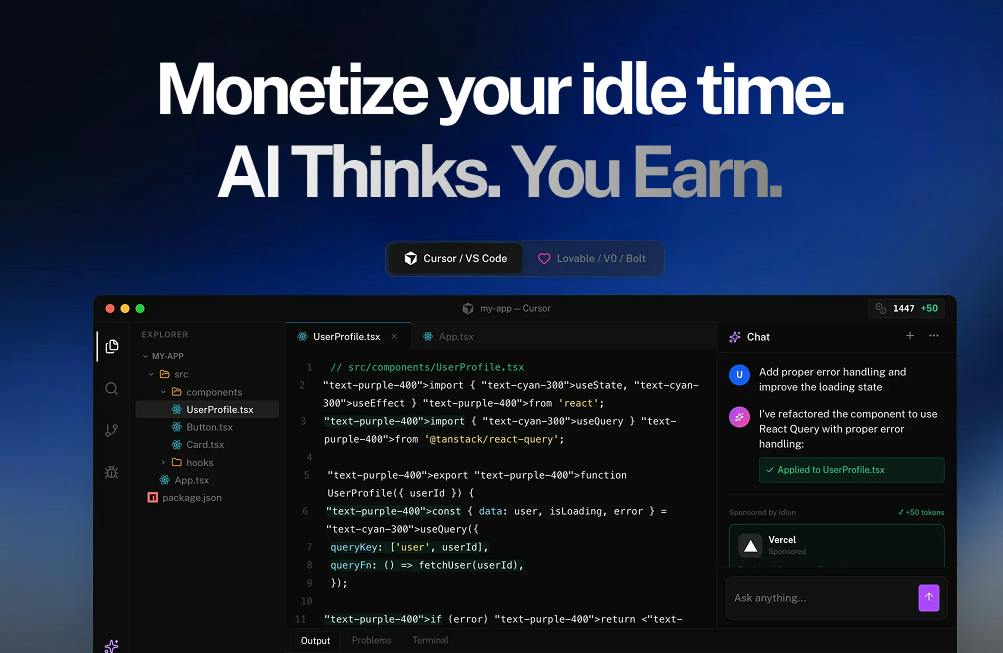
Idlen's core insight is straightforward: developers spend all day waiting for AI, and that wait is an ad slot.
As tools like Cursor, GitHub Copilot, and various chat-based coding assistants become ubiquitous, developers' workflows are now peppered with fragmented moments of waiting for model responses. Traditionally, this time is considered pure dead weight. Idlen aims to monetize it — by inserting a native ad during the interval between a prompt and the model's response.
This approach differs from traditional interstitial ads: it doesn't interrupt an active action, but rather fills a gap where you were passively waiting anyway. From a product design standpoint, this reduces the perceived intrusiveness of the ads — which explains why the team is confident enough to market it as "earn while you work."
One Network, Three Doors: How Each Role Participates
Idlen describes itself as "One network, three doors," designing different entry points for three distinct types of users.
Developers Who Write Code
If you write code, all you need to do is install the VS Code, Cursor, or Chrome extension. While the model is thinking, a native ad appears in the interface, and you keep 70% of the revenue. The team explicitly promises: We don't read your prompts — a direct response to the privacy concern developers care about most.
Vendors Selling Developer Tools
If you sell developer tools, Idlen offers precise reach: ads appear inside developers' IDEs and browsers, targeted based on the tech stacks they're actually using (e.g., React, Python, AWS).
The product makes a bold conversion promise — Pay €200, get €400 this week. This "double your money" pitch looks more like an early-acquisition incentive than a standard claim, and results should be interpreted with appropriate skepticism.
Developers Building Chat Applications
If you've already shipped a chat-based application, you can integrate via npm i @idlen/chat-sdk — the team claims it takes just three lines of code. Ads are optional: omit the key and no ads run; add the key and you keep the same 70% revenue share.
Breaking Down the Business Model: An Ad Network for Developers
Strip away the packaging, and Idlen is fundamentally a native advertising network built for developer contexts. It plays three roles simultaneously:
- For developers, it's a revenue-sharing channel that monetizes idle waiting time.
- For tool vendors, it's a targeting platform that reaches audiences by tech stack.
- For app developers, it's an embeddable ad monetization SDK.
A 70% creator revenue share is quite generous by ad platform standards (most platforms offer creators between 50–70%), which helps attract supply-side participants during cold-start. Tech-stack-level targeting (React / Python / AWS) is its key differentiator over generic ad networks — developer tool advertisers care most about reaching exactly the right people.
Native advertising differs from traditional display ads primarily in how it blends into the host platform's experience — visually and stylistically — rather than appearing as jarring banners or pop-ups. eCPM (effective cost per thousand impressions) is the key metric for measuring an ad network's monetization efficiency. Generic display ads typically yield eCPMs of $0.5–$3, while vertical native ads targeting high-purchasing-power audiences like developers or B2B buyers can reach $10–$50 or higher. This is the underlying logic behind Idlen's emphasis on "tech stack precision targeting" — developer tool advertisers are willing to pay a premium for accurate reach, which directly determines whether the per-developer payout is actually meaningful.
Potential Challenges and Things to Watch
The model sounds clever, but executing it is far from easy.
The chicken-and-egg problem on both sides. An ad network's value depends on scale. The developer side needs enough "wait-time inventory," while the advertiser side needs enough budget. Without either, the network stalls. The "pay 200, get 400" subsidy is clearly designed to break this deadlock.
Privacy trust is the linchpin. An IDE is a developer's most private work environment. The "we don't read your prompts" promise is easy to make and hard to verify. Whether Idlen can provide auditable technical guarantees will directly determine whether professional developers are willing to install the extension.
Ad experience acceptance. Even if it fills an otherwise idle gap, any form of advertising can trigger resistance — especially among users of paid tools. This model is more likely to gain traction first among free tools and independent developers.
What the actual earnings look like. "Earn while you work" is a compelling narrative, but the team hasn't disclosed real eCPM figures or how much monetizable wait time the average developer accumulates each day. That determines whether this amounts to "pocket change" or "meaningful income."
The two-sided market cold-start challenge for ad networks has plenty of industry precedent. Early Google AdSense solved the supply-side problem by opening access to long-tail publishers; Carbon Ads stayed focused on the developer and designer vertical, sustaining its ecosystem with high quality at small scale. Idlen's choice to subsidize advertisers (pay 200, get 400) rather than developers as its cold-start strategy means it's prioritizing demand-side budget injection first, then using that to attract supply-side installs — the opposite of the more common "subsidize users first" approach. The risk is that if advertiser conversion data underperforms, the subsidy promise itself becomes a liability.
Conclusion
Idlen has identified a real and novel opportunity in the AI coding era: monetizing AI wait time. Through its "one network, three doors" structure, it connects developers, tool vendors, and app builders into a closed loop, with 70% revenue share and tech-stack targeting as its core selling points.
As an early-stage product that just debuted on Product Hunt, the idea is sharp — but whether it can clear three very real hurdles (privacy trust, supply-demand balance, and genuine per-developer earnings) will determine how far it goes. For anyone watching the developer tools monetization space, this is an experiment worth keeping an eye on.
Related articles
DeepSeek Harness in Practice: Building a Low-Cost AI Coding Powerhouse
Learn how to transform DeepSeek's open-source harness using Claude Code, Bright Data scraping, and vision models to build an AI coding workflow costing just half a cent per task.
Overseas Developer Tests: DeepSeek Already Rivals Opus — Stop Waiting for the Next Model
An overseas developer finds DeepSeek V4 Pro rivals Opus 4.8 at a fraction of the cost. Learn how DeepSeek + BrightData compares to Claude Code for building SaaS.
DeepSeek V4.1 Flash Hands-On: Can a Small-Activation New Architecture Top the Open-Source Charts?
DeepSeek V4.1 Flash deep dive: new MoE encoder-decoder architecture, 552B total params, tiny active params, reduced KV cache. Open-source on Hugging Face. Full hands-on test from BrowserOS to 3D printing.