IFA 2025 Live from Berlin: A Roundup of the Best and Weirdest Tech Products
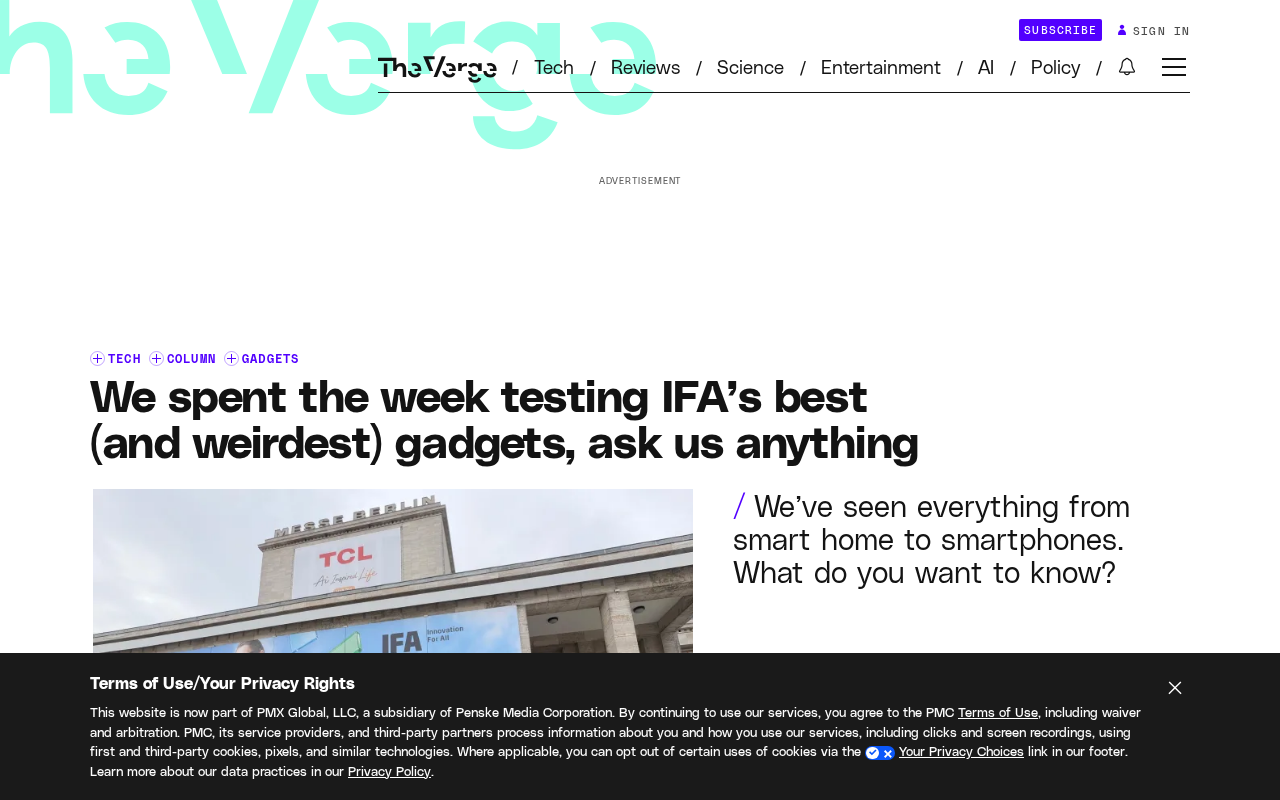
IFA 2025 returns to Berlin in full force, showcasing the best and weirdest in AI-powered consumer electronics.
IFA 2025 marks the full-scale return of Europe's largest consumer electronics trade show. From AI-driven smart home systems and Matter protocol integration to experimental devices, the exhibition highlights both mainstream innovation and bold experimentation. The Verge's on-site team offers hands-on reviews and subscriber-exclusive AMAs, reflecting evolving tech media engagement models.
IFA 2025: Europe's Biggest Tech Event Returns to Berlin
As the largest tech trade show in Europe, IFA (Internationale Funkausstellung Berlin — literally "Berlin International Radio Exhibition") once again took center stage in the German capital this week. With a history dating back to 1924, IFA is one of the oldest tech exhibitions in the world. In its early days, the show centered on broadcast and radio technology — Albert Einstein himself attended in 1930. After World War II, IFA gradually evolved into a comprehensive consumer electronics exhibition, and during the Cold War, it served as a showcase for West Berlin's technological prowess. The venue, Messe Berlin, boasts over 160,000 square meters of indoor exhibition space and attracts more than 1,800 exhibitors and nearly 250,000 visitors each year. Between 2020 and 2022, the event was scaled back or shifted to a hybrid format due to the pandemic, making the 2025 edition's full-scale return a signal that the show has bounced back to its pre-pandemic glory.
The Verge's team was on the ground, spending an entire week experiencing and testing a dazzling array of tech products — from stunning flagship releases to mind-boggling experimental devices.
In response to reader curiosity, The Verge hosted a special AMA (Ask Me Anything) session for subscribers, answering questions at 12 PM Eastern Time. The AMA format originated from Reddit's community culture and has since been widely adopted across content platforms. By integrating it into their paid subscription system, The Verge enabled its editorial team to deliver firsthand observations directly to followers — a reflection of how tech media is increasingly prioritizing deeper audience engagement when covering major trade shows.
IFA's Industry Standing: A Global Trendsetter on Par with CES
Complementing America's CES, IFA has long been one of the core bellwethers of the global consumer electronics industry. CES (Consumer Electronics Show) takes place every January in Las Vegas, organized by the Consumer Technology Association (CTA), with a focus on the North American market and cutting-edge technology concepts — upstream technologies like automotive tech and chip platforms play a significant role. IFA, co-organized by GFU (the German industry association for consumer electronics and home appliances) and Messe Berlin, leans more toward consumer-facing end products, particularly excelling in major home appliances (refrigerators, washing machines, kitchen appliances), where its exhibition scale far surpasses CES. The two events are complementary in timing: CES sets the tech direction for the first half of the year, while IFA focuses on product launches for the second half and the holiday shopping season. Additionally, IFA is open to the public (CES is industry-only), giving it a more direct impact on consumers.
Every September, Berlin draws manufacturers from around the world to unveil their major product lines for the latter half of the year and beyond. For the European market in particular, IFA is a critical stage where local brands compete head-to-head with international giants.
From traditional home appliances and audio-visual equipment to the rapidly rising categories of smart home devices, wearables, and AI-driven consumer electronics, IFA's product categories continue to expand. This expansion is especially pronounced in the AI space — next-generation processors like Qualcomm's Snapdragon X series, MediaTek's Dimensity, and Intel's Core Ultra now integrate dedicated NPUs (Neural Processing Units), enabling devices to run large language models and image generation tasks locally without relying entirely on cloud computing. On the application side, platforms like Samsung's Bixby and LG's ThinQ are evolving from simple voice controls into intelligent systems that understand user habits and proactively optimize device parameters. At IFA 2025, the concept of "AI Agent" became a buzzword, with multiple manufacturers showcasing home AI systems capable of cross-device coordination and autonomous execution of complex task sequences — a fundamental departure from the single-device AI features of the past.
This also means that media teams on the ground must cover an ever-expanding range and depth of products. Simply listing products is no longer nearly enough to satisfy readers' demand for in-depth reviews and trend analysis.
From "Best" to "Weirdest": The Two Faces of IFA
The Verge used "best and weirdest" to sum up this year's IFA product experience — a description that is itself quite telling. Major tech exhibitions tend to present two strikingly different faces:
On one hand, there are the carefully refined, near-production-ready mature products from major manufacturers — representing the industry's highest standards and mainstream direction. On the other hand, there are conceptually avant-garde, boldly designed, and even somewhat "radical" experimental products. While the latter may never make it to market, they often hint at emerging technology trends or reflect manufacturers' bold explorations of niche demands.
It's precisely the coexistence of these two types of products that makes exhibitions like IFA both practically informative and endlessly entertaining.
The Unique Value of On-Site IFA Reviews
In an age of information overload, manufacturers' official launches and press releases tend to present only the most polished side of their products. The significance of media teams going to the show floor for hands-on testing lies precisely in providing an independent, authentic third-party perspective.
Editorial teams can feel the build quality firsthand, experience actual response speeds, observe display quality in person, and even spot shortcomings that official marketing deliberately glosses over. This "seeing is believing" approach to reporting is irreplaceable by any secondhand information. When readers face a flood of new products with no way to judge, firsthand experiences from the IFA floor become an invaluable resource for purchase decisions.
The AMA Model: A New Connection Between Tech Media and Readers
The Verge's decision to share IFA insights through a subscriber-only AMA is worth noting. The Verge, part of the Vox Media group, has in recent years launched "The Verge+" subscription service, offering ad-free browsing, exclusive content, and community interaction. The underlying business logic of tying AMAs to paid subscriptions is clear: when free content is everywhere, "exclusivity" and "interactivity" become the core drivers of users' willingness to pay. Similar transformations have appeared at outlets like The Information and Stratechery, reflecting an industry-wide shift from advertising-driven to subscription-driven models.
Compared to traditional one-way reporting, AMAs allow readers to actively ask questions about what matters most to them — whether it's hands-on details about a specific product or broader industry trend analysis. Notably, the real-time interactive nature of AMAs places higher demands on editorial teams' knowledge base and on-the-spot judgment — readers' questions often involve very specific product details, requiring journalists to conduct sufficiently thorough hands-on testing at the show rather than merely skimming the surface.
This model not only enhances the relevance and interactivity of content but also reinforces the perceived value of paid subscriptions. As media subscription models become increasingly prevalent, exclusive and interactive in-depth content is emerging as the key to attracting and retaining users. For tech media, how to convert on-the-ground show resources into differentiated subscription benefits remains a direction worth continued exploration.
Conclusion: Industry Trends Behind IFA 2025 Coverage
On the surface, IFA 2025's on-site coverage is a series of product tests and reviews. At a deeper level, it reflects multiple currents running through the consumer electronics industry: AI technology is accelerating its penetration into all types of devices, smart home ecosystems continue to converge, and manufacturers' strategies for balancing mature products with innovative concepts are becoming increasingly nuanced.
In terms of smart home integration, the core driving force is the continued adoption of the Matter protocol. Matter was officially released by CSA (the Connectivity Standards Alliance, formerly the Zigbee Alliance) in 2022 and has received joint backing from Apple, Google, Amazon, Samsung, and other major players. Built on IP networks (Wi-Fi, Thread, Ethernet), the protocol aims to solve the long-standing problem of smart home devices being incompatible across different ecosystems. As of 2025, more than 3,000 Matter-certified products are on the market, though Matter 1.0 only covers basic categories like lights, plugs, and door locks — support for more complex devices like cameras and robot vacuums is still being rolled out. At IFA 2025, multiple European appliance brands demonstrated cross-brand interoperability scenarios based on Matter — something that was hard to imagine in previously closed ecosystems, and a sign that consumers will enjoy greater freedom when choosing smart home products in the future.
For everyday consumers, rather than being overwhelmed by a blizzard of new product announcements, it's better to focus on independent on-site reviews and in-depth analysis. They help us see through the fog of marketing rhetoric and identify which products are truly worth looking forward to and which are just fleeting gimmicks. This is perhaps the most enduring value of major tech exhibition coverage.
Related articles

AI Writes Code, Will Programmers Lose Their Jobs? The Truth About Devin's Autonomous Programming
Devin and other autonomous AI coding agents are changing software development: from Copilot-assisted coding to fully automated engineering agents, the programmer's role shifts from writing code to system design and oversight. This article analyzes the impact of AI programming on employment, code security, and junior developer training, as well as the real direction of programmer demand under the efficiency paradox.

Citigroup's 14,000 Engineers Use Devin, Slashing Tech Outsourcing Bill by 30%
Citigroup's 14,000 engineers used AI coding agent Devin to cut its tech vendor bill by 30% and speed releases 30-40%, while JPMorgan says AI gains aren't in earnings yet.

AGENTS.md in Practice: Making Coding Agents Actually Work
AGENTS.md and CLAUDE.md can boost coding agent performance, but research shows misuse raises costs 20%. Here's what to write, what to delete, the 200-line and 32KB limits, monorepo nesting rules, and a security warning.