IFAH: A New Kind of Instrument That Treats Sound as Space

IFAH reimagines sound creation by treating acoustic fields as composable, reproducible spatial environments.
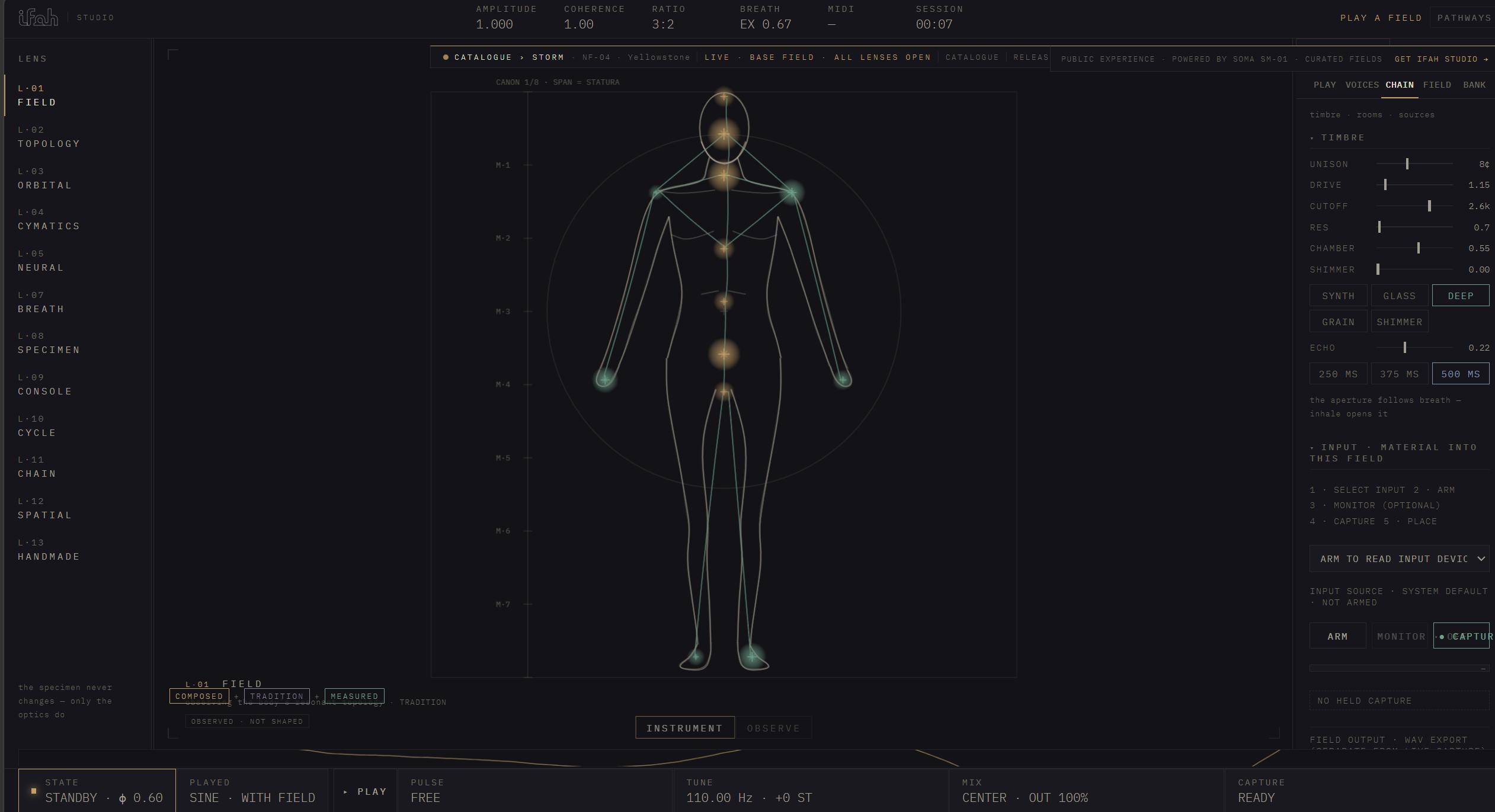
IFAH is a new family of instruments built around the concept of composing and experiencing sound as space rather than time-based signals. Its core innovation centers on reproducible acoustic fields—sealed, self-contained sound environments that can be saved, shared, and precisely replayed. With an offline-first architecture spanning music creation, spatial audio, and sound healing, IFAH proposes a paradigm shift in how we create and interact with immersive audio experiences.
When Sound Becomes a Space You Can Shape
In music technology, we're accustomed to understanding sound as a signal flowing through time—melody, rhythm, timbre. But a new product called IFAH offers a radically different perspective: sound itself can be treated as an environment, a space, to be composed and experienced.
IFAH's tagline is "Instruments for composing and experiencing sound as a space." It's not a single piece of software or hardware, but rather a family of instruments built around the concept of "acoustic fields." Its product categories span music, audio, and health—signaling that it's not solely a tool for musicians.
Core Concept: Reproducible Acoustic Fields
What makes IFAH most distinctive is its treatment of the "acoustic field" as the fundamental unit of creation. Traditional music composition revolves around notes and waveforms, but IFAH proposes that a sound can be created, saved, and reproducibly replayed—for listening, practice, performance, and research.
An acoustic field is a foundational concept in physical acoustics, referring to the distribution of sound waves in three-dimensional space, including the values of sound pressure, intensity, and velocity at each point. In conventional audio engineering, we typically simplify sound into single-channel or multi-channel time-domain signals for processing, while the acoustic field concept preserves the complete information about how sound propagates, reflects, and interferes in space. In recent years, technologies like Ambisonics and Wave Field Synthesis (WFS) have attempted to capture and reproduce complete acoustic fields, but they've primarily been used for playback. IFAH's innovation lies in elevating the acoustic field to a fundamental unit of creation, allowing creators to work directly at the field level rather than merely at the signal level.
The key word here is "reproducible." In scientific research and sound therapy contexts, the ability to precisely recreate the same acoustic environment has real practical value—whether for controlled experiments or for letting users repeatedly enter the same auditory experience. IFAH encapsulates these "fields" as objects that can be saved and played back, essentially providing a "snapshot" capability for sound environments.
IFAH's Three Core Capabilities
According to official descriptions, IFAH integrates three core capabilities:
- Offline-first instruments: Prioritizing offline operation, creation doesn't depend on cloud services or network connectivity—data and experiences are all handled locally.
- Sealed acoustic experiences: An acoustic field is "sealed" into a complete, self-contained experiential unit that can be distributed and repeatedly experienced.
- New sound interaction interfaces: From carefully orchestrated acoustic fields to new interaction methods that let you "play" music directly with your hands.
IFAH's concept of "sealed acoustic experiences" evokes the containerization philosophy in software engineering—packaging runtime environments and applications into independent, self-sufficient units. In the audio domain, existing formats like WAV and MP3 only encapsulate signal data, while IFAH's sealed experiences likely package richer metadata including spatial parameters, interaction logic, and playback conditions. This approach aligns with the recent trend of "experience as product": music is no longer merely content to be passively listened to, but an interactive experience that can be packaged, distributed, and repeatedly entered. From a business perspective, this also opens up a new form of digital asset—acoustic fields that can be created, traded, and collected.
This combination allows IFAH to serve simultaneously as a creative tool, an experience medium, and an acoustic research platform.
A Product Positioned Across Music, Audio, and Health
IFAH is classified under Music, Audio, and Health simultaneously—a cross-domain positioning worth exploring in depth.
Significance for Music Creators
Composing sound as space means shifting from "writing melodies" to "building auditory environments"—a natural extension of the rising trends in immersive and spatial audio.
Spatial Audio has been one of the most important technological trends in the audio industry over the past five years. Apple's launch of head-tracked spatial audio in 2021, the proliferation of Dolby Atmos Music, and technologies like Sony 360 Reality Audio are all pushing music from two-dimensional stereo toward three-dimensional immersive experiences. Meanwhile, demand for spatial audio in VR/AR is growing rapidly—devices like Meta Quest and Apple Vision Pro treat spatial audio as a core experiential element. However, most current spatial audio tools are still based on traditional DAW workflows, requiring creators to arrange the spatial positions of sound sources track by track on a timeline. IFAH's "sound as space" paradigm may represent an approach that transcends existing spatial audio workflows.
For musicians working in ambient music and environmental soundscapes, IFAH offers an entirely new creative approach.
Value for the Audio Technology Field
Reproducible acoustic fields provide a new data structure—sound is no longer a one-time performance but a digital asset that can be encapsulated, transmitted, and reproduced. This carries significant implications for audio research and acoustic experimentation.
Applications in Health and Wellness
Controllable and repeatable sound environments have clear use cases: sound healing, meditation practice, and focus training all require stable, reproducible auditory stimuli. IFAH's emphasis on "practice" and "listening" directly addresses these needs.
Sound Healing is an ancient field currently being re-examined by modern science. From Tibetan singing bowl therapy to Binaural Beats, from noise masking to targeted frequency stimulation, an increasing body of research is attempting to use evidence-based methods to verify sound's effects on human physiology and psychology. However, one of the core challenges facing this field is precisely reproducibility: if acoustic stimulation conditions cannot be precisely controlled and reproduced, experimental results are difficult to verify and scale. Traditional sound healing typically depends on specific spaces and practitioners, with each experience varying. IFAH's design of encapsulating acoustic fields as reproducible objects directly addresses this need—it can provide individual users with consistent experiential outcomes while also offering researchers standardized experimental tools.
Offline-First Design Philosophy
At a time when nearly every product is embracing the cloud, IFAH has explicitly chosen an "offline-first" approach—a product direction worth noting.
Offline-first is a software architecture philosophy whose core principle is that applications should maintain full functionality without network connectivity, with the network serving only as an optional channel for synchronization and extension. This philosophy initially gained popularity in the Progressive Web App (PWA) community before being adopted by an increasing number of productivity tools, such as the note-taking app Obsidian and Figma's offline mode. In the audio domain, offline-first has special significance: real-time audio processing is extremely sensitive to latency, and the uncertainty introduced by network round-trips can disrupt the continuity of audio experiences. Furthermore, as user awareness of data privacy grows and skepticism toward SaaS "rental" models increases, offline-first is becoming a product differentiation strategy, particularly favored in the creative tools space.
Offline-first means stronger privacy protection, lower latency, and greater controllability. For auditory experiences requiring immersion and focus, freedom from network dependency enables a purer, more stable experience. At the same time, it makes the concept of "sealed acoustic experiences" more internally consistent—a preserved acoustic field should be complete and self-contained, unaffected by external conditions.
Product Outlook: An Experimental Direction Worth Watching
As a newly launched product, the publicly available information about IFAH currently remains largely at the conceptual level. Created by its maker Mars, the specific form it will take (app, hardware device, or a combination), and how the hands-on sound interaction actually feels in practice, remain to be validated.
Nevertheless, the "sound as space" creative paradigm that IFAH proposes is thought-provoking enough on its own. As audio experiences increasingly move toward immersion and personalization, reimagining sound from "signals on a timeline" to "environments that can be shaped and preserved" may well be an important direction for the next generation of sound tools.
For music creators, audio researchers, and practitioners in sound healing, IFAH is an experimental product worth keeping a close eye on.
Related articles

AI Writes Code, Will Programmers Lose Their Jobs? The Truth About Devin's Autonomous Programming
Devin and other autonomous AI coding agents are changing software development: from Copilot-assisted coding to fully automated engineering agents, the programmer's role shifts from writing code to system design and oversight. This article analyzes the impact of AI programming on employment, code security, and junior developer training, as well as the real direction of programmer demand under the efficiency paradox.

Citigroup's 14,000 Engineers Use Devin, Slashing Tech Outsourcing Bill by 30%
Citigroup's 14,000 engineers used AI coding agent Devin to cut its tech vendor bill by 30% and speed releases 30-40%, while JPMorgan says AI gains aren't in earnings yet.

AGENTS.md in Practice: Making Coding Agents Actually Work
AGENTS.md and CLAUDE.md can boost coding agent performance, but research shows misuse raises costs 20%. Here's what to write, what to delete, the 200-line and 32KB limits, monorepo nesting rules, and a security warning.