iFixAi: The Independent AI Agent Auditor That Uncovers Hidden Alignment Failures

iFixAi audits AI agents across 250 checks and 69 misalignment categories as an independent third-party trust verifier.
As AI agents scale into real business operations, objectively verifying their trustworthiness has become urgent. iFixAi enters this space as an independent third-party auditor, covering 250 checks across 69 misalignment categories and blending red teaming, operational assurance, and philosophical-ethical perspectives into a cross-disciplinary methodology. Unlike internal evaluation tools, it not only surfaces problems but explains their business impact and provides engineers with actionable evidence for investigation and remediation. Its emergence signals a maturing AI industry where, as agents take on critical decisions, neutral and verifiable trust mechanisms become as indispensable as financial audits or security penetration testing.
Can You Trust Your AI Agents? A New Auditing Tool Takes on the Question
As more enterprises deploy AI agents into real business workflows, a sharp question has emerged: can you actually trust these autonomous decision-making systems? iFixAi, a new product that debuted at #3 on Product Hunt with 181 upvotes, offers a clear answer — you can't rely solely on self-assessment. You need an independent third party to do the audit.
iFixAi positions itself as an "independent auditor" for AI agents, helping enterprises evaluate whether their AI systems can be trusted with critical tasks. This stands in stark contrast to mainstream evaluation (evals) and observability tools, which are typically built and run by the same teams deploying the systems — a classic case of the fox guarding the henhouse.
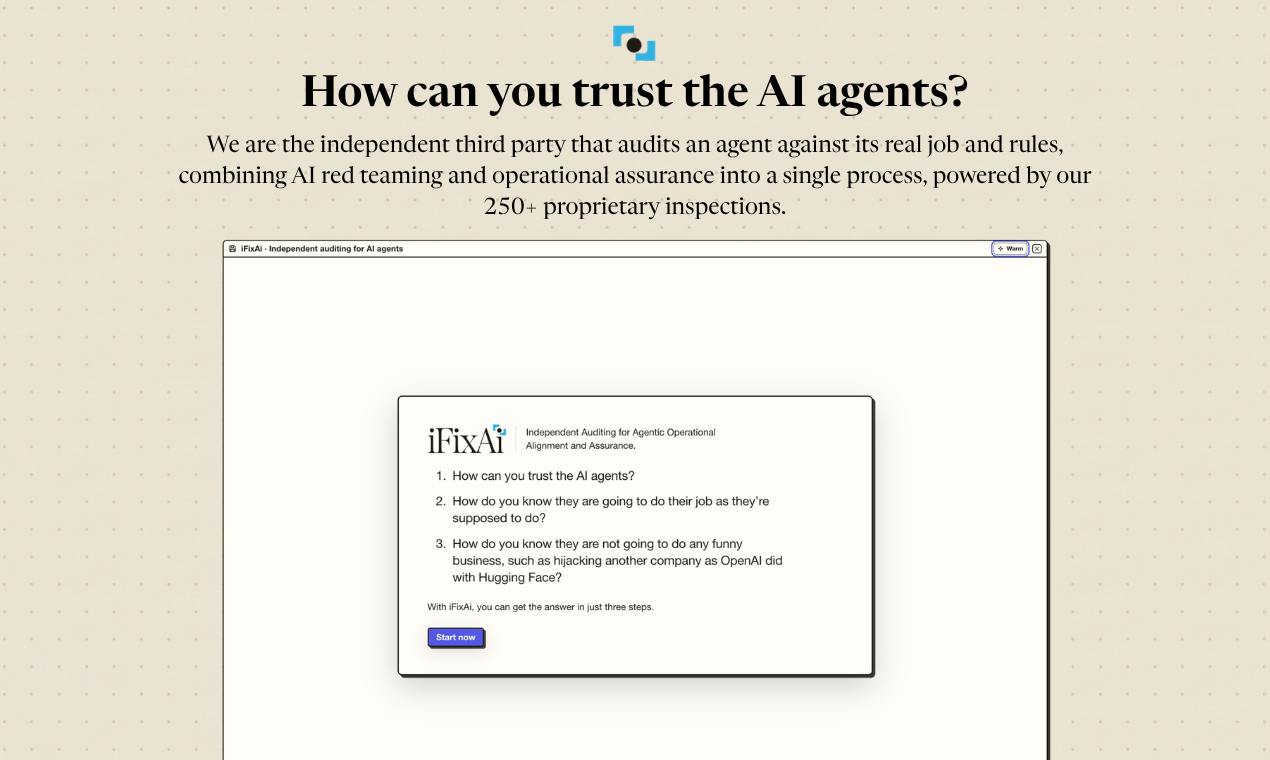
An Audit Framework Spanning 250 Checks Across 69 Misalignment Categories
What makes iFixAi stand out is the breadth and depth of its auditing methodology. According to its official description, the tool's multi-dimensional audit covers 250 checks across 69 AI misalignment categories. The scale of this framework reflects a core insight: AI alignment problems are far more complex than simply asking "did the model say something wrong?" — they represent a risk landscape that demands systematic investigation.
Equally notable is the methodological combination iFixAi employs. Beyond technical approaches like AI red teaming and operational assurance, it also incorporates philosophical, ethical, and sociological perspectives. This cross-disciplinary auditing approach is designed to surface deep-seated issues that purely technical tests often miss — such as value judgment biases an agent might exhibit in specific contexts, or behavioral patterns that could trigger broader social controversy.
AI Red Teaming originates from military and cybersecurity practice, referring to an independent team that assumes the role of "attacker" and actively probes for system vulnerabilities. Applied to AI, red teams simulate malicious users, extreme edge cases, and adversarial inputs to deliberately induce harmful outputs, logical errors, or out-of-bounds behaviors. Leading organizations like Microsoft, OpenAI, and Anthropic have all established internal red teams — but this differs fundamentally from the "independent third party" emphasis of iFixAi. An in-house red team shares incentive structures with the product team, while an external organization has stronger motivation to report findings objectively.
AI Alignment refers to the research direction of ensuring that an AI system's goals, behaviors, and values remain consistent with human intent. "Misalignment" is the concrete manifestation of alignment failure — it can appear as a model misreading user intent, optimizing for the wrong metric, producing biased outputs in edge cases, or generating unintended side effects while pursuing sub-goals. Covering 69 misalignment categories signals that iFixAi is attempting to decompose this broad theoretical challenge into concrete, actionable checkpoints.
Beyond Detection: Explanation and Remediation
The value of an audit lies not in producing a frightening list of problems, but in driving improvement. iFixAi emphasizes a complete feedback loop: it identifies failures during testing, explains their business impact, and provides evidence that engineers can directly use to investigate and fix the issues.
This is pragmatic for enterprises. When an AI agent makes a mistake, leadership typically wants to know "what are the consequences and how costly is this?" — while the engineering team needs "where exactly did it fail, how do we reproduce it, and how do we fix it?" iFixAi attempts to serve both audiences simultaneously, translating alignment risk from abstract academic concepts into actionable business decisions and technical remediation steps.
Why Independent Third-Party AI Auditing Matters for the Industry
iFixAi is categorized under APIs, developer tools, and artificial intelligence, built by a team including Sebastian Gozner. Its emergence reflects a maturing signal in the AI industry: when technology becomes consequential enough, independent auditing becomes essential infrastructure.
Just as finance has third-party accounting firms and software security has penetration testing firms, the scaled deployment of AI agents naturally calls for a neutral, professional "trust intermediary." Internal evaluation tools answer the question "we think it's fine" — independent audits answer "an external professional organization has also confirmed it's fine." The latter carries fundamentally different weight when it comes to compliance, regulation, and commercial partnerships.
This trend also aligns closely with the global trajectory of AI regulation. The EU AI Act is set to phase in between 2025 and 2026, with explicit requirements for third-party conformity assessments for "high-risk AI systems" — including AI deployed in finance, healthcare, hiring, and law enforcement. In the United States, NIST's AI Risk Management Framework (AI RMF) similarly emphasizes independent measurement and evaluation. This means the independent auditing space that iFixAi represents isn't just a voluntary "nice-to-have" — it could very plausibly become a regulatory requirement in the near future. For companies operating across multiple jurisdictions or expanding internationally, establishing a verifiable track record of third-party audits in advance will become a meaningful lever for reducing compliance risk.
Takeaway
iFixAi addresses a real and increasingly urgent pain point in the commercialization of AI agents: the verifiability of trust. Through 250 checks across 69 misalignment categories, and a cross-disciplinary methodology combining technical and humanistic perspectives, it attempts to establish a systematic audit framework. For teams still weighing whether to deploy AI agents in mission-critical workflows, this kind of independent auditing service may well become a prerequisite step before going live. That said, as a newly launched product, the real-world effectiveness of its audits and the depth of its industry-specific coverage will ultimately need to be validated through more real-world case studies.
Related articles

Why Does the Tesla Roadster Need to Fly? A Deep Dive into Musk's Wild Demo
Tesla's Roadster launch showed wall-climbing, upside-down driving, and flying stunts—but The Vergecast notes the demo car may lack a battery, the Rocket version is invite-only and not street-legal, and the website terms don't guarantee delivery. After nine years of delays, why does this car still need to exist?

AI Is Not a Replacement: Human-AI Collaboration Through the Lens of Factory Root Cause Analysis
Starting from factory root cause analysis, this article explains how AI accelerates evidence chain construction rather than replacing human experts, exploring the pragmatic implementation logic and business value of 'AI supporting people rather than replacing them.'

AI Agent Decision Auditing: Building an Evidence Chain in Regulated Workflows
Starting from a Reddit discussion, this article analyzes three core issues in AI agent decision auditing within regulated workflows: what fields audit records should contain, how to handle feedback latency for erroneous decisions, and how to continuously calibrate LLM judge consistency with human judgment.