ilha: Real-Time Monitoring of Claude Code and Codex Usage in the MacBook Notch

ilha puts AI coding tool usage monitoring in the Mac notch, with multi-account switching and cost attribution.
ilha is a native Mac app by Rafael Khalil that keeps usage monitoring for Claude Code, Codex, and Grok Build in a persistent notch capsule, showing 5-hour and weekly window usage, reset times, and predictions of early exhaustion. It supports automatic multi-account switching without logging out and features Insights that price weekly consumption at API rates by project. The article notes it's a dashboard + scheduler, not middleware, but depends on upstream data and has undisclosed credential management details.
Claude Code, Codex, and similar AI coding tools bill by usage — their 5-hour windows and weekly quotas can vanish without warning. Developer Rafael Khalil released ilha on Product Hunt, which moves usage monitoring into the Mac notch — a persistent little capsule that tells you at a glance how much you have left.
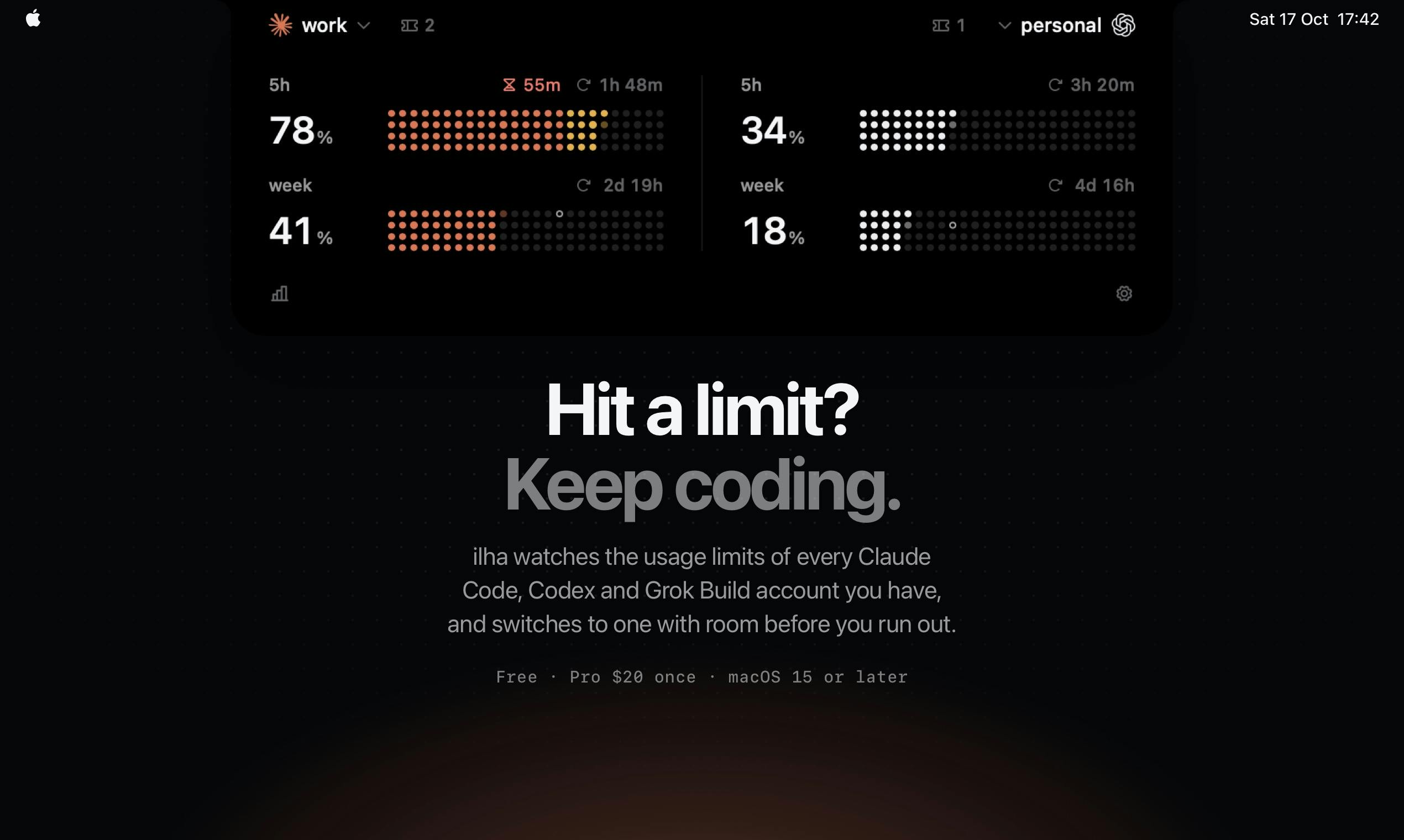
The Pain Point of Usage Monitoring and ilha's Solution
For developers who use Claude Code heavily, the most awkward moment is when a task is halfway done and the quota runs out, causing the request to be rejected. The official dashboard requires manually opening a web page to check, and offers no immediate feedback during coding. ilha's approach is straightforward: keep usage data permanently within your line of sight.
It's a native Mac app whose main interface is a small capsule in the notch; on external monitors without a notch, it appears as a floating capsule. It displays the percentage used of the 5-hour and weekly windows, reset times, and whether you'll run out before reset at your current consumption rate — that last part is pure predictive capability, which has more decision-making value than simply looking at numbers.
Billing models for AI coding tools like Claude Code and Codex typically use a rolling time window: the 5-hour window refers to the cumulative usage limit within any consecutive 5 hours, while the weekly window is a quota based on a calendar week or a rolling 7 days. Unlike traditional API monthly quotas that reset on a fixed schedule, these windows release quota gradually as time slides forward, so "remaining amount" and "reset time" are two independently changing variables. The user's consumption rate in the middle of the window determines whether they'll hit the limit early — this is why ilha emphasizes "predicting whether you'll run out before reset at your current consumption rate": a simple percentage figure can't reflect this risk.
Automatic Multi-Account Switching: The No-Logout Details
ilha supports multi-account scenarios. If you pay for multiple Claude Code or Codex accounts, when the current account approaches its limit, the app automatically switches the command-line tool to an account that still has balance — without needing to log out and back in. For developers maintaining both a personal and a work account, this saves the hassle of manually switching environments.
Note the boundary here: ilha only handles usage display and account switching. It doesn't proxy requests or modify billing logic. Its positioning is "dashboard + scheduler," not a middleware layer.
Multi-account switching for CLI tools typically relies on credentials in local config files or environment variables (such as API keys or OAuth tokens). The traditional approach is to manually modify configs or run a logout/login flow, whereas "no-logout switching" means the app needs to maintain multiple sets of credentials in the background and atomically replace the credential source that the CLI reads when a limit is detected. This requires ilha to be able to read and write these tools' config directories, so where credentials are stored (plaintext config files, the system keychain, or the app's own encrypted storage) directly determines the security boundary. Security-sensitive users should verify whether credentials are copied into ilha's own storage and whether least-privilege access is supported.
Insights: Pricing Weekly Consumption at API Rates
ilha's Insights feature prices each week's consumption at API rates and breaks it down by project. This is especially useful for teams that need to assess the cost attribution of AI coding — you can see which project is eating most of the quota, and thus judge whether a subscription or pay-as-you-go is more cost-effective.
It's worth noting that this kind of cost attribution used to require building your own logging pipeline; ilha turns it into an out-of-the-box view.
Pricing at API rates means multiplying the token consumption in a subscription-based tool by the per-million-token price of the corresponding model on the public API, converting it into an equivalent dollar amount. Since subscriptions are usually a fixed monthly fee with window-limited usage, users find it hard to intuitively sense "how much money I actually used this week." After converting at API rates, if the equivalent amount is significantly higher than the subscription fee, the subscription is a good deal; otherwise, pay-as-you-go is more economical. Breaking down by project relies on identifying the source of CLI calls (such as working directory or session tags) to attribute token consumption to specific projects — a common need when teams do cost allocation.
Key Points to Note
- Native Mac app, persistent in the notch, shown as a floating capsule on non-notch displays
- Covers the 5-hour and weekly windows for three tools: Claude Code, Codex, and Grok Build
- Supports automatic multi-account switching without logging out
- Insights prices weekly consumption at API rates and breaks it down by project
On Product Hunt, ilha received 72 votes and ranked 15th. The discussion heat isn't particularly high, but the target audience is clear: professional developers who use multiple AI coding CLIs and are sensitive to quotas. Whether it's worth installing depends on how often you get interrupted by limits — if you hit the wall once a week, this little capsule in the notch will likely save you a few meltdowns.
Limitations and Reflections
It should be noted that ilha relies on the usage data interfaces exposed by each tool. If upstream changes its billing windows or data definitions, display accuracy will be affected. In addition, automatic multi-account switching involves credential management, and the official description doesn't elaborate on the specific implementation. Security-sensitive users are advised to understand its credential storage mechanism before deciding whether to enable it.
From a product direction perspective, as AI coding tools shift from "unlimited use" to tiered limits, more and more toolchains around quota management will emerge. ilha chose an extremely lightweight entry point — not an IDE plugin, not a web panel, but the most conspicuous position at the operating system level. This "frictionless monitoring" design may fit developers' real workflows better than any dashboard.
One-line Summary
ilha brings AI coding tool usage monitoring into the Mac notch, with multi-account switching and cost attribution.
Paragraph Summary
ilha is a native Mac app released by developer Rafael Khalil that keeps usage monitoring for AI coding tools like Claude Code, Codex, and Grok Build in a persistent little capsule in the Mac notch. It shows the percentage used of the 5-hour and weekly windows, reset times, and predicts whether you'll run out early. It supports automatic multi-account switching — when approaching the limit, it switches the CLI to an account with balance without logging out. The Insights feature prices weekly consumption at API rates and breaks it down by project to help teams assess cost attribution. The article notes that its positioning is "dashboard + scheduler" rather than middleware — it doesn't proxy requests or modify billing logic — but it depends on the stability of upstream usage interfaces, and the credential management details for multi-account switching aren't public, so security-sensitive users should be cautious.
Related articles
AWS AgentCore Gateway: Connecting AI A…
AWS AgentCore Gateway: Connecting AI Agents to Enterprise Backends with MCP
How AWS AgentCore Gateway acts as a primary MCP server to aggregate REST APIs, Lambda, and existing MCP services? Analyzing its AST real-time mapping, zero cold start, semantic search for tool overload, session isolation, and key injection security design, plus the architectural approach to decoupling enterprise AI agents from backends.

One Link Gives Figma AI a New Skill: Hands-On with MCP Connectors
Paste one MCP server link and the AI Agent in Figma gains new tool capabilities. We break down the setup flow, 20+ one-click apps, read/write permissions and execution policies, and the public HTTPS requirement.

Cognition SWE-2 in Practice: One Prompt to Handle the Whole Product Launch Process
Analyzing a YouTube creator's prompt for using Cognition SWE-2 to launch a product: a landing page, seven-email sequence, and non-buyer follow-up tool, plus how the 'test and report' constraint changes AI delivery quality.