Implementing a Python Interpreter in 1024 Bytes: The Ultimate Code Golf Challenge
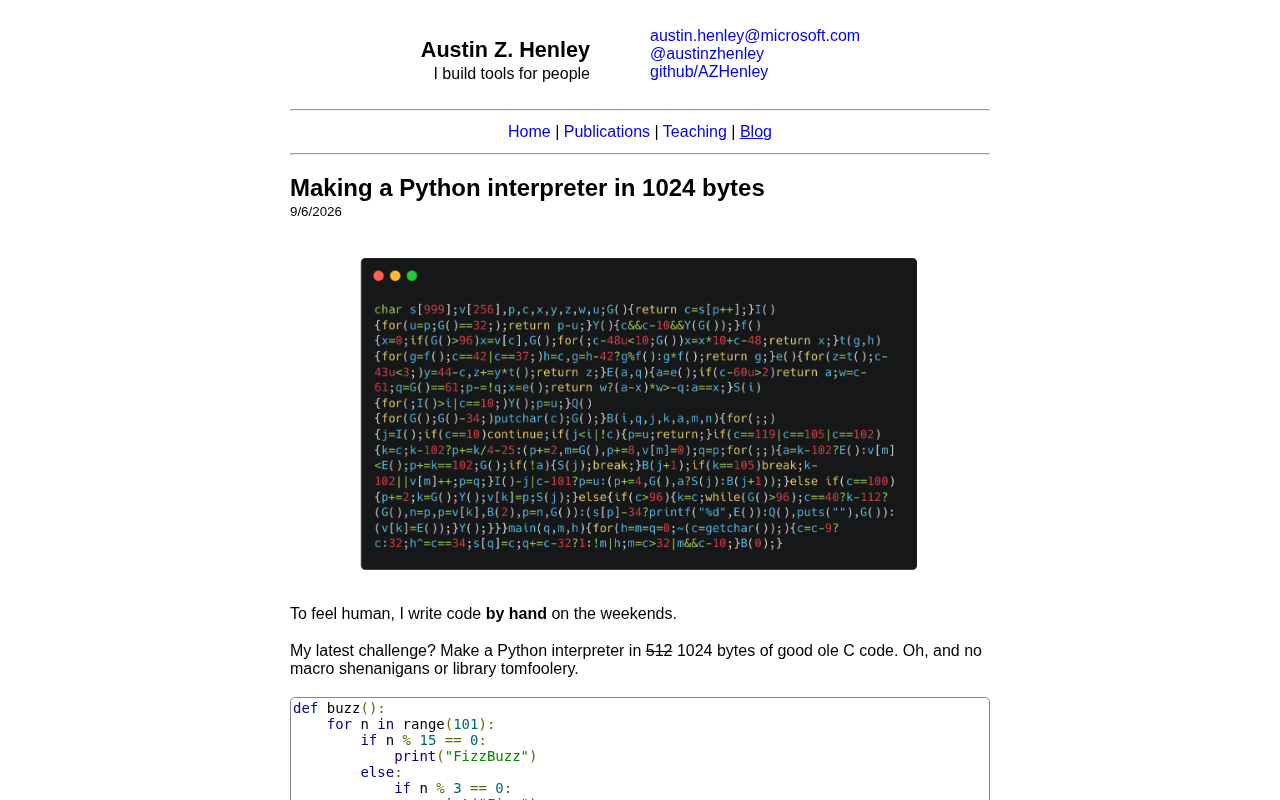
Exploring how developers implement a Python interpreter subset in just 1024 bytes through code golf.
This article examines the extreme challenge of building a Python interpreter in just 1024 bytes, covering the core components of interpreters — lexers, parsers, evaluators, and runtime environments — and the compression techniques used to fit them into minimal space. It explores the history of code golf, the strategic trade-offs in language subsetting, recursive descent parsing, host language selection, and draws connections to demoscene culture and the nature of Turing completeness.
The Ultimate Art of Code Golf
In software development, we typically pursue code readability, maintainability, and robustness. But there's a special domain that takes the opposite approach — it strives to accomplish the most complex functionality with the fewest bytes possible. This is known as "Code Golf."
The Origins and Culture of Code Golf
The name "Code Golf" derives from the sport of golf, where "fewer strokes is better." This competitive programming activity originated in the Perl community during the 1990s, when developers were passionate about solving problems with the shortest possible code. As the internet evolved, dedicated code golf websites like Code Golf Stack Exchange emerged, providing a competitive platform for developers worldwide.
In this community, participants typically score by bytes or characters, with separate categories for different programming languages. Some languages like APL, J, and Golfscript were even designed specifically for code golf, offering extremely concise syntax and powerful symbolic computation capabilities. Although this code has absolutely no readability in practical engineering, it represents an exploration of the limits of language expressiveness and has cultivated a community of enthusiasts with deep understanding of programming language design.
Developer Austin Henley recently published a blog post showcasing an astonishing extreme challenge: implementing a usable subset of a Python interpreter in just 1024 bytes. The article garnered 214 points and 77 comments on Hacker News, clearly demonstrating the tech community's enthusiasm for such extreme programming challenges. It's not merely a technical showpiece — it's a profound exploration of interpreter principles and the nature of computation.
What Is the Extreme Byte Challenge
1024 bytes, or 1KB, is an extremely stringent space constraint. To appreciate just how small this is, consider this: the paragraph you're reading right now probably already exceeds 1KB. Yet within this space, the author had to fit an entire interpreter capable of parsing and executing Python code.
The Historical Significance of 1024 Bytes
1024 bytes (1KB) as a constraint wasn't chosen arbitrarily — it holds special significance in computing history. This number is 2 to the power of 10 and serves as a fundamental unit of computer memory and storage. In the early computing era, particularly with 8-bit home computers of the 1970s-80s (such as the Commodore 64 and Apple II), available memory was often only a few KB to tens of KB, and programmers had to implement complex functionality within extremely limited space.
Famous examples include the Integer BASIC interpreter on the 1977 Apple II, which was only about 5KB in its entirety. The 1KB challenge is essentially a tribute to and recreation of that "golden age of constraints." Furthermore, in modern embedded systems, microcontrollers (some Arduino models have only 2KB of RAM), and the demoscene culture, extreme space programming remains an active technical challenge. These constraints force developers to deeply understand hardware architecture, instruction set efficiency, and algorithmic fundamentals.
Core Components of an Interpreter
A typical programming language interpreter usually contains the following core components:
-
Lexer: Breaks the source code character stream into meaningful tokens. The lexer is the first stage of the compiler frontend — it reads the raw character sequence and identifies basic syntactic units such as keywords, identifiers, operators, and literals. For example, the code
x = 10would be decomposed into the identifierx, the assignment operator=, and the numeric literal10— three tokens. -
Parser: Builds the token stream into an Abstract Syntax Tree (AST).
-
Evaluator: Traverses the syntax tree and performs the corresponding computations. The evaluator is the interpreter's execution engine — it takes the AST as input, recursively visits each node in the tree, and executes the appropriate operations. For expression nodes, it computes their values; for statement nodes, it executes the corresponding side effects (such as variable assignment, function calls, etc.).
-
Runtime Environment: Manages variable scoping, memory, and built-in functions. The runtime environment maintains the contextual information needed for program execution, including variable namespaces (typically implemented as symbol tables or environment chains), the call stack (for function calls and returns), and bindings to the built-in function library.
In a normal engineering implementation, any single one of these modules alone might far exceed 1KB of code. For instance, CPython's (the official Python interpreter) lexer module spans thousands of lines. The author had to implement all of them within this space, meaning every single byte had to be meticulously budgeted.
The Role of the Abstract Syntax Tree (AST)
The Abstract Syntax Tree (AST) is a core data structure in compilers and interpreters — it's a tree-like abstract representation of source code. Unlike a concrete syntax tree, an AST removes syntactic details from the source code (such as parentheses, semicolons, etc.) and retains only the program's logical structure.
For example, the expression 3 + 4 * 5 would be parsed into a tree: the root node is the addition operator, the left child is the number 3, and the right child is the multiplication operator (whose children are 4 and 5). This tree structure naturally reflects operator precedence and associativity. In a standard interpreter implementation, the AST is the product of lexical and syntactic analysis phases, and subsequent semantic analysis, optimization, and execution are all based on this tree.
However, constructing and storing a complete AST requires substantial data structures and memory space. In the 1KB extreme challenge, many implementations adopt a "single-pass" strategy — parsing and executing simultaneously, skipping the step of explicitly building an AST. While this trade-off sacrifices the flexibility of optimization and error checking, it significantly reduces code volume.
Technical Approaches to Extreme Compression
To implement a Python interpreter within such a tiny space, developers must employ a series of ingenious techniques.
Careful Trade-offs in Language Subsetting
The first and most critical step is making trade-offs on target language features. Fully implementing all of Python's features is obviously impossible, so the author must carefully select which language features are most essential and best capture the "Python flavor." This typically means supporting basic variable assignment, arithmetic operations, control flow (such as conditionals and loops), and function definitions, while discarding the standard library, object-oriented features, exception handling, decorators, generators, and other extensive capabilities.
In language design, there's a concept called "Minimal Viable Dialect" — retaining the smallest set of features that can express Turing-complete computation. For instance, lambda calculus proves that only function definition and function application are needed to implement all computable functionality. In practice, to maintain a degree of usability, implementations typically include variables, basic data types (numbers, strings), arithmetic and logical operations, if conditional statements, while or for loops, and function definitions. This combination of features is sufficient for writing most algorithms while keeping code volume manageable.
Extreme Refinement of Recursive Descent Parsing
Within such limited space, authors often employ a highly streamlined recursive descent parsing strategy, or directly merge parsing with evaluation, skipping the explicit construction of a complete AST. This "parse-and-execute" approach sacrifices architectural clarity but dramatically saves code space.
Recursive Descent Parsing Explained
Recursive Descent Parsing is a top-down syntax analysis technique whose core idea is to write a corresponding function for each non-terminal in the grammar. These functions build the syntax tree through mutual recursive calls, hence the name "recursive descent."
The advantage of this approach is that it's intuitive to implement, easy to understand, and can be hand-written without generator tools. For example, when parsing arithmetic expressions, you can define an expression() function to handle addition and subtraction, a term() function to handle multiplication and division, and a factor() function to handle numbers and parentheses. Their recursive calls naturally reflect operator precedence.
In code golf scenarios, recursive descent parsers can be written extremely compactly. By eliminating intermediate variables, merging similar logic, and leveraging advanced language features (such as regular expressions, list comprehensions, etc.), a basic recursive descent parser can be compressed to just a few dozen lines of code. However, this requires deep understanding of grammar design and parsing techniques to avoid common pitfalls like left recursion. In practice, developers may use operator precedence parsing or Pratt parsing — algorithm variants better suited for expression parsing that maintain simplicity while correctly handling operator precedence and associativity.
Leveraging the Host Language's Built-in Capabilities
Another key technique is fully exploiting the existing capabilities of the host language (the language used to write the interpreter). For example, if the host language itself provides powerful expression evaluation, string processing, or hash table capabilities, the interpreter can "borrow" these capabilities rather than implementing them from scratch, saving substantial bytes.
The Impact of Host Language Choice
When implementing a micro interpreter, the choice of host language (meta-language — the language used to write the interpreter) is crucial. Different host languages offer vastly different built-in capabilities, directly affecting implementation complexity.
For example, the advantages of using Python as the host language include: dynamic typing eliminates explicit type declarations, built-in dictionaries can be directly used as variable environments, eval() and exec() can assist with expression evaluation, and rich string processing functions. These features can save substantial amounts of code. By contrast, implementing in C requires manual memory management, hash table implementation, string processing functions, and more — multiplying the code volume.
In the code golf community, common host language choices include: Python (for its conciseness and powerful built-in functionality), JavaScript (convenient for browser-based demonstrations), Ruby (flexible syntax with metaprogramming support), and functional languages like Haskell (pattern matching and higher-order functions can greatly simplify parsing logic). Choosing the right host language and fully leveraging its language features is one of the key strategies for successfully implementing an interpreter under byte constraints.
The Value of These Challenges
Some might question: what practical significance does a feature-incomplete, extremely unreadable interpreter actually have? Its value lies precisely not in practicality, but in education and exploration.
Deep Understanding of Interpreter Principles
When you're forced to implement an interpreter within 1KB, you must have a thorough understanding of every component, knowing clearly what is absolutely essential and what is expendable redundancy. This extreme constraint actually helps developers strip away all complexity and reach the essence of computation. As many Hacker News commenters pointed out, such projects serve as excellent teaching materials for learning compiler theory and language implementation.
From a pedagogical perspective, traditional compiler courses often use large, complete compiler projects as case studies, where beginners can easily get lost in thousands of lines of code. A 1KB micro interpreter provides a learning object that "can be fully grasped" — students can read line by line, understand every design decision, and even attempt their own variant implementations. This "small but complete" quality makes it an ideal teaching tool.
Showcasing Programming Creativity
Code golf is essentially an intellectual game and art form. It demonstrates human creativity and problem-solving ability under extreme constraints. Behind every byte saved, there may be a clever algorithmic trick or a deep insight into language features.
For example, in JavaScript, leveraging side effects of type coercion can merge multiple operations into a single expression; in Python, list comprehensions and dictionary comprehensions can accomplish complex data transformations in a single line; in functional languages, higher-order functions and currying can eliminate large amounts of boilerplate code. While these techniques should be used cautiously in production code, they reveal the deeper mechanisms of language design and inspire thinking about programming paradigms and language expressiveness.
Reflections on the Nature of Computation
These challenges also prompt us to think about Turing completeness — just how much code is needed to build a system capable of universal computation? History is filled with similar explorations, such as minimal Lisp interpreters and micro compilers, all continuously pushing the boundaries of our understanding of "minimal viable systems."
The Minimal Boundary of Turing Completeness
Turing Completeness is a core concept in computation theory, referring to a computing system's ability to simulate a Turing machine — that is, to execute any computable algorithm. To achieve Turing completeness, a system needs a few basic elements: infinite (or sufficiently large) storage space, conditional branching ability, and loop or recursion capability.
Theoretically, Turing-complete systems can be extremely simple. The most famous historical example is the Brainfuck language, which has only 8 instruction symbols (>, <, +, -, ., ,, [, ]), yet is Turing complete. Another example is lambda calculus, which needs only three basic constructs (variables, function abstraction, function application) to express all computable functions. Some have even proven that certain unexpected systems are Turing complete, such as Conway's Game of Life, the Magic: The Gathering card game, and even PowerPoint's animation system.
In practical extreme interpreter implementations, developers need to find a balance between Turing completeness and usability. While theoretically only very few language features are needed for Turing completeness, to make the interpreter "usable" (able to write reasonably readable programs), features like variables, function definitions, and basic data types are usually added — all of which increase code volume. Therefore, the real challenge of a 1KB interpreter lies in achieving Turing completeness while maintaining a degree of practical usability.
Demoscene and Extreme Programming Culture
Demoscene is a computer art subculture originating in the 1980s, centered on creating "demos" — audiovisual demonstration programs that run under extreme constraints (such as 64KB, 4KB, or even 256 bytes). These works often display visual and audio effects far exceeding what their file size would suggest, creating music, 3D graphics, and animations through procedural generation.
In demoscene culture, developers use various extreme optimization techniques: procedural generation instead of stored assets, assembly language programming, exploiting hardware features, mathematical formula compression, and even leveraging file format characteristics. Famous examples include the .kkrieger game (a 3D shooter compressed to 96KB) and various 64K demo productions.
This culture shares similarities with code golf — both pursue creative expression under extreme constraints. The difference is that demoscene focuses more on audiovisual artistic effects, while code golf emphasizes the conciseness of functional implementation. Both have cultivated communities with deep understanding of low-level technology, algorithmic optimization, and creative problem-solving, and there is considerable overlap between these communities.
From Extreme Challenges to Software Engineering
Although everyday software engineering and code golf have opposing goals, some of the thinking embodied in the latter is still worth learning from.
First is the pursuit of essentials. In real projects, we should similarly think about what constitutes core functionality, avoiding unnecessary over-engineering and feature bloat. The YAGNI principle (You Aren't Gonna Need It) in software architecture embodies this thinking — implement only what is currently needed, rather than pre-building abstraction layers that "might be useful someday." The trade-off decisions forced by extreme challenges actually demonstrate this design wisdom in its most extreme form.
Second is mastery of underlying principles. Only by truly understanding how tools work can you perform deep optimization when necessary. When production systems hit performance bottlenecks, developers with deep understanding of compiler optimization, memory models, and algorithmic complexity can more quickly identify problems and propose effective solutions. Code golf practice is one way to cultivate this depth of technical understanding.
Of course, boundaries need to be drawn here. Code produced through extreme compression is virtually unmaintainable, difficult to debug, and entirely unsuitable for production environments. As the software engineering maxim states: "Premature optimization is the root of all evil." In real projects, code clarity and maintainability are far more important than saving bytes. Code review, documentation, testing, version control, and other engineering practices — all abandoned in code golf — are the cornerstones of software quality. Code golf should be viewed as a learning tool and intellectual challenge, not a template for production code.
Conclusion
Implementing a Python interpreter in 1024 bytes is a technical exploration full of wisdom and fun. It makes us re-examine the essence of programming language implementation and showcases the creativity developers can unleash under extreme constraints. For developers seeking to deeply understand interpreter principles, such projects provide an excellent entry point for learning — by studying these extremely streamlined implementations, we can more clearly see the skeletal structure of how a programming language runs.
Whether you're a beginner in compiler theory or a seasoned systems engineer, such extreme challenges are worth exploring. They remind us that programming is not merely a tool for completing tasks, but an art full of creativity and the spirit of exploration. From the memory constraints of early computing, to modern code golf competitions, from demoscene's audiovisual marvels to micro interpreter implementations, these extreme challenges continue to advance our understanding of the nature of computation and inspire new generations of developers to push the boundaries of technology.
Key Takeaways
- Code golf is a competitive programming activity that seeks to implement functionality with the fewest bytes possible, originating in the Perl community in the 1990s
- The 1024-byte (1KB) constraint has historical significance, echoing early computer memory limitations and modern embedded system constraints
- Implementing a micro interpreter requires careful trade-offs in language features, typically retaining core functionality like variables, basic operations, control flow, and function definitions
- Recursive descent parsing is the most commonly used parsing technique, often merged with the evaluation process in extreme scenarios to save code space
- The Abstract Syntax Tree (AST) is a core data structure in interpreters, but is typically skipped in 1KB challenges to reduce code volume
- Host language choice is critical — high-level languages like Python and JavaScript are common choices due to their rich built-in functionality
- Turing completeness can be achieved with very few language features, but a practical interpreter must balance theoretical minimality with actual usability
- The value of extreme challenges lies in their educational significance — they help developers deeply understand compiler theory and the nature of computation
- Demoscene culture shares a similar spirit of extreme optimization with code golf, though the former focuses more on audiovisual artistic expression
- While extremely compressed code is unsuitable for production environments, the "pursuit of essentials" and "understanding of fundamentals" it embodies are worth adopting in engineering practice
Related articles
AI Daily: The Speed War and Cost War Are in Full Swing
OpenAI GPT 5.6 UltraFast mode delivers 14x faster inference, Gemini 3.7 Flash slashes prices while boosting performance, MOE architecture gains traction, HBF storage breakthrough—AI industry competition shifts from model capability to speed and cost efficiency dual-front battle.
AI-Assisted Creative Production: Building an Interactive Odyssey Narrative Scroll with Astra
A developer with weak 3D skills used Astra AI to create an interactive Odyssey narrative scroll. Learn how AI tools lower technical barriers through story comprehension, parallel workflows, and design iteration.

Internet Archive Fundraising Crisis: Server Operations Challenge Behind 800 Billion Archived Web Pages
The Internet Archive faces server operations funding pressure with 800 billion archived pages. Analysis of Wayback Machine cost challenges, nonprofit digital preservation survival crisis, and sustainable development paths.