Implementing Claude Code in Java: A Complete Beginner's Tutorial for AI Agent Development

Java implementation of Claude Code's core features, providing a beginner-friendly AI Agent learning path for Java developers.
This open-source project reproduces Claude Code's core architecture in Java through 12 progressive lessons covering basic conversation, tool calling, task decomposition, and multi-Agent systems — helping Java developers master AI Agent design principles without crossing language barriers. The project includes a companion web learning page, and its core philosophy is that Agent architecture is language-agnostic — understanding principles in a familiar language first makes cross-language transfer far more efficient.
Project Background: The AI Agent Dilemma for Java Developers
For Java programmers looking to learn AI Agent development, there's an awkward reality — nearly all Agent projects and tutorials on the market are written in Python. This means you not only have to understand Agent architecture design, but also learn Python's tech stack, package management, and various unfamiliar frameworks across language boundaries.
The open-source project introduced today was created specifically to solve this pain point. The author implemented Claude Code's core functionality in Java, guiding you through 12 progressive lessons — from basic conversation and tool calling to task decomposition and multi-Agent systems — to fully grasp Claude Code's main design philosophy.
What is an AI Agent? An AI Agent is an intelligent system capable of autonomously perceiving its environment, making decisions, and executing actions. Unlike simple Q&A-style large models, Agents possess a closed-loop capability of "perceive-think-act" — they can call external tools, access databases, execute code, and even collaborate with other Agents. Claude Code is a programming assistant built on the Claude model by Anthropic, and its core architecture embodies the essence of modern Agent design: extending model capabilities through Tool Use, and breaking down complex requirements into executable steps through Task Planning. This architectural pattern is language-agnostic, which is precisely the theoretical foundation that enables this project to fully reproduce it in Java.
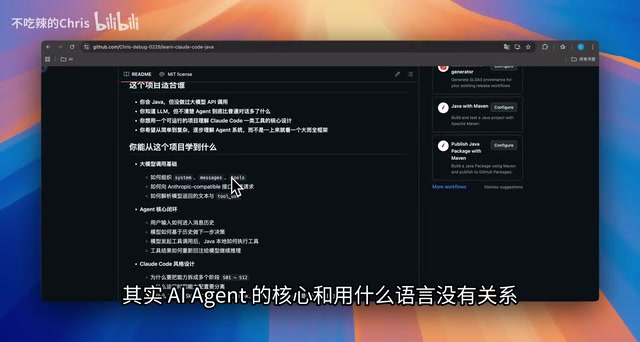
Core Philosophy: AI Agent Architecture Is Language-Agnostic
The greatest value of this project lies in one core insight: AI Agent core design is independent of programming language. Whether using Python or Java, the architectural thinking, tool calling mechanisms, and task orchestration logic are universal.
The author's approach is clear: first understand Agent architecture design using Java — the language you're most familiar with — figure out how Claude Code works, and then look at the Python implementation. At that point, you'll quickly understand what the Python code is doing. This learning path of "understand principles first, then cross languages" is far more efficient than directly struggling through Python source code.
From an engineering perspective, the core logic of an Agent system can be abstracted into several language-agnostic layers: the Model Communication Layer (handling interactions with LLM APIs), the Tool Registration and Execution Layer (managing callable external capabilities), the Context Management Layer (maintaining conversation history and state), and the Task Orchestration Layer (coordinating multi-step or multi-Agent execution flows). The implementation of these four abstraction layers differs between Java and Python, but the design philosophy is identical — this is the foundation for cross-language transfer learning.

Project Structure and Quick Start Guide
Code Organization
The project's code structure is very clear:
- The
src/directory contains Java source code s01is the first and simplest example that can be run directly- Each lesson corresponds to an independent module, building progressively
- The
web/directory contains an accompanying frontend learning page
Environment Configuration
Before running the project, you need to complete a simple configuration:
- Copy the environment variable template file and rename it to
.env - Fill in the LLM API address, model name, and API Key in the file
- Run the corresponding startup class
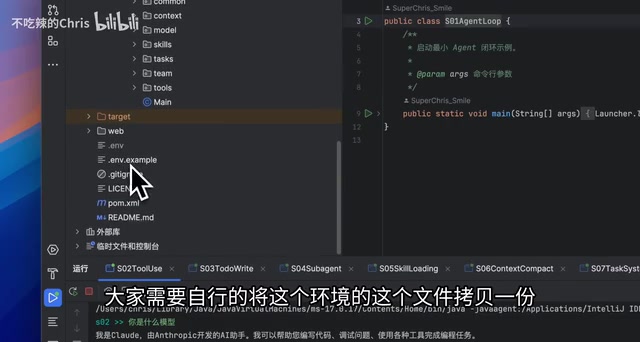
Once configured, running the first example will launch a terminal interactive interface. You can converse with it just like using Claude Code, and it will call the corresponding LLM API to return responses.
Companion Web Learning Page
The project also thoughtfully provides a web frontend page. After starting the project in the web directory, visit localhost port 3000 to access the learning interface:
- The left panel lets you select content from different sections
- The right panel displays corresponding flowcharts and key code explanations
- Supports Chinese/English switching for easier comprehension

The Complete 12-Lesson Learning Path
The project uses a progressive teaching design, gradually advancing from simple to complex:
- Basic Conversation: The simplest LLM API call, implementing basic Q&A interaction
- Tool Calling (Function Calling): Giving the Agent the ability to call external tools
- Task Decomposition: Breaking complex tasks into multiple subtasks for step-by-step execution
- Multi-Agent System: Multiple Agents collaborating to complete complex workflows
Deep Dive into Function Calling: Function Calling (also known as tool calling) is one of the core capabilities of modern large language models, first introduced by OpenAI in 2023, with Anthropic, Google, and other major model providers following suit. Its essence is allowing the model to identify the right moment to call an external function during text generation, output a structured function call request (including function name and parameters), have the host program execute it and return the result to the model, which then continues generating a response based on that result. This mechanism is the technical foundation that enables Agents to "do things" rather than merely "talk." In Java implementations, this typically corresponds to a set of tool registration interfaces and reflection-based invocation mechanisms, which achieve the same goal as Python's decorator-based registration approach through different means.
The Architectural Value of Multi-Agent Systems: Multi-Agent Systems represent an advanced evolution of Agent architecture. A single Agent is limited by context window length and a single role definition, making it inefficient for complex tasks. Multi-Agent systems introduce a division of labor between "Orchestrators" and "Sub-agents," allowing different Agents to focus on specific subtasks while coordinating through message passing or shared state. Claude Code's multi-Agent design allows a primary Agent to distribute coding, testing, documentation, and other subtasks to specialized sub-Agents for parallel processing, significantly improving efficiency for complex engineering tasks. Understanding this pattern is the key step from "being able to use an Agent" to "being able to design Agent systems."
This learning path essentially covers Claude Code's core design philosophy. After mastering these concepts, whether you're reading source code from other Agent frameworks or developing Agent applications from scratch, you'll have a clear architectural understanding.
Who Should Learn from This Java AI Agent Project
This project is particularly suitable for the following groups:
- Developers transitioning from Java to AI: No need to learn Python first — start directly with a familiar language
- People building AI tools/applications: Understanding Agent architecture is fundamental to developing AI applications
- Those who want to understand Claude Code's principles: Gain deep insight into its working mechanisms through code implementation
- AI Agent beginners: This is one of the most beginner-friendly Java learning paths available
It's worth noting that the Java ecosystem has unique advantages in enterprise-level AI application development. Java-native AI frameworks like Spring AI and LangChain4j are maturing rapidly. Java developers who master Agent architecture principles can directly apply these capabilities to existing enterprise system modernization without rewriting the entire tech stack — a migration advantage that Python developers don't have.
Summary: The Best Way for Java Developers to Get Started with AI Agents
Although this project's star count is still in its early stages, its educational value should not be overlooked. It solves a real pain point: enabling Java developers to understand AI Agent core architecture with minimal learning cost.
The recommended learning path is: first follow the 12 lessons to run and understand the Java version, then study the original Python project mentioned in the author's README. At that point, you'll find that Python code isn't so difficult to read either — because you've already understood the underlying design philosophy.
The essence of AI Agent development is architecture design and process orchestration; language is merely an implementation tool. Starting with the language you're most familiar with is the most efficient learning strategy.
Related articles
 Tutorials
ChatGPT Plus Subscription Guide: Are GPT-5.5, image-2, and Codex Worth the Upgrade?
A detailed look at ChatGPT Plus features — GPT-5.5, image-2, and Codex — with a Plus vs Pro comparison and a complete step-by-step subscription guide for users outside the US.
 Tutorials
Harness AI Engineering in Practice: Using Claude Code to Master Enterprise-Level E-Commerce Development
Deep dive into Harness AI Engineering: master enterprise e-commerce development with Claude Code using the Rules, Skills, Wiki, and Changes framework.
 Tutorials
Cursor + Codex Dual-IDE Collaboration: A Practical Methodology for Open-Source Project Customization
A complete methodology for open-source project customization based on real-world experience, detailing the Cursor+Codex dual-IDE workflow, seven-stage process, MVP validation, and AI source code reading techniques.