Implicit Instruction Following in Full-Duplex Voice Assistants: DSB-IFEval Benchmark Analysis
DSB-IFEval benchmark exposes full-duplex voice assistants' struggle with implicit reasoning and safety conflicts.
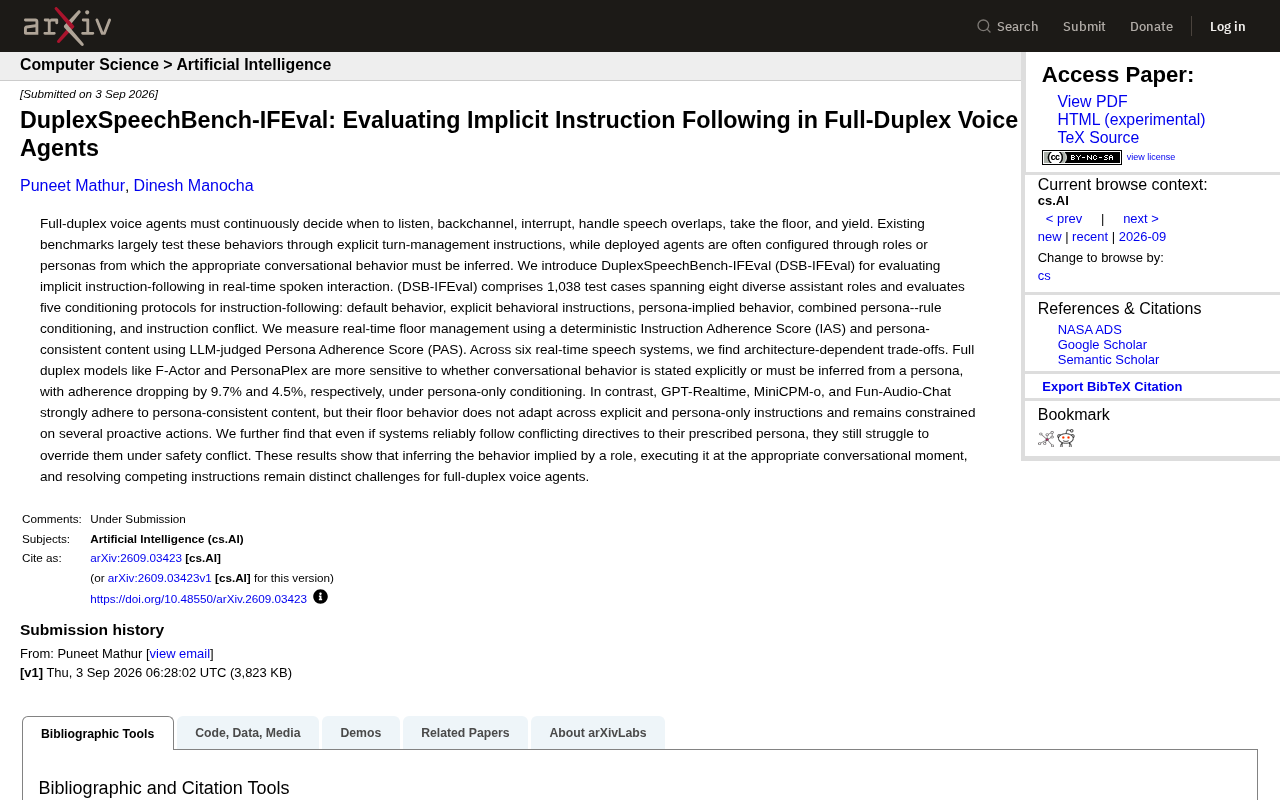
DSB-IFEval is a benchmark designed to evaluate implicit instruction-following capabilities in real-time voice interactions. Testing 1,038 cases across 8 assistant roles and 5 conditioning protocols, it reveals that full-duplex models like F-Actor show 9.7% performance drops when inferring behaviors from persona alone, while content-focused models like GPT-Realtime excel at persona consistency but struggle with turn-taking flexibility. The research identifies three independent challenges: inferring role-implied behaviors, executing actions at appropriate moments, and resolving instruction conflicts—especially safety conflicts where models fail to override personas.
The Implicit Reasoning Challenge in Voice Assistants: From Explicit Instructions to Reading Between the Lines
As voice interaction technology continues to mature, full-duplex voice agents are becoming the core form of next-generation human-computer interaction. Unlike traditional half-duplex "question-and-answer" exchanges, full-duplex voice assistants need to act like real humans—making real-time decisions about when to listen, when to backchannel, when to interrupt, how to handle overlapping speech, when to take the conversational floor, and when to yield it. These nuanced conversational behavior management capabilities are precisely what determine whether a voice assistant's interaction experience feels natural.
However, a long-overlooked issue is now coming to the surface: most existing evaluation benchmarks test these behaviors through explicit turn-management instructions, such as directly telling the model "you can interject when the user pauses." But in actual deployment scenarios, voice assistants are often configured through roles or personas—they need to infer on their own appropriate conversational behavior strategies from settings like "you are a patient customer service representative."
This ability to perform "implicit reasoning" from persona to behavior is what truly tests models in real-world application scenarios.
DSB-IFEval: An Evaluation Benchmark Designed for Implicit Instruction Following
Addressing this evaluation gap, researchers have proposed DuplexSpeechBench-IFEval (DSB-IFEval)—a benchmark specifically designed to assess implicit instruction-following capabilities in real-time voice interactions.
Benchmark Scale and Structural Design
DSB-IFEval contains 1,038 test cases, covering 8 diverse assistant roles, and systematically evaluates five different "conditioning protocols," examining the depth of instruction-following ability layer by layer:
- Default Behavior: Baseline performance when no behavioral instructions are given
- Explicit Behavioral Instructions: Direct, clear guidance on how the model should manage conversations
- Persona-Implied Behavior: Only providing role persona, requiring the model to infer behavioral strategies on its own
- Combined Persona and Rule Conditioning: Simultaneously providing persona descriptions and explicit behavioral rules
- Instruction Conflict: Deliberately setting contradictory instructions to test the model's trade-offs and conflict resolution
These five protocols progress from simple explicit compliance to complex conflict resolution, forming a complete capability evaluation spectrum.
Two-Dimensional Evaluation Metric System
For fine-grained assessment, DSB-IFEval employs two complementary quantitative metrics:
- Instruction Adherence Score (IAS): Uses deterministic methods to measure whether real-time turn-taking management behavior meets expectations
- Persona Adherence Score (PAS): Uses LLM-judged evaluation to assess whether generated content remains consistent with the assigned persona
This approach of separating "behavioral layer" from "content layer" evaluation enables more precise identification of model strengths and weaknesses across different dimensions.
Testing Six Voice Systems: Architecture Determines Capability Trade-offs
The research team conducted comprehensive testing on six mainstream real-time voice systems, arriving at a core insight: significant capability trade-offs exist between different architectures.
Full-Duplex Models: Highly Sensitive to Instruction Presentation
Full-duplex models represented by F-Actor and PersonaPlex show more flexibility in conversational behavior management. However, they are highly sensitive to how instructions are presented—when behavior needs to be inferred from persona (persona-only conditioning) rather than explicitly stated, instruction adherence drops by 9.7% and 4.5% respectively.
This means that while these models possess strong real-time turn management capabilities, once explicit instructions are absent and they need to "read between the lines," performance degrades noticeably. This precisely exposes implicit reasoning as a shortcoming that full-duplex models urgently need to overcome.
Models Strong in Content but Weak in Behavior Management
In contrast, GPT-Realtime, MiniCPM-o, and Fun-Audio-Chat exhibit completely different performance patterns: they excel at persona-consistent content, effectively maintaining role tone and style; but their turn-taking management behavior remains "virtually unchanged"—regardless of whether instructions are explicit or implicit, conversational behavior does not adjust accordingly, showing clear limitations in proactive actions.
Simply put, these models "know how to speak" but "don't know how to interject"—they align with role settings at the content level but lack human-like on-the-spot flexibility at the behavioral level.
Deeper Challenges: Instruction Conflict Resolution and Safety Boundaries
The research also reveals a particularly concerning finding: even when systems can reliably follow instructions that conflict with persona, they still struggle to make correct trade-offs when facing safety conflicts. When persona settings contradict safety norms, models often cannot effectively "override" established personas to maintain safety baselines.
This represents a hazard with significant real-world implications. Imagine a voice assistant set to "always accommodate the user"—when the user makes dangerous or non-compliant requests, can it break free from persona constraints and firmly refuse execution? Test results indicate that current systems remain weak in safety conflict resolution capabilities, posing a non-negligible risk to voice assistant deployment.
Conclusion: Three Independent Capability Challenges for Full-Duplex Voice Assistants
DSB-IFEval research ultimately points to a clear conclusion: for full-duplex voice agents, the following three capabilities constitute independent challenges, and strength in any one does not guarantee performance in the others:
- Inferring Role-Implied Behaviors: Accurately reading appropriate conversational behavior strategies from persona descriptions
- Executing Behaviors at Appropriate Moments: Completing actions like listening, interjecting, or yielding at the correct real-time junctures
- Resolving Competing Instructions: Making correct priority trade-offs when instructions conflict, especially in safety conflicts
This work reminds us that measuring voice assistant "intelligence" cannot rely solely on whether it can converse fluently—we must also assess whether it can, in the absence of explicit instructions, participate in interactions with appropriate judgment like a person who understands boundaries. For teams developing next-generation voice products, DSB-IFEval provides a mirror reflecting models' true capability boundaries.
Related articles

DeepCell: One-Click AI Generation of Documents, Spreadsheets, and Slides
DeepCell tops Product Hunt with one-click generation of documents, spreadsheets, and slides, using the .deepcell format for linked updates, designed for System 2 tasks like modeling and sales reviews.

Doneas: 15-Minute Daily Accountability Calls That Keep Indie Developers From Procrastinating
Doneas is a daily accountability tool for indie developers: plan tasks on Monday, join a 15-minute call with five builders each day, and log deliveries on a public progress page. This article analyzes its core mechanics, effectiveness, and potential issues around retention and matching.

Fastlane 2.0: Fully Automated AI Ad Campaigns, From Creative to Optimization
Fastlane 2.0 is an AI ad automation tool: enter your website and it learns your brand, generates video and image ads, and runs and optimizes them on Meta, TikTok, Instagram, and YouTube.