Importance Gate: How Agent Memory Write Gates Block Noise Accumulation

The same-named "importance gate" tests wildly different logic across products; understanding what each write-path gate tests is the key.
The article argues that agent memory gets overwhelmed by noise not at retrieval but on the write path, which accepts content it should reject. The fix is an "importance gate" that decides at write time whether content gets stored. But identically-named gates test completely different things across products—Mnemoverse measures novelty, Mem0's OpenClaw triage uses four gates, Zep uses declarative types, Cognee uses distillation confidence, Letta leaves it to the agent, and Supermemory relies on user-written criteria. The author notes Mnemoverse's importance field is really a novelty score, and offers a four-step control-group write test, insisting every rejection should carry a reason.
An agent that stores everything it hears will overflow storage within a week. Its memory bank is littered with three copies of "the deployment region is Dublin," two paraphrased versions, a dozen "ok, thanks" messages, and the JSON from every tool call. Ask it where the deployment is, and multiple copies of the same fact occupy the top of the search results. There's no retrieval bug—the problem is at the storage layer, which accepted writes it should have rejected.
The solution is an importance gate: a judgment on the write path that decides whether an incoming write gets stored. Noise is rejected before it enters storage, rather than competing for ranking at read time. But a gate can only intercept the noise its test can see—the same-named "importance gate" may do completely different things in different products.
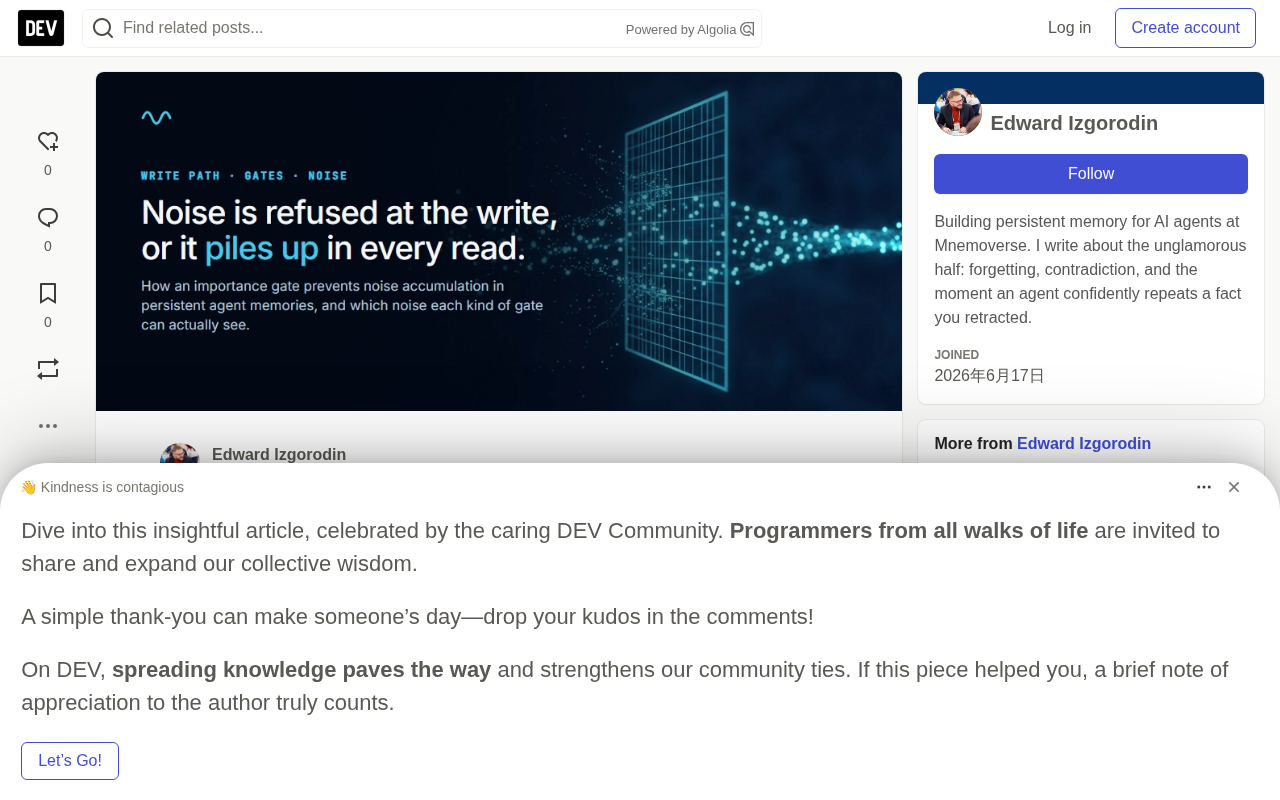
Write gates decide storage, not ranking
A write gate is a decision on the write path about whether a given write gets stored; it does not rank memories at read time. Two key distinctions:
- Rejecting a write is not the same as filtering extracted content. A product can discard an extracted entity while keeping its source text. With Zep's strict ontology enabled, entities that don't match a declared claim type are dropped, but "the raw source material remains searchable and retrievable."
- A name doesn't define the test logic. Mnemoverse defines the
storedfield in its API reference as "whether the atom passed the importance gate," where the gate scores novelty by comparing against the nearest-neighbor memories in the same domain. Mem0's OpenClawAd integration describes a "structured protocol with an importance gate and domain coverage"—in the triage protocol, the agent runs four gate checks on each candidate fact, of which Gate 2 (NOVELTY) checks whether that fact has already been recalled. Same noun, two different tests.
This means that when you see the term "importance gate," you need to ask: what is it actually testing?
Embedding is the process of mapping a piece of text to a high-dimensional vector, where distances between vectors reflect semantic similarity. The "novelty comparison" in a write gate works by computing the vector distance between a new write and already-stored memories to judge whether they are distinguishable: if the distance is close enough, the embedder considers them the same semantic content, and the write is judged a duplicate; if the distance is far enough, it's treated as new information and accepted. This also explains why similarity tests work on paraphrases but can't filter out chit-chat—a fresh "ok, thanks" has no near neighbor anywhere among stored text, so its vector distance is large and it sails through the gate.
Match the test to the noise type
Different kinds of noise need different interception strategies, with different costs:
| Noise type | Matching test | Cost |
|---|---|---|
| Identical text | Content hash or novelty comparison | One lookup or near-neighbor comparison |
| Paraphrase of the same fact | Similarity/novelty comparison against stored memories | Write-time vectorization + near-neighbor search |
| Nameable chit-chat | Written pattern list | Maintaining a list |
| Unnameable chit-chat | A model judging by criteria you write | Inference call cost + occasional misses |
| Anything outside the schema | Declarative types | Maintaining a schema; only captures declared types |
Similarity tests ask the wrong question when facing chit-chat: a fresh "ok, thanks" doesn't restate any stored content, so it passes cleanly. Nameable junk gets blocked by lists, unnameable junk gets blocked by a model, and you pay for every call—including the cost of misjudgments.
Declarative types and ontology (schema / ontology) refer to predefining the categories of entities and their relationships that are allowed to exist in a system, such as "deployment region," "person name," "date," etc. Enabling a strict ontology means only entities matching declared types get extracted and retained; everything else is discarded. This approach has strong interception power, because anything outside the schema cannot get in, but the cost is equally clear: the system can only see the types you declared in advance, and genuine information outside the schema gets rejected along with everything else. It suits scenarios with a fixed, clearly structured domain, not open-domain conversation, because you need to continuously maintain the schema, and undeclared types cause silent information loss.
What six products test on the write path
Each row below is a path explicitly documented by the vendor, not the product's complete paths, and not measured data:
| Product and path | What the test asks | What a rejected write becomes |
|---|---|---|
| Mem0: add path, OpenClaw triage | Is this fact already stored? In the plugin: does it pass the four triage gates? | Recognized duplicates are no longer stored; triage writes nothing; messages matching noise patterns are discarded |
| Cognee: session distillation, folder pre-classification | Not flagged as harmful and confidence passes the distillation gate? Does the writer accept after checking existing lessons? Which scan groups do you approve? | Rejected lessons are discarded; pre-classification only ingests groups you approve |
| Letta: Letta Code reflection process | Is it persistent rather than transient? Is it uncaptured? Is it generalizable? | No change, no commit |
| Supermemory: LLM filter | Does the new content match your organization's written criteria, and is shouldLLMFilter set to true? | Can be filtered out of indexed content |
| Zep: episode ingestion, strict ontology | Is it within size limits? Do extracted entities match declared types? | Oversized episodes are rejected rather than truncated; undeclared entities are dropped but the episode is retained |
| Mnemoverse: write API | How novel is this write relative to same-domain nearest-neighbor memories? | Not stored: stored is false, atom_id is null, with a reason |
Mem0 checks related memories on the add path "to avoid storing the same fact again," its open-source pipeline includes "hash-based deduplication (MD5, preventing exact duplicates)," and the managed platform further recognizes "most exact or near-duplicate restatements." Its custom instructions add the ability for the model to judge by criteria you write. The OpenClaw triage protocol states plainly: "Most turns produce zero memory operations. This is correct and expected."
Cognee states its gate on the improve page: "Instructions are only eligible when not flagged as harmful and when confidence passes the distillation gate." The proposed lessons then go to a writer/rejecter that "checks them against existing lessons and graph entities." Folder pre-classification "reports what is junk, duplicate, versioned, personal, or already in cognee, then ingests the groups you approve."
Letta hands the decision to the agent itself: "Your agent updates memory when it learns something persistent." Its accompanying reflection prompt includes a captured check: "If the memory or skill already sufficiently contains this information, skip."—this is an instruction to the model, not a threshold in code.
Supermemory accepts the filter prompt you write: "Tell Supermemory what content matters during ingestion." Its graph memory page lists noise filtering under automatic forgetting as a tendency: "Casual, meaningless chit-chat is unlikely to become a persistent memory."
Zep demonstrates the difference between filtering extraction and rejecting writes. With strict ontology enabled, entities that don't match declared types are dropped, while the raw source material remains searchable. Its ingestion guide adds an extraction-level similarity test: "Zep primarily deduplicates entities by name when extracting them from episodes," plus a hard rejection on size: "Zep rejects episodes longer than 10,000 characters rather than truncating them."
Mnemoverse describes its gate behavior on its getting-started page: "The write gate compares each write against the nearest-neighbor existing memories in the same domain, rejecting only writes the embedder cannot distinguish from what's already stored. The number in importance is that novelty score; the gate does not judge how important or true a memory is." Rejected writes have no ID: atom_id is defined as "the UUID of the stored atom, or null when filtered."
Worth noting (and this needs emphasis): the field is named importance, but it's actually a novelty score. This gate belongs to the similarity family—it prevents a domain from filling up with copies the embedder can't distinguish, but it does not judge whether a new line is worth keeping. Chit-chat that differs from everything stored must still be intercepted by the agent's choice of what to write, or by a list/model before the write.
Verifying gate behavior with a control group
Beyond theoretical analysis, you can verify whether a gate actually works with a four-step write test. In a fresh domain, write in sequence:
- Original fact: "The deployment region is Dublin."—expected to be stored
- Exact same text: same as above—the documented rejection case, expect
storedfalse, no ID, with a reason - Paraphrased version: "Deployments run in the Dublin region."—record the actual result rather than assuming
- Control group (new fact): "The staging database is backed up nightly."—must return stored; if rejected, the check logic is faulty
Then write a correction using wording similar to the corrected fact: "The deployment region is now Frankfurt."—a similarity test must be able to distinguish a correction from a restatement. On Mnemoverse, corrections can use the supersedes field to indicate what they replace.
Run the same cases against any storage system, and insist that every rejection come with a reason. A silent filter is an undebuggable write path.
The supersedes field and fact corrections are a key mechanism for how memory systems handle information updates. When a fact changes (e.g., the deployment region moves from Dublin to Frankfurt), the system faces two choices: either add a new memory and keep the old one, or mark the new memory as replacing the old one. The supersedes field is the implementation of the latter—it lets a new write explicitly declare which old record it replaces, avoiding old and new versions of the same thing lingering in the store and causing retrieval conflicts. Note that the similarity gate itself cannot distinguish a "correction" from a "restatement," because both are close to the original fact in vector space; you must rely on explicit markers like supersedes to correctly handle update semantics.
Core insight
The value of an importance gate isn't in its name, but in understanding what each gate on the write path actually tests. When you get a write response, the only way to determine the gate type is to ask: what question did it ask? What is the product of a rejection? Did it give a reason?
The real question is: what noise does your storage retain that its gate was never designed to recognize?
One-line Summary
The same-named "importance gate" has wildly different test logic across products; understanding what each gate on the write path actually tests is the key.
Paragraph Summary
The article argues that the root cause of agent memory being overwhelmed by noise isn't retrieval but the write path accepting content it should reject. The solution is an "importance gate"—deciding at write time whether a piece of content gets stored, rather than competing for ranking at read time. But identically-named gates test completely different things across products: Mnemoverse measures novelty, Mem0's OpenClaw triage uses four gates, Zep uses declarative types, Cognee uses distillation confidence, Letta hands it to the agent itself, and Supermemory relies on user-written criteria. Different noise requires different tests, each with its own cost. The author stresses that Mnemoverse's importance field is actually a novelty score rather than a measure of importance, provides a four-step control-group write test, and argues that every rejection should carry a reason—a silent filter cannot be debugged.
Related articles

AIsphere Opens Hong Kong Cyberport Office: PixVerse R2 Debuts, AI Industry Co-Creation Program Launched
AIsphere opens Hong Kong Cyberport office as an AI hub, launches the AI Industry Co-Creation Program, and showcases the real-time world model PixVerse R2 with partnerships in film, tourism, and community services.

Structuring Data for AI Agents: Five Approaches and a Selection Guide
There's no single best way to structure data for AI Agents. This article compares semantic models, knowledge graphs, RAG, Markdown+grep, and open formats, drawing on research from dbt, Microsoft, and Chroma to help you pick the right data architecture based on question type.

Fish Audio Drama 3 Open-Source Launch Sparks Debate: The 35B Speech Model's Selling Points and Licensing Controversy
Fish Audio Drama 3 sparks debate with 35B parameters and open weights, ranking first on pronunciation benchmarks with director-style control and word-level inpainting, but its community license restricts commercial resale, API prices are rising, and local runs need ~39GB VRAM.