Infinite Tool Loops: Why Autonomous Agents Cause Cloud Token Costs to Soar 400%

Agentic runaway drives up to 64% of enterprise cloud token waste; only hard external guardrails like state-machine circuit breakers can curb quadratic cost growth.
The article points out that when enterprises move from chatbots to autonomous agents, cost structures shift from linear to exponential. Agentic runaway accounts for 64% of cloud token waste, and a single stalled agent can burn $8,000 over a weekend. The root cause is delegating loop termination to LLM self-reflection, compounded by context snowballing, hallucinated recovery, and polite reflection, causing token consumption to grow as O(K²) with iteration depth. Logic42's benchmark of four architectures shows a 42% runaway rate for naive self-reflection versus 0% for state-machine circuit breakers. The article proposes three engineering rules: hard state-machine budget clamping, local SLM-based semantic convergence validation (cosine similarity >0.88 triggers the breaker), and a context pruning substrate. The core conclusion: prompt guardrails inevitably fail under complex reasoning, and an external software circuit breaker is the only reliable mechanism for guaranteeing enterprise AI unit economics.
When enterprises migrate from simple conversational chatbots to multi-step autonomous agents, the cost structure undergoes a fundamental shift—from predictable linear pricing to wildly volatile exponential consumption. Asif Muhammad Iqbal, founder of Logic42, points to enterprise audit data showing that Agentic Runaway accounts for as much as 64% of total cloud token spending, with a single stalled agent burning through $8,000 in frontier API credits over an unattended weekend.
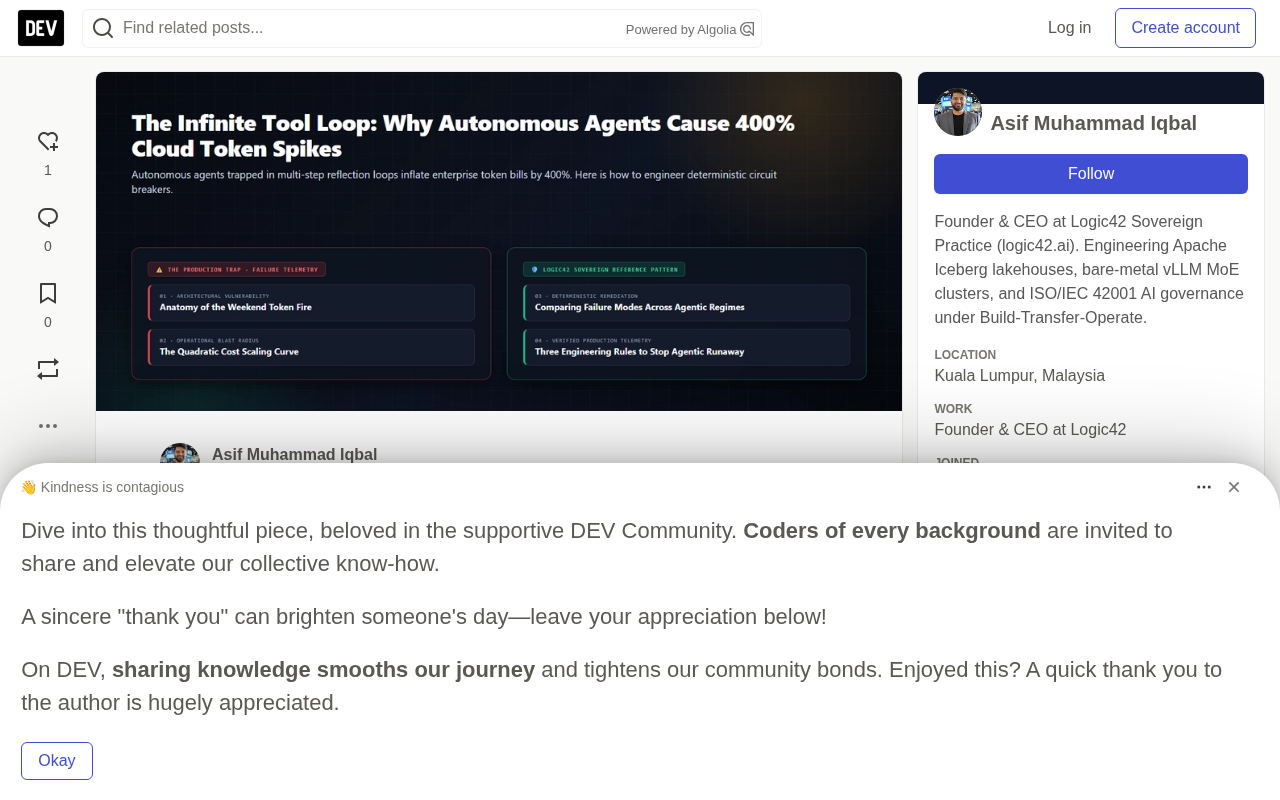
The Anatomy of Agentic Runaway: How a Weekend Token Fire Ignites
Traditional software engineering relies on deterministic while loops and strict iteration counters. By contrast, early agent frameworks—such as naive LangChain graphs or CrewAI swarms—delegate loop termination authority to the model's self-reflection. This design plants the seeds of disaster.
A routine query escalating into a budget catastrophe involves three compounding mechanisms. Context snowball effect: after each failed tool execution, raw HTTP responses, JSON dumps, and stack traces get appended to the conversation context; by step 8, the model is resubmitting 45,000 input tokens per round just to decide the next move. Hallucinated recovery strategies: when the backend database returns ambiguous error codes (like HTTP 429 or SQL State 23505), frontier models hallucinate alternative parameters instead of failing fast, re-querying the same endpoint with tiny string variations, consuming 1,500 output tokens per attempt. The polite reflection trap: if instructions require the model to perform polite self-criticism, it spends 300 tokens reviewing the last failure, generating a verbose internal monologue—all while being billed.
One enterprise architect noted in Logic42's audit report: "Delegating execution termination to an LLM's self-reflection is like running a database query without an index or a timeout."
Agentic Runaway refers to a phenomenon in which autonomous agents, lacking external hard termination mechanisms during task execution, fall into infinite or near-infinite tool-calling loops, causing compute resources and API costs to far exceed expectations. Its essence is misassigning the execution lifecycle—which in distributed systems should be controlled by an external orchestration layer—to the model's own reasoning process. In traditional software, loops are terminated by deterministic counters, timeouts, or circuit breakers; in early agent frameworks, the model decides whether to continue via natural-language reflection, which makes it inclined to keep retrying rather than failing fast when facing ambiguous error codes or partial-success states. Typical hallmarks of agentic runaway include highly repetitive tool-call sequences, continuously expanding context windows, non-linear growth in per-task token consumption, and failures being infinitely amplified during unattended periods (such as weekends). It is not a deficiency in model capability, but a structural risk caused by the absence of a deterministic control plane in system architecture.
The Quadratic Cost Curve: The Leap from Linear to Exponential
In standard chat interactions, token consumption grows linearly with turns (O(N)). But in unconstrained agent tool loops, token consumption grows quadratically with iteration depth K (O(K²)), because historical context accumulates at every intermediate step.
Take a 15-step debugging loop: assuming a 4,000-token prompt and 2,500 tokens of tool output per step, total input tokens come to roughly 360,000. At frontier cloud pricing ($10 per million input tokens, $30 per million output), a single runaway task costs $4.80. Across 2,000 automated background tickets, one unhandled transient failure can trigger a $9,600 weekend bill spike.
Logic42's architecture audit shows that agentic runaway accounts for 64% of enterprise cloud token waste—not an isolated incident, but a systemic engineering design flaw.
Quadratic cost growth (O(K²)) describes the phenomenon in unconstrained agent tool loops where total token consumption grows squarely with iteration depth K. Its mathematical root is that each intermediate step must resubmit the complete historical context of all prior steps to the model, so the input tokens at step i are proportional to i, and cumulative input tokens across K steps are proportional to K(K+1)/2. This stands in stark contrast to the linear growth of standard chat interactions (where each turn only appends the latest message and total consumption is proportional to N). In engineering practice, this means that each doubling of agent loop depth increases cumulative cost by roughly threefold; when K reaches 15 steps, total input tokens can balloon to hundreds of thousands even if individual step outputs are small. The curve is further compounded by output tokens, since the model may generate verbose explanations or alternative parameters at every step. Therefore, the key to controlling agent unit economics is not reducing per-call pricing, but suppressing K to a constant level through hard step caps and context pruning, thereby pulling the cost curve from quadratic back to linear or even sublinear.
Comparing Failure Modes Across Four Agent Architectures
To quantify the resilience of different architectures, the Logic42 team benchmarked four enterprise agent architectures under 100 injected fault conditions (transient network timeouts, schema mismatches, empty search results):
| Agent Architecture | Unconstrained Runaway Rate | Median Token Consumption on Failed Tasks | Mean Time to Failure | Financial Risk Level |
|---|---|---|---|---|
| Naive self-reflection loop | 42.0% | 148,500 | 18.4 minutes | Severe ($12.40/run) |
| Prompt-based guardrail iteration cap | 18.5% | 62,000 | 6.2 minutes | High ($4.80/run) |
| Heuristic regex gateway | 11.0% | 28,400 | 2.1 minutes | Moderate ($1.90/run) |
| State-machine circuit breaker | 0.0% | 4,200 | 0.3 minutes | Negligible ($0.18/run) |
The data confirms that natural-language prompt guardrails (such as "don't try more than 3 times") fail under pressure. When reasoning paths become complex, models prioritize completing the task over obeying negative constraints.
Three Engineering Rules to Stop Agentic Runaway
Eliminating autonomous agents isn't necessary; the key is implementing architectural guardrails at the gateway layer.
Hard State-Machine Budget Clamping
Never let the model control loop termination. Wrap the agent loop in a deterministic state machine managed by an orchestration host (such as Temporal or a custom Go/Rust agent). Define hard caps in code: maximum execution steps K≤5, cumulative session token cap ≤25,000, wall-clock timeout ≤45 seconds. When thresholds are breached, the host terminates execution, fires alerts, and passes a fallback message to a human operator.
Local SLM-Based Semantic Convergence Validation
Before dispatching step i+1, feed the proposed tool parameters into a lightweight local small language model (such as Qwen 2.5 7B or Mistral 7B). If the semantic cosine similarity between the current tool call and the previous two attempts exceeds 0.88, the engine detects looping behavior and immediately triggers the circuit breaker.
similarity = cosine_similarity(embed(current_tool_call), embed(history[-1].tool_call))
if similarity > 0.88:
    raise CircuitBreakerException("Agent trapped in cyclic tool loop; terminating execution.")
Semantic cosine similarity is a metric that measures semantic closeness by mapping text into high-dimensional vectors and computing the cosine of the angle between them; its range is typically -1 to 1, and values closer to 1 indicate greater semantic similarity. In agent loop detection, this technique is used to compare the semantic vectors of current tool-call parameters against historical calls. The specific process is: first use an embedding model (such as a local SLM or dedicated embedding model) to serialize the tool name, parameter key-value pairs, and context into vectors, then compute the cosine similarity between the current call and the most recent or previous two calls. When similarity exceeds a preset threshold (such as 0.88), the system determines that the agent is repeating the same operation with fine-tuned parameters—i.e., trapped in looping behavior. The advantage of this method is that it doesn't rely on exact string matching and can catch retries like "changing id from 101 to 102" that are semantically equivalent but literally different. Threshold selection requires balancing sensitivity against false-positive rates: too low kills legitimate retries, too high misses loops. Combined with a local small model, it also avoids sending sensitive parameters to the cloud, balancing cost and privacy.
Context Pruning Substrate
Stop appending raw JSON payloads to working memory. Implement aggressive pruning filters that extract only validated entity fields before updating conversation context. By combining deterministic token circuit breakers with bitemporal vector lineage, enterprises can stop subsidizing cloud waste for corrupted queries.
The Essential Difference Between Prompt Guardrails and State-Machine Clamping
The difference between these two is not one of degree but of category. Prompt guardrails rely on the model's interpretation of natural-language instructions (such as "only try three times"), which collapse in complex reasoning chains. State-machine clamping is a hard-coded software boundary in the runtime host that physically severs network sockets and API calls when preset token or time thresholds are triggered.
The Logic42 architecture practice team concludes: "You can't solve distributed system failures with prompts." When models encounter ambiguous tool errors, they hallucinate alternative retry parameters rather than failing gracefully. An external software circuit breaker is the only reliable mechanism for guaranteeing enterprise unit economics.
Autonomous AI agents deliver enormous operational efficiency, but unconstrained tool calling turns transient network faults into four-figure cloud bills. This is not a model capability problem—it's a systems engineering failure. Only by enforcing deterministic state-machine limits at the agent layer and implementing semantic convergence detection for repeated tool calls can enterprises protect their capital budgets from runaway token consumption.
State-Machine Circuit Breaker is a hard execution boundary mechanism implemented in an orchestration host (such as Temporal or a custom Go/Rust agent), whose design draws on the circuit breaker pattern from distributed systems. Like traditional software circuit breakers, when it detects preset fault conditions (such as consecutive failures, step overruns, token exhaustion, or wall-clock timeout), it physically severs network sockets and API calls, forcibly terminating the agent loop and triggering fallback logic or human intervention. The fundamental difference from prompt guardrails is that the state-machine circuit breaker does not rely on the model's interpretation of natural-language instructions but is enforced at runtime by external code, making it deterministic and non-bypassable. Its core components include: a state register (tracking steps, cumulative tokens, elapsed time), a threshold comparator, and a termination executor. In agent architectures, the circuit breaker is typically placed at the gateway or orchestration layer, independent of the model's reasoning process, ensuring that even if the model hallucinates or ignores negative constraints, the system can still stop safely within budget boundaries. This mechanism transforms agent reliability from a model capability problem into a verifiable software engineering problem.
One-line Summary
Agentic runaway causes up to 64% of enterprise cloud token waste, and only external hard guardrails like state-machine circuit breakers can curb quadratic cost growth.
Paragraph Summary
The article points out that when enterprises move from chatbots to autonomous agents, cost structures shift from linear to exponential, with agentic runaway accounting for 64% of cloud token waste and a single stalled agent burning $8,000 over a weekend. The root cause is delegating loop termination to LLM self-reflection, compounded by context snowballing, hallucinated recovery, and polite reflection, causing token consumption to grow as O(K²) with iteration depth. Logic42's benchmark of four architectures shows a 42% runaway rate for naive self-reflection versus 0% for state-machine circuit breakers. The article proposes three engineering rules: hard state-machine budget clamping, local SLM-based semantic convergence validation (cosine similarity >0.88 triggers the breaker), and a context pruning substrate. The core conclusion: prompt guardrails inevitably fail under complex reasoning, and an external software circuit breaker is the only reliable mechanism for guaranteeing enterprise AI unit economics.
Related articles

AI New Grad Resume Diagnosis: How to Stand Out for ML/CV Roles?
How can AI/ML new grads optimize their resumes to get interviews? Based on a real Reddit case, this article analyzes project selection, depth display, and structure for ML/CV roles, with actionable revision advice.

OpenAI Opens Up Decision Models as Competition with Jev Heats Up
OpenAI makes its decision model widely available, directly challenging first mover Jev. We analyze the impact on the decision model competitive landscape and key considerations for developers and enterprises.

Startup Growth Secrets: Early Sales Are Not the Key
At Disrupt, experts from Lovable, Polska, and Theory Ventures said early startup growth depends not on early sales but on a repeatable sales process, a clear ICP, team development, and data-driven iteration.