Instruction-Tuned Models Are a New Genre: The Genre Logic of AI Dialogue
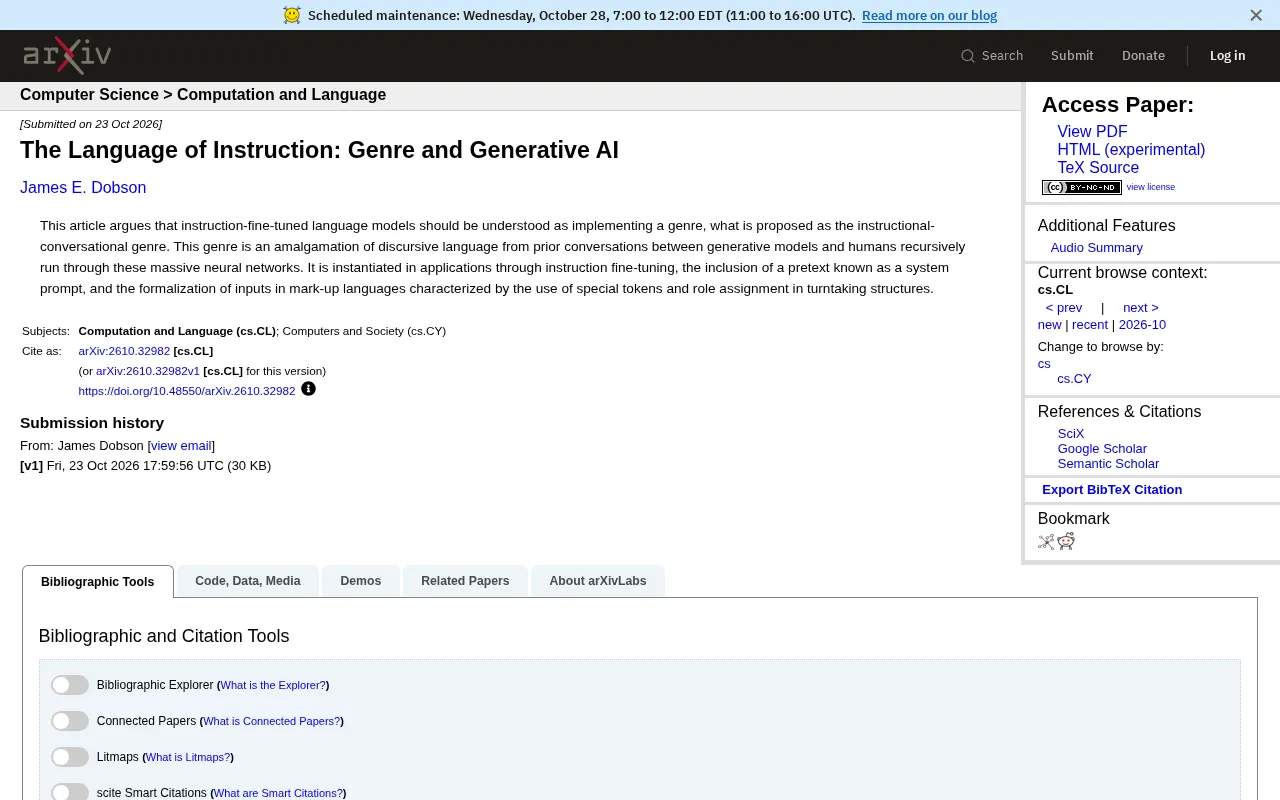
Instruction-tuned models realize a recursively evolving "instruction-dialogue genre," not merely a tool.
From an academic blog perspective, the article argues that instruction-tuned language models are essentially realizing a specific "instruction-dialogue genre," shaped by instruction tuning, system prompts, and structured input with special tokens and role assignments. This genre is a recursive hybridization of historical human-model dialogue discourse that evolves with use. Compared with the "tool" perspective, the "genre" perspective better explains why well-designed system prompts significantly change output style, and it reveals users' unconscious genre adaptation. The article thus repositions prompt engineering as "writing within an existing literary form" and warns of genre inertia's generalization limits.
Introduction: When AI Dialogue Becomes a "Genre"
We're used to thinking of interactions with large models as "question-answer," but an article from an academic blog offers a sharper perspective: language models that have undergone instruction tuning are essentially realizing a specific genre — the "instruction-dialogue genre." This isn't a rhetorical analogy; it's a structural description of how model behavior works. The author argues that this genre is shaped by three key elements: instruction tuning, the system prompt, and a structured input format with special tokens and role assignments.
Understanding this helps us move beyond the debate over whether models "understand" and focus on a more practical question: what exactly are we doing when we talk to a model, and how does that way of talking in turn shape the model's output?
The Components of the Instruction-Dialogue Genre
A Recursively Hybridized Corpus Foundation
The article points out that this genre isn't designed from scratch — it's a recursive hybridization of prior dialogue discourse between humans and generative models. Every human-machine conversation produces new text, which may then be incorporated into subsequent training data, processed repeatedly through large-scale neural networks, and eventually sedimented into a stable pattern of expression. In other words, what the model learns isn't just language ability but a conversational convention of "how to be instructed."
Instruction Tuning and the System Prompt
Instruction tuning is the key step that shifts a model from "continuing text" to "following instructions." The system prompt, meanwhile, plays the role of a pretext — it sets the role, boundaries, and tone before the formal conversation begins. The article emphasizes that the system prompt is not optional decoration but one of the formal conditions that make this genre possible.
Instruction tuning refers to supervised fine-tuning of a pretrained language model on large numbers of "instruction-answer" pairs, teaching the model to treat input as a task to be executed rather than text to be continued. It is often used together with reinforcement learning from human feedback (RLHF): the former teaches the model to "do as told," while the latter adjusts the quality and safety of responses based on human preferences. It is instruction tuning that transforms the model from a passive text generator into a dialogue agent capable of responding to system prompts and role settings, making it the technical precondition for the "instruction-dialogue genre" to exist.
Markup Language and Role Turns
At the formal level, input is organized into turn structures with special tokens and role assignments (such as system, user, assistant). This markup language may look like an engineering implementation detail, but in fact it defines the "grammar" of the conversation — who is speaking, how far they've gotten, and who speaks next are all encoded into the input format.
Special tokens are symbols reserved in the vocabulary specifically for structural control, such as <|im_start|>, <|im_end|> or [INST], [/INST] in dialogue templates. They don't belong to natural language, yet they delimit role boundaries and turn start/end points in the input sequence, enabling the model to distinguish the three speaking positions of system, user, and assistant. Different model families use different token schemes, which is one reason the same prompt performs differently across models. From a genre perspective, these tokens are equivalent to punctuation and paragraph breaks in written text — an explicit encoding of conversational "grammar."
Why the "Genre" Perspective Explains More Than the "Tool" Perspective
Viewing the model as a tool makes it easy to overlook one fact: how a tool is used in turn constrains the user's expression. When we type a message, we're already unconsciously adapting to the genre — adding "please," "as an expert," "answer step by step," and other modifiers is in effect imitating dialogue patterns that have appeared in training data.
The article's core insight is that this genre is recursive: new discourse produced by human-machine dialogue becomes material for the next round of model training. This means the "instruction-dialogue genre" is not a static template but a dynamic form that evolves with use. For AI application developers, this explains a common phenomenon: why a carefully designed system prompt can significantly change output style — because you're activating a genre convention that has already been encoded in a large corpus.
Implications for AI Products and Prompt Engineering
From a genre perspective, prompt engineering is no longer just "making the question clear" but writing within an existing literary form. The system prompt is like a genre specification, role tokens are like narrative perspective, and special tokens are like paragraph separators. Understanding this can help product teams design dialogue flows more systematically rather than relying on a patchwork of scattered tricks.
At the same time, the article reminds us to beware of genre inertia: when a model is trained to be highly adapted to one form of dialogue, it may perform poorly in others. This places higher demands on the diversity of instruction-tuning data.
Prompt engineering is often understood in practice as a collection of phrasing tricks, but a more accurate framing is this: within the dialogue genre the model has already learned, anchor the output distribution through role setting, format constraints, and examples (few-shot). The system prompt is like a genre specification, few-shot examples are like model texts, and techniques such as chain-of-thought are like rhetorical strategies that guide the unfolding of narrative. This understanding explains why structured prompts that conform to the training distribution often outperform a patchwork of scattered tricks, and it suggests that product teams should treat prompt design as a kind of genre design rather than parameter tuning.
Conclusion
The notion of the "instruction-dialogue genre" connects technical implementation with discursive practice. It doesn't claim that the model "understands" anything; rather, it points out that the model is reproducing a structured form of discourse. For those concerned with AI applications and prompt design, this is a perspective worth incorporating into their thinking framework.
One-line Summary
Instruction-tuned models realize a recursively evolving "instruction-dialogue genre" rather than being mere tools.
Paragraph Summary
From an academic blog perspective, the article argues that instruction-tuned language models are essentially realizing a specific "instruction-dialogue genre," shaped jointly by instruction tuning, the system prompt, and a structured input with special tokens and role assignments. This genre is not designed from scratch but is a recursive hybridization of historical dialogue discourse between humans and generative models, evolving continuously with use. Compared with the "tool" perspective, the "genre" perspective better explains why a carefully designed system prompt can significantly change output style, and it reveals the phenomenon of users unconsciously adapting to the genre. On this basis, the article repositions prompt engineering as "writing within an existing literary form" and warns of the generalization limitations brought by genre inertia.
Related articles

Hermes Agent Beginner's Guide: A Self-Evolving AI Assistant
Hermes Agent beginner's tutorial: how to install and use the 41.7K-star self-evolving AI Agent. We break down its learning loop, three-tier memory, and Skill self-improvement, compare it with Claude Code and OpenClaw, and include WSL installation steps.

RAG Interview Essentials: Breaking Down the Full Offline Indexing and Online Retrieval Pipeline
A complete breakdown of the RAG retrieval-augmented generation workflow: offline document loading, chunking, vectorization, and indexing; online query rewriting, vector retrieval, reranking, and generation, plus core interview points and system optimization directions.

AI Large Models for Absolute Beginners: Principles and API Calling in Practice
From AI's evolution to large model training principles and core concepts like Token, Temperature, and Top-P, this article explains system prompts, Function Call, RAG, and memory with hands-on examples and four API call scenarios—ideal for beginners.