Internal AI Still Using Outdated Info? Practical Methods to Test Data Freshness

Reddit discussion summarizes four methods and two major challenges for testing whether internal AI has stopped using outdated information.
This article addresses the problem of internal AI assistants still citing old documents after knowledge updates. Based on Reddit community discussions, it outlines four practical methods: building policy update test cases, document version tagging and conflict resolution, manual spot-checking with user feedback loop, and automated regression testing and monitoring. It also identifies two unresolved challenges: determining priority among contradictory documents and test coverage and maintenance costs. The conclusion is that there is currently no unified solution, and it is recommended to combine multiple methods according to team maturity. Early-stage projects can start with manual verification of high-frequency questions and gradually automate.
When an internal AI assistant answers questions based on company documents, if policies are updated but old documents remain in the knowledge base, it may continue to give outdated answers. How do you test whether the AI has truly stopped using old information? A question raised by a developer on Reddit sparked discussion. This article combines community feedback to outline four practical methods and two core challenges.
The Problem: Why Does AI Still Cite Old Documents After Knowledge Updates?
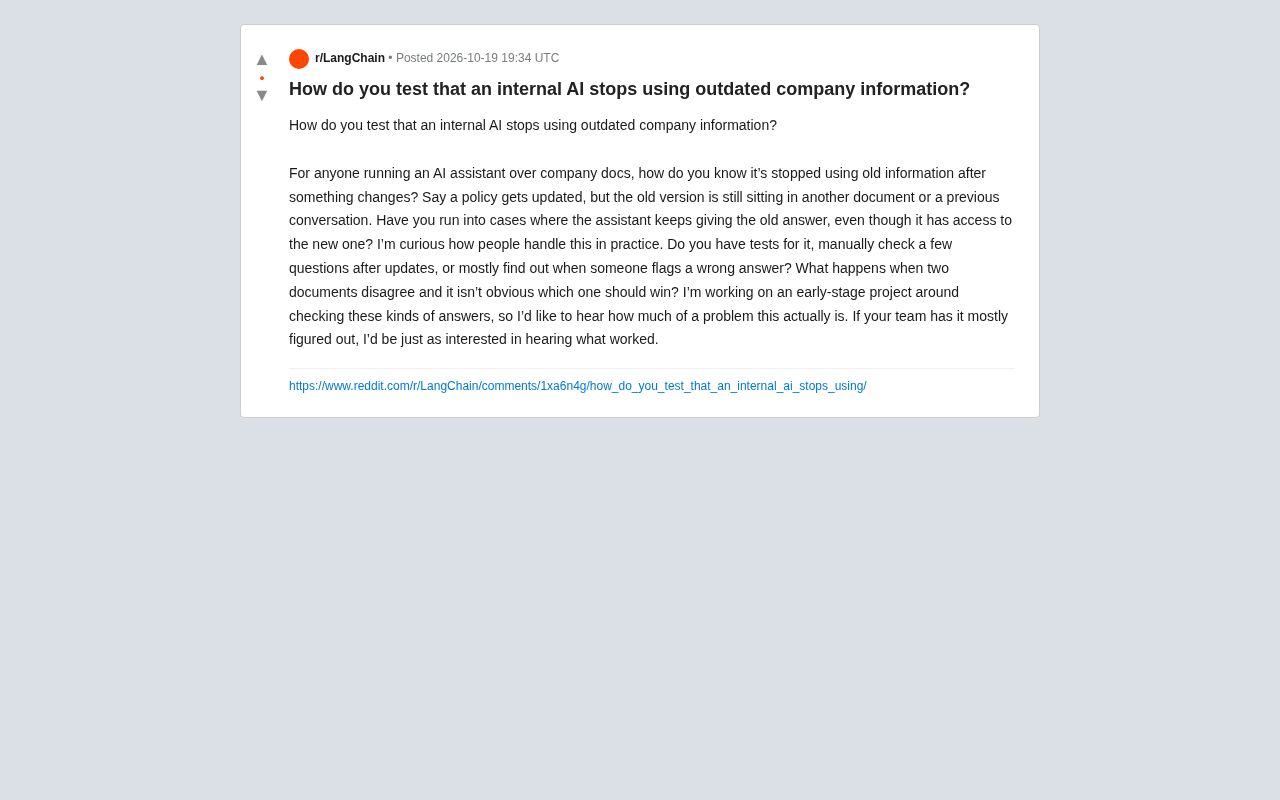
According to the original Reddit post, when company policies are updated, the old version may still exist in other documents or historical conversations. Even if the AI assistant can access new information, it may prioritize returning old answers. The poster asked how teams handle this: do they build automated tests, manually spot-check a few questions after updates, or only discover the issue when someone reports a wrong answer?
This touches on a common pain point in RAG (Retrieval-Augmented Generation) systems: the retriever may recall both old and new documents simultaneously, while the generator lacks version-awareness, leading to contradictory or outdated answers.
RAG (Retrieval-Augmented Generation) is a technical architecture that combines information retrieval with large language model generation. Its workflow typically has two steps: first, the system converts the user's question into a vector and retrieves the most relevant document fragments from a vector database; then, these fragments are fed as context to the large language model, which generates the final answer. The core advantage of RAG is that it can leverage external knowledge without fine-tuning the model and improves answer traceability. However, this also introduces the fragility of "retrieval determines generation": if the retriever recalls outdated or contradictory documents, the model often lacks the ability to judge document timeliness, thereby outputting outdated information. Therefore, knowledge updates in RAG systems require not only replacing documents but also ensuring that the retrieval step correctly filters out old versions.
Method 1: Build "Policy Update" Test Cases
Community members suggest establishing test sets for key policies (such as leave policies, reimbursement processes). After each policy change, not only update the knowledge base but also run preset questions to verify whether the AI gives the new answer. For example:
- Question: "How many days of annual leave are there?"
- Old answer: "15 days"
- New answer: "20 days"
During testing, ensure that old documents are marked as outdated or removed from the retrieval library; otherwise, the AI may still cite them. Some teams use "canary testing": first enable the new knowledge base for a small group of users and monitor answer accuracy.
Method 2: Document Version Tagging and Conflict Resolution Strategies
When two documents contradict each other, how does the AI choose? Some developers propose adding metadata to documents (such as effective date, version number, status) and prioritizing the latest valid version during retrieval. For example, when storing documents in a vector database, attach effective_date and deprecated fields, and filter by time sorting after retrieval.
But not all teams have implemented this. One commenter admitted: "We mainly rely on manual discovery of errors; we don't have systematic testing." This reflects the common state of early-stage projects.
Vector databases are database systems specifically designed for storing and retrieving high-dimensional vectors, commonly used in RAG to store document embeddings. Unlike traditional databases, they use approximate nearest neighbor (ANN) algorithms to quickly find document fragments most similar to the query vector. In the RAG pipeline, documents are split and converted into vectors before being stored in the vector database; during retrieval, the top-k results are returned based on similarity scores. To support version management, vector databases typically allow attaching metadata to each vector, such as effective date, version number, status, etc. During retrieval, metadata filtering can be used to exclude deprecated documents or sort by time to prioritize the latest version. Common vector databases include Pinecone, Weaviate, Milvus, etc., and some open-source solutions also support metadata filtering.
Method 3: Manual Spot-Checking and User Feedback Loop
For teams with limited resources, manually testing a few high-frequency questions after updates is the most direct approach. Some teams have a product manager or domain expert randomly select 10-20 questions after each knowledge base update and compare the AI's answers with the official position.
User feedback is also an important signal. When an employee reports "the AI got it wrong," the team traces the retrieved documents to determine whether it's an uncleaned old document or a retrieval ranking issue. Although this passive approach lags, it can expose blind spots not covered by test cases.
Method 4: Automated Regression Testing and Monitoring
More mature teams build automated pipelines: each document update triggers a test suite that uses preset question-answer pairs to verify accuracy. They monitor confidence scores of online answers and route low-confidence cases to human review.
However, the Reddit discussion did not mention specific tools or open-source solutions; it was more about sharing ideas. The poster said they are developing an early-stage project and wanted to understand how common the problem is, but the number of replies was limited, and the sample is insufficient for statistical conclusions.
Regression testing in software engineering refers to re-running existing test cases after code changes to ensure that existing functionality has not been broken. In RAG systems, regression testing is extended to mean: after each knowledge base update, automatically run a preset test set of question-answer pairs to verify whether the system's answers still meet expectations (especially whether new policies take effect). This requires a testing framework to manage test cases, execute queries, compare expected answers with actual answers, and report pass rates. Confidence scores are the model's quantitative assessment of the reliability of its own answers, typically generated by the model or computed by an additional model. Low confidence scores can trigger human review or fallback responses to avoid error propagation. Combining regression testing with confidence monitoring can form an "update-test-monitor" loop, but implementation costs are high and require continuous maintenance of test sets and thresholds.
Two Unresolved Challenges
Challenge 1: Determining priority among contradictory documents. When old and new documents coexist without version tags, it is difficult for the AI to determine which is correct. Manual rules are needed (e.g., by modification time, author permissions), but the rules themselves may be ambiguous.
Challenge 2: Test coverage and maintenance costs. When policies change frequently, test cases need to be updated synchronously; otherwise, the tests themselves become outdated. Small teams often find it difficult to sustain investment.
Conclusion: No Silver Bullet, But They Can Be Combined
Based on the Reddit discussion, there is currently no unified solution. Practical approaches include: establishing regression tests for key policies, adding version metadata to documents, and combining manual spot-checking with user feedback. For early-stage projects, it is recommended to focus on high-frequency questions first, manually verify update effects, and then gradually automate.
The poster did not disclose project details, and community feedback was scattered, so the views in this article mainly come from individual developers' experience sharing and are for reference only.
Background Supplement
Metadata is data that describes data. In document management, it refers to structured information attached to documents, such as author, creation time, modification time, effective date, version number, status (valid/deprecated), etc. In RAG systems, metadata can be used for filtering and sorting during retrieval to help resolve conflicts between old and new documents. For example, each document can be tagged with effective_date and status, and during retrieval, documents with "valid" status and the latest effective date are prioritized. However, the accuracy and completeness of metadata depend on manual maintenance; if tags are missing or incorrect, priority determination will still fail. Therefore, establishing metadata standards and regular audits is a prerequisite for its effectiveness.
One-line Summary
Reddit discussion summarizes four methods and two major challenges for testing whether internal AI has stopped using outdated information.
Paragraph Summary
This article addresses the problem of internal AI assistants still citing old documents after knowledge updates. Based on Reddit community discussions, it outlines four practical methods: building policy update test cases, document version tagging and conflict resolution, manual spot-checking with user feedback loop, and automated regression testing and monitoring. It also identifies two unresolved challenges: determining priority among contradictory documents and test coverage and maintenance costs. The conclusion is that there is currently no unified solution, and it is recommended to combine multiple methods according to team maturity. Early-stage projects can start with manual verification of high-frequency questions and gradually automate.
Related articles

A Single Prompt Triggers a Global PHP Security Storm: Is AI a Savior or a Hidden Risk?
A single AI prompt triggered a global PHP security crisis affecting Wikipedia and the Internet Archive. This article reviews the incident, analyzes the OpenAI-Amazon controversy, and explores the security paradox of lowered vulnerability discovery barriers in the AI era and developer response strategies.

When AI Is Taken Away: How Reliance on Shortcuts Undermines Your Problem-Solving Resilience
A study of 1,222 people found that after using AI to answer questions, once AI was removed, people gave up on more problems than a control group that never used AI. The article analyzes the impact of AI reliance on learning resilience and metacognition, and explores design implications for AI learning tools.

Carta and NewView Partner to Let Startup Employees Cash Out Equity Early
Carta and NewView Capital partner to simplify startup tender offers, helping employees sell equity early. Analysis of the mechanism, liquidity pain points, and impact.