Interspecies Communication: Decoding Animal Language and Glimpsing Their Inner World

Animal communication is far more complex than imagined, with AI aiding decodification—but anthropocentric bias must be guarded against.
The article notes that humans are not the only species skilled at communication; animals convey rich information through multimodal means such as sounds, gestures, and body coloration. Decoding these systems helps reveal animals' inner experiences, promotes recognition that animals are sentient, thinking beings, and influences animal welfare and conservation. Machine learning and AI are now used to analyze massive animal sound data and identify hidden patterns, but research stresses focusing on animals' own systems rather than forcing translation into human language. Interspecies communication still faces challenges like structural differences and anthropocentric bias; its ultimate goal should be to reexamine humans' relationship with other species.
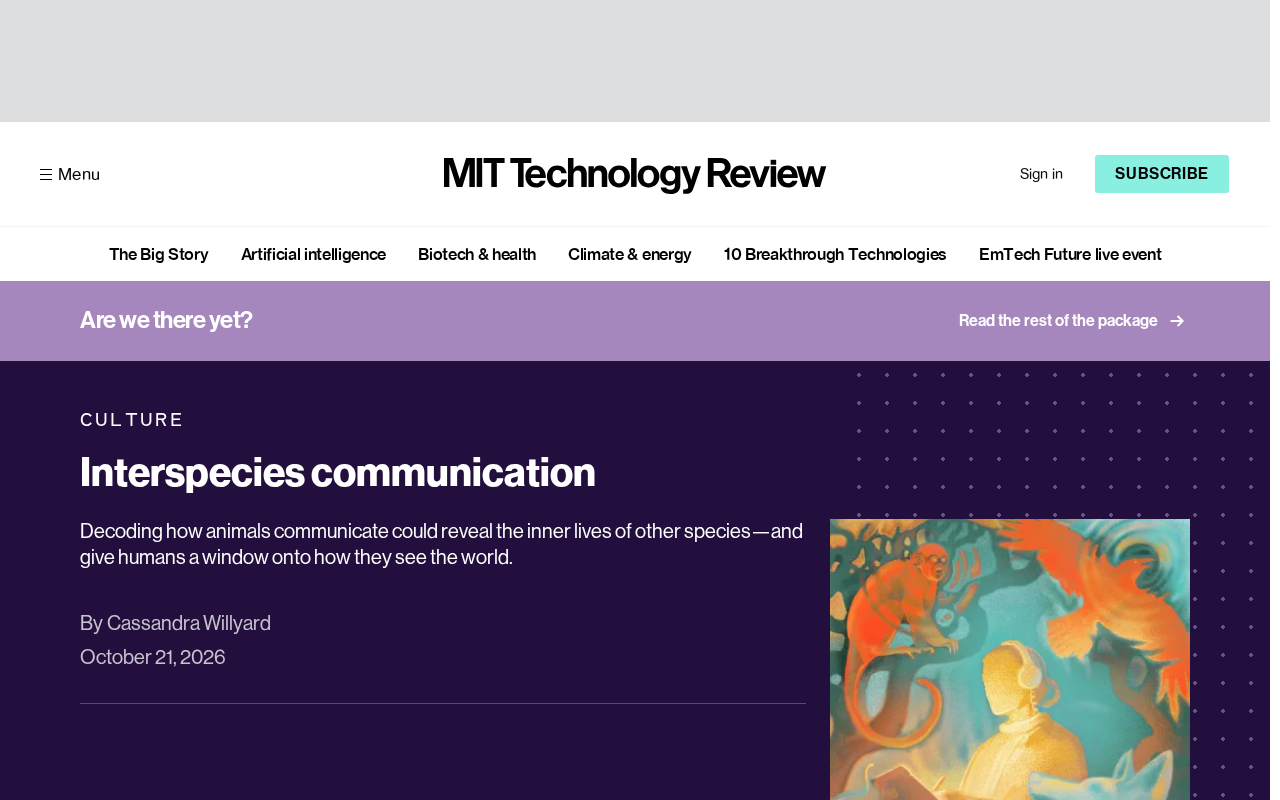
Humans are not the only species skilled at "talking." From the complex vocalizations of primates to the long, mournful songs of whales, animal communication is far richer than we imagine. Decoding these forms of exchange not only lets us glimpse the inner worlds of other species, but also helps humans reconsider their own place in the natural world.
The Diversity and Complexity of Animal Communication
According to an article from an RSS source titled "Interspecies communication," humans are far from the only species with a gift for communication—our furry, feathered, and finned friends may have a great deal to say to us. Decoding how animals communicate with one another can open a window into the inner lives of other species and help humans recognize that "animals are thinking, sentient beings."
This view challenges the long-standing traditional perception of animals as instinct-driven automata. From the dances of bees to the gestures of chimpanzees, communication systems in the animal kingdom display astonishing diversity.
From Calls to Body Language
Animal communication is not limited to sound. Primates use a rich repertoire of gestures and facial expressions, birds convey information through feather postures, and even fish communicate through changes in body color and fin movements. These multimodal forms of communication show that animals often use multiple channels simultaneously when conveying information—much like humans use language, facial expressions, and body movements together in face-to-face interaction.
Multimodal communication refers to the phenomenon in which a single signal simultaneously contains multiple sensory channels (such as acoustic, visual, tactile, and chemical signals). In animal communication research, this concept emphasizes that information is not transmitted through a single channel alone: for example, a chimpanzee's threat display simultaneously includes calls, facial expressions, and piloerection; the honeybee's "waggle dance" combines movement trajectory, vibration, and odor. Multimodal signals are often redundant (enhancing reliability) or complementary (conveying different information), and research must record multiple channels simultaneously, otherwise key semantics are easily missed.
Mental representation in cognitive science refers to an organism's internal encoding or "mental model" of the external world (such as predators or food locations). When animals produce functionally referential signals (such as alarm calls specific to particular predators), researchers infer that they possess the ability to categorize external objects and map them onto signals, which is regarded as evidence of mental representation. This concept is central to discussions of whether animals "think": if calls are merely triggered directly by stimuli without internal representation, they are closer to reflexes; if calls can be flexibly combined and decoupled from immediate stimuli, this suggests more complex cognitive mechanisms.
The Scientific Significance of Decoding Animal Communication
The core value of understanding animal communication lies in its ability to reveal animals' inner experiences. When a chimpanzee emits a specific alarm call, it is not merely reacting to danger—it may be conveying specific information to its companions about the type of predator, its location, or even the degree of urgency. This complexity of information transfer implies that animals possess some form of mental representational capacity.
The source article emphasizes that this decoding work helps humans recognize that "animals are sentient beings, and they think." This recognition has profound ethical and practical implications: it affects how we treat farmed animals, how we protect endangered species, and how we consider animal welfare within legal frameworks.
How Technology Is Helping Interspecies Communication
In recent years, advances in machine learning and artificial intelligence have injected new vitality into animal communication research. Researchers are using AI to analyze large volumes of animal sound data, attempting to identify hidden patterns and structures within. From sequence analysis of whale songs to semantic classification of primate calls, computational tools are helping scientists process massive datasets that could not previously be analyzed manually.
These technological approaches are not intended to "teach animals to speak human language," but rather to help humans better understand animals' own communication systems. This shift toward an animal-centered perspective is an important trend in current interspecies communication research.
Machine learning is a branch of artificial intelligence in which algorithms enable computers to automatically learn patterns from data without explicitly programmed rules. In animal communication research, commonly used methods include: unsupervised clustering (automatically discovering syllable types from unlabeled calls), supervised classification (mapping calls to behavioral contexts or predator types), and sequence modeling (such as hidden Markov models or recurrent neural networks, analyzing the syntactic structure of calls). The value of these tools lies in handling high-dimensional, massive, and noisy acoustic data, but results still require validation through behavioral experiments to avoid overinterpreting statistical patterns.
Challenges and the Future of Interspecies Communication
Despite its promise, interspecies communication research still faces enormous challenges. Animal communication systems may differ fundamentally in structure from human language, and a direct translation approach may not work. In addition, researchers' interpretations are susceptible to anthropocentric bias, and how to maintain methodological humility and openness is a question this field must continually reflect on.
The core viewpoint of the source article—that animals are thinking, sentient beings—reminds us that the ultimate goal of interspecies communication may not be for humans to "understand" animals, but rather to reexamine the relationship between humans and other species by understanding their ways of communicating.
This article is based on brief content from an RSS source. The original material is limited in information, and some analysis is reasonable extrapolation.
Anthropocentric bias refers to researchers unconsciously applying the structures, categories, and intentionality of human language to animal signals, thereby misreading their function. Typical manifestations include: forcing complex animal calls into correspondence with "words," assuming signals must necessarily be referential (e.g., "this word stands for 'eagle'"), or ignoring the emotional/social functions of signals. Methodological responses include: functional validation grounded in the species' natural behavioral ecology, blind coding, and developing analytical frameworks that do not rely on human language categories (such as information-theoretic metrics). This reflection is key to maintaining scientific objectivity in interspecies communication research.
One-line Summary
Animal communication is far more complex than imagined, and AI is helping decode it—but we must guard against anthropocentric bias.
Paragraph Summary
The article points out that humans are not the only species skilled at communication; animals convey rich information through multimodal means such as sounds, gestures, and body coloration. Decoding these communication systems helps reveal animals' inner experiences, promotes societal recognition that animals are sentient, thinking beings, and influences animal welfare and conservation practices. In recent years, machine learning and AI technologies have been used to analyze massive animal sound datasets and identify hidden patterns and sequence structures, but research emphasizes that the focus should be on animals' own systems rather than forcibly translating them into human language. Interspecies communication still faces challenges such as structural differences and anthropocentric bias, and its ultimate goal should be to reexamine the relationship between humans and other species.
Related articles

A Single Prompt Triggers a Global PHP Security Storm: Is AI a Savior or a Hidden Risk?
A single AI prompt triggered a global PHP security crisis affecting Wikipedia and the Internet Archive. This article reviews the incident, analyzes the OpenAI-Amazon controversy, and explores the security paradox of lowered vulnerability discovery barriers in the AI era and developer response strategies.

When AI Is Taken Away: How Reliance on Shortcuts Undermines Your Problem-Solving Resilience
A study of 1,222 people found that after using AI to answer questions, once AI was removed, people gave up on more problems than a control group that never used AI. The article analyzes the impact of AI reliance on learning resilience and metacognition, and explores design implications for AI learning tools.

Carta and NewView Partner to Let Startup Employees Cash Out Equity Early
Carta and NewView Capital partner to simplify startup tender offers, helping employees sell equity early. Analysis of the mechanism, liquidity pain points, and impact.