Introduction to Prompt Engineering: A Complete Guide from Understanding to Implementation

A complete beginner's guide to prompt engineering: functions, process, and limitations.
Prompts are the neural signals that steer AI. This guide explains the four core functions of prompts, how prompt engineering differs from fine-tuning and RAG, the six-step workflow, and the technical and practical limitations you must understand to use AI effectively.
Prompts Are More Than Just "Sending a Message to AI"
Many people's understanding of prompts stops at "sending AI a sentence," assuming that if you can type, you can use AI. But if it were really that simple, why can the same AI model produce dull, ordinary articles for some people while generating professional industry reports for others?
The difference lies not in the AI itself, but in the input prompts. Prompts are our most direct means of controlling AI output—you can think of them as the "neural signals" sent to the AI: whatever signal you send, that's the direction the AI thinks in. It's precisely through this instructional language that we can establish truly effective communication with AI and guide it to produce the results we need.
Behind this lies a key technical fact: a large language model (LLM) is essentially a probability-based text prediction system. It's built on the Transformer architecture—an architecture proposed by Google in 2017 in the paper "Attention Is All You Need," whose core innovation is the Multi-Head Self-Attention mechanism, allowing the model to simultaneously attend to information at all other positions in the sequence when processing each token, completely revolutionizing the field of natural language processing. Unlike the previously mainstream recurrent neural networks (RNNs), the Transformer computes attention weights between all positions in parallel, both solving the long-range dependency problem and dramatically improving training efficiency.
The reason the Transformer architecture was able to give rise to a series of large models like GPT, BERT, and Claude also depends on the maturation of the self-supervised pretraining paradigm—models don't need large amounts of manually labeled data, but instead learn language patterns and world knowledge directly from massive text by predicting masked words or the next word. This paradigm makes "brute force yielding miracles" possible: as model parameter counts and training data scale increase, models exhibit an "Emergence" phenomenon that researchers didn't anticipate—after parameter counts cross a certain threshold, models suddenly acquire reasoning capabilities that weren't present at smaller scales.
By performing self-supervised learning on corpora of trillions of tokens, models establish a statistical understanding of language patterns. Their core mechanism is "Next Token Prediction"—the model doesn't truly "understand" semantics, but rather learns which word sequences are statistically most reasonable given a context. The prompt is that "given context," and it directly determines the model's starting point and direction in the probability space. This means every word choice in the prompt alters the model's conditional probability distribution, thereby affecting the generation path—different prompts activate different "knowledge regions" in the model's parameter space, just like searching the same database with different keywords retrieves entirely different content. Understanding this is the starting point for learning prompt engineering. Below, we'll explore four questions: what is a prompt, how does it differ from prompt engineering, why is it worth learning, and what limitations should not be overlooked.
The Four Core Functions of Prompts
Prompts may seem simple, but they actually play four key roles.
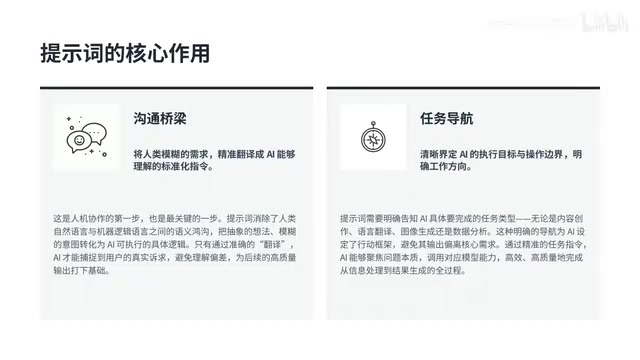
Communication Bridge
Just like ordering takeout, you can't just say "give me some food"—you need to specify which dish, the spice level, whether to add rice. The same goes for AI—the needs in your mind are often vague, while AI can only understand explicit instructions. The function of a prompt is to "translate" those unclear, hard-to-articulate ideas into language the AI can understand. If this step isn't done well, the subsequent output will inevitably go off track.
Task Navigation
When you say "help me deal with this file," the AI has no idea whether you want statistical analysis, visualization, or a summary—it can only pick a random direction, and the result is most likely not what you want. A good prompt gives the AI a clear goal and boundaries—just like driving navigation requires an accurate destination, otherwise you'll only circle aimlessly.
Style Control
This is the most easily overlooked yet extremely important point. Writing a business email and writing a social media post have completely different styles. AI defaults to an "impartial, characterless" generic style—this default style stems from the statistical average formed after the model was trained on massive amounts of internet text. It represents "lowest common denominator" expression, not the optimal solution for any specific scenario. Through prompts, you can make it present any style—write commentary in Lu Xun's style, write a diary in a child's tone, or write a paper in rigorous academic language. When the style is right, the time spent on later revisions is naturally greatly reduced.
Boundary Constraints
This is one of the most effective ways to solve AI's tendency to "talk nonsense." AI is especially talkative—if left unconstrained, it can extend from one point to a hundred thousand miles away, and even fabricate content that doesn't exist. Boundary constraints tell the AI what should and shouldn't be said. For example, when analyzing financial reports, explicitly requiring it to only look at data from a specific quarter and not extend to macro policy will make the output more focused and practical.
An Intuitive Comparison
Asking AI to "write an article about spring"—such a basic prompt is too broad: North or south? Prose or narrative? How long? What style? The AI can only fill in randomly, and the results are all the same. An optimized prompt, on the other hand, first gives it an identity (prose writer), sets a word count (800 words), clarifies the scene (spring in Jiangnan), then specifies the style (beautiful, lyrical language, focusing on depicting the hazy water-town atmosphere). The before-and-after comparison is clear at a glance: the essence of prompt optimization is transforming vague needs into specific, executable rules.
Prompt ≠ Prompt Engineering
Many people conflate "prompts" with "prompt engineering," but the two are quite different.
Prompt engineering isn't as simple as "being able to write a few good prompts." It's a complete methodology: getting the AI to stably produce the results we want purely by designing input instructions, without modifying the AI's underlying code and parameters. It's the key to getting general-purpose AI models to solve specific business problems, and the core capability for collaborating efficiently with AI.
It's worth noting that prompt engineering fundamentally differs from two other AI customization approaches—fine-tuning and full retraining. Fine-tuning continues to update parameters on top of pretrained weights through backpropagation, adapting the model to a specific domain or task style. Full fine-tuning is extremely computationally expensive, so the industry more commonly uses parameter-efficient fine-tuning methods like LoRA (Low-Rank Adaptation)—its core idea comes from an important observation: the update matrix of model weights has a very low intrinsic rank, so there's no need to update all parameters. You only need to add two low-rank matrices (with rank typically set between 4 and 64) in parallel alongside the original weight matrix. The number of trainable parameters is usually only 0.1%–1% of the original model, making it possible to fine-tune models with tens of billions of parameters on consumer-grade GPUs.
LoRA was proposed by Microsoft Research in 2021, and its theoretical basis is precisely the empirical finding that neural network weights exhibit low-rank properties during training. Another advantage of LoRA is that you can train multiple task adapters for the same base model, loading and switching them on demand during inference, greatly enhancing engineering flexibility—this is also an important technical foundation supporting the flourishing of the current open-source model ecosystem (such as various vertical-domain models based on LLaMA and Mistral). Nevertheless, fine-tuning as a whole is still suited to scenarios where you need the model to master a specific domain's style or knowledge—it has a long cycle and high barriers, and is usually an enterprise-level need. Prompt engineering completely bypasses parameter modification; essentially it's navigating within the model's "activation space," leveraging the model's existing capabilities rather than creating new ones—it's highly flexible and low-cost, and is the preferred path for most individuals and small-to-medium enterprises. The two aren't mutually exclusive—enterprise-level AI products are often a combination of "a fine-tuned model + carefully designed prompts."
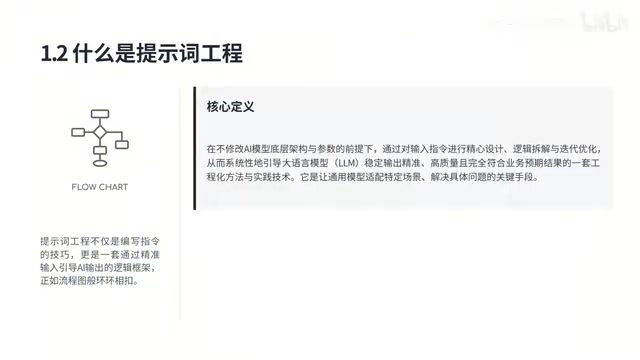
The biggest difference between the two is: a prompt is one-off, like executing a line of code to solve a single problem—it may not work well when you switch scenarios. So-called "universal prompts" are basically a gimmick—there's no universal prompt, only prompts suited to specific scenarios. Whereas prompt engineering is a process, relying on methodology rather than inspiration, and solving "a class of problems" rather than "a single problem."
The Six Steps of Prompt Engineering
The complete prompt engineering process can be broken down into six steps:
- Requirement Decomposition: Break complex big problems into small problems that AI can handle;
- Solution Design: Design corresponding prompts and roles for each small problem;
- Execution & Testing: Actually run it and observe the results;
- Effect Evaluation: Judge output quality against specific standards;
- Strategy Iteration: Continuously optimize based on shortcomings;
- Consolidation & Reuse: Save effective solutions so you can directly call them when facing similar problems.
This process is highly similar to software development, except that instead of writing code, you're writing natural language.
Four Core Goals for Measuring Success
Prompt engineering ultimately pursues four goals: improving accuracy (output is exactly what you want), reducing hallucination (less fabricated content), enhancing stability (results are relatively consistent regardless of who uses it or when), and lowering costs (getting the best results with the fewest tokens). These four points are also the core criteria for evaluating whether a prompt solution is good or bad.
Here we need to explain the relationship between "tokens" and "cost": tokens are the basic units by which large language models process text. The way they're divided isn't a simple split by character or word, but rather algorithms like Byte Pair Encoding (BPE) break text down into subword units—common words usually correspond to a single token, while rare words may be split into multiple tokens. In Chinese, one character usually corresponds to 1-2 tokens; in English, one word corresponds to about 1-1.3 tokens. API call fees are charged based on the total number of input and output tokens—the longer the prompt, the higher the cost per call. Mainstream models like GPT-4, Claude, and Gemini all use this billing method. In enterprise scenarios with high-frequency calls, prompt length directly affects operating costs. This is also why "lowering costs" is listed as one of the core goals.
Why Everyone Should Learn Prompt Engineering Now
The reasoning is straightforward: AI capabilities are already very strong, but most people don't fully utilize them. Data shows that over 90% of users only use AI for basic Q&A—this is like buying a sports car but only driving it in first gear, wasting its performance for nothing.

The barrier to prompt engineering is extremely low—you don't need to understand programming and algorithms; you just need to be able to explain things clearly to get started. The most direct benefit after learning it is improved efficiency: work that used to take a day might now be done in an hour, and you can even handle complex tasks that AI previously couldn't manage.
Beyond efficiency, it also has significant commercial value: it can help enterprises or content creators optimize content production processes and monetize side hustles; it can compress "work that originally required a whole team" into something one person can handle independently, greatly reducing the trial-and-error cost of starting a business; for content creators, monthly output can increase from 10 articles to dozens, without compromising quality. Prompt engineering isn't just a skill—it's a low-barrier, high-return window of opportunity in the AI era.
Don't Deify It: The Limitations of Prompt Engineering
The most important and most easily overlooked point is—prompts are not omnipotent. Recognizing their boundaries is what allows you to avoid detours.
First, it cannot break through the AI's own capability ceiling. Model training data has a cutoff date, so it doesn't know about things beyond that range; a math problem it can't solve won't be solved no matter how much you optimize the prompt. Second, the output is inherently unstable—sometimes changing a single word yields drastically different results; and if the prompt is too long, the AI starts to "forget." Finally, there's the hallucination problem, which optimization can only reduce but not completely eliminate—as long as it's a large language model, content fabrication is bound to occur, so always verify important information yourself.
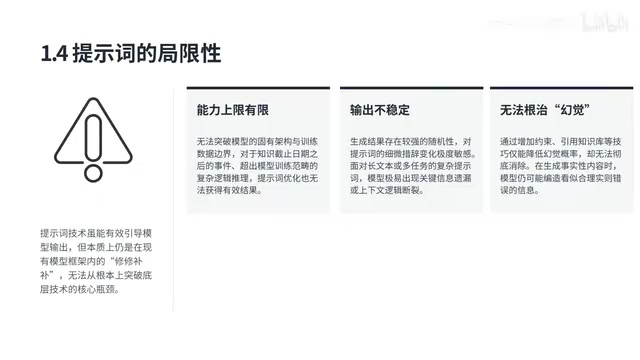
The reason "hallucination" is an inherent flaw of large language models lies precisely in their working mechanism: the model's training objective is to generate "linguistically reasonable" text, not "factually correct" text. When the model encounters a domain where training data is insufficient, it won't say "I don't know" but instead tends to "complete" an answer that sounds reasonable. Currently, the most mainstream mitigation solution in the engineering world is Retrieval-Augmented Generation (RAG) technology—its complete tech stack involves components like vector databases (such as Pinecone, Weaviate, Chroma), embedding models (which convert text into coordinate points in a high-dimensional vector space, where semantically similar texts are closer in the vector space), and approximate nearest neighbor search (ANN).
It's worth adding that the vector embedding technology RAG relies on has its own complete technical ecosystem: mainstream embedding models include OpenAI's text-embedding-3 series, and open-source options like BGE (Beijing Academy of Artificial Intelligence) and E5. These models compress text of arbitrary length into dense vectors of a fixed dimension (usually 768 to 3072 dimensions), allowing semantic similarity to be precisely measured through mathematical operations like cosine similarity or Euclidean distance. Approximate nearest neighbor search (ANN) algorithms (such as HNSW, IVF-PQ) solve the engineering challenge of finding the most similar items among millions of vectors in milliseconds. The core process is to slice the external knowledge base, vectorize and store it, then when a user asks a question, first convert the question into a vector, retrieve semantically relevant fragments from the knowledge base, and then inject the retrieval results into the prompt as context, guiding the model to generate answers based on real data. This "retrieve first, then generate" paradigm transforms the model's role from a "memory bank" to a "reasoning engine," significantly improving factual accuracy, and knowledge updates only require updating the vector database without retraining the model—it's the standard solution for enterprise knowledge base Q&A, and high-precision scenarios like law and medicine. Notably, the effectiveness of a RAG solution also largely depends on prompt design—how to effectively inject retrieval results into the context, and how to guide the model to prioritize external knowledge over relying on its own parameters, still requires careful prompt engineering. But from an overall architecture perspective, this already goes beyond pure prompt engineering and requires code-level engineering support.
Three Hard Technical Limitations
From the underlying technology perspective, there are three problems that are difficult to fundamentally cure:
- Limited context length: The attention mechanism in the Transformer architecture is responsible for modeling the correlations between tokens in a sequence, and its computational complexity is O(n²). The context window is the maximum number of tokens the model processes at once. Early GPT-3 supported only about 4,000 tokens; current mainstream models have expanded to hundreds of thousands or even millions of tokens (e.g., Claude 3 supports about 200K tokens, and Gemini 1.5 Pro supports up to 1 million tokens). This progress is thanks to algorithms like FlashAttention optimizing GPU memory access patterns, and techniques like Rotary Position Embedding (RoPE) improving extrapolation ability for ultra-long contexts. However, a larger window doesn't mean the problem is completely solved: a 2023 Stanford University study found that models exhibit a "Lost in the Middle" phenomenon with content in the middle of long contexts—attention weights are significantly higher at the beginning and end than in the middle. This means that in long conversations, you should periodically restate key requirements and place the most important constraints at the beginning or end of the prompt, rather than burying them in the middle. Just like a phone's RAM, when too many apps are open, the background is automatically cleared—when the prompt is too long or the conversation goes on too long, the AI will forget the initial requirements, a result of the statistical preference of the attention mechanism itself.
- Unstable on complex tasks: Multi-step computation and reasoning tend to skip steps and break logic, so you must first break the task down into small units and hand them to the model one by one. The Chain-of-Thought (CoT) prompting technique that has emerged in recent years was systematically proposed by the Google Brain team in 2022. By adding "please think step by step" to the prompt or providing reasoning examples, it guides the model to externalize its working memory into visible intermediate steps, thereby reducing logical errors caused by step-skipping. Later developments such as zero-shot CoT (just add "Let's think step by step"), self-consistency sampling (sampling multiple times and voting), and Tree of Thoughts (exploring multiple reasoning paths) further expanded the application boundaries of this approach to complex tasks like mathematical reasoning and logical analysis.
- No true long-term memory: Each conversation is a completely fresh start for the AI—it can't remember your preferences and background, and can only rely on external databases to compensate. This is also why major AI applications are competing to launch "memory features"—essentially persisting key information and then automatically injecting it into the prompt at the start of each new conversation, which is an engineering-level patch rather than a breakthrough in the model's own capabilities.
Three Practical Pitfalls in Implementation
- Safety and alignment limitations: Illegal and non-compliant content will absolutely not be generated, but sometimes legitimate requests are mistakenly blocked—this is a common flaw of all large models. This limitation stems from Reinforcement Learning from Human Feedback (RLHF) during the model training phase—systematically proposed by OpenAI in the InstructGPT paper (2022). By training a reward model with preference data from human annotators, and then using it to optimize the language model's output, it makes the output safer and more aligned with human values. However, RLHF inevitably introduces the side effect of over-refusal—the model sometimes learns to "please" annotators rather than pursue true accuracy. Methods like Anthropic's Constitutional AI and Direct Preference Optimization (DPO) are attempting to reduce such side effects while maintaining safety alignment.
- Pure prompts can't be engineered: Using them yourself is fine, but building them into a product for large-scale user calls doesn't work—you can't do version management, problem traceback, or support large-scale batch tasks. Enterprise-level applications must be a combination of "prompts + code."
- Cost trap: AI is billed by token, so the longer the prompt, the more expensive it is, and costs grow non-linearly. Hidden costs are considerable with high-frequency calls. When writing prompts, always strive for conciseness.
Conclusion
Prompt engineering is indeed a handy tool in the AI era, but it's not a master key—things that require manual handling still need human intervention. Establishing a correct understanding—clearly knowing what it can and cannot do—is precisely the first step to mastering this skill, and a prerequisite for avoiding pitfalls and truly unleashing AI's capabilities.
Key Takeaways
Key Takeaways
Key Takeaways
Key Takeaways
Key Takeaways
Related articles

Replacing spaCy's Sentencizer with yasbd: Accuracy Jumps from 55% to 98.9%
spaCy's default Sentencizer achieves only 55.4% accuracy on edge cases, while open-source library yasbd reaches 98.9%. Analysis of limitations and integration code examples.

Gemini 3.1 Pro Rate Limiting Exposed: Why Paying Users Can't Actually Use Their Full Quota
Deep analysis of Google Gemini 3.1 Pro's rolling window rate limiting, revealing the massive gap between paper quotas and actual usability for paying subscribers.

AI-Generated Spanish-Language Series Nido de Villanas: Analyzing a New Form of Short-Video Narrative
Deep analysis of the AI-generated Spanish web series Nido de Villanas Ep.9: narrative design, visual metaphors, psychological intrigue, and AI short drama production trends.