Introduction to Prompt Engineering: The Real Reason AI Can't Understand You

Poor AI output stems from communication issues; prompt engineering is the core skill for structured human-AI communication.
This article reveals that the root cause of poor AI responses lies not in AI itself but in how humans communicate with it. AI is essentially making probabilistic predictions rather than truly understanding language, while human language is inherently full of ambiguity and omissions. The core goal of prompt engineering is to eliminate ambiguity and precisely align expectations, transforming vague requirements into structured instructions — essentially an art of moving human-machine communication from vague to precise.
It's Not That AI Is Incompetent — It's Your Communication That's the Problem
Have you ever had this experience: you pour out a detailed request to an AI, only to get a response that's completely off the mark? Many people complain, "This isn't artificial intelligence — it's artificial idiocy." But the truth is, the problem usually isn't with the AI itself — it's with how we communicate with it.
Prompt Engineering is the core skill for solving this problem. It teaches us how to use structured language to translate vague requirements into precise instructions that AI can understand and execute. Based on the systematic tutorial by Bilibili creator "志博AI景行," this article lays out the cognitive foundation of prompt engineering — helping you understand why AI can't understand what you're saying.

How AI's "Thinking" Differs from Human Thinking
Starting with Ordering Food: The Problem of Missing Information
Imagine walking into a restaurant and telling the waiter, "I want to eat." The waiter will inevitably follow up: What dishes? Spicy or not? Do you want rice? This is a classic case of missing information in communication.
From an information theory perspective, everyday human language has extremely high entropy — the same sentence can carry completely different meanings in different contexts. Linguists classify this phenomenon into three categories: lexical ambiguity (one word with multiple meanings), syntactic ambiguity (multiple possible structural interpretations), and pragmatic ambiguity (literal meaning differs from actual intent). Humans can easily resolve ambiguity because we rely on shared world knowledge, real-time situational awareness, and socially developed pragmatic rules — abilities accumulated through decades of embodied experience. While current large language models possess vast textual knowledge, they lack real-world perceptual interfaces and causal reasoning capabilities. They are essentially doing "pattern matching" rather than "intent understanding." Therefore, the core work of prompt engineering is to manually compress high-ambiguity natural language into low-ambiguity structured instructions, bridging the semantic gap between humans and machines.
Human language is inherently full of ambiguity, and we habitually omit information. Two people can understand each other after just a few words because we have empathy, common sense, and contextual reasoning abilities. But AI doesn't have these — it lacks human empathy and common-sense understanding, and must receive sufficiently precise instructions to know what to do.

How AI Actually "Thinks": Probabilistic Prediction, Not True Understanding
Here's a critical misconception that needs clarifying: AI is not thinking at all — it's simply making probabilistic predictions.
The core architecture of large language models (LLMs) is the Transformer, proposed by Google in the 2017 paper Attention Is All You Need. These models learn through self-supervised training on massive text datasets, essentially learning the conditional probability distribution of "given the preceding text, what is the next word?" When you input a prompt, the model converts it into high-dimensional vectors, uses the Attention Mechanism to calculate contextual relevance weights, and ultimately outputs a probability distribution over the vocabulary, sampling from it to generate a response. This means the model's output is statistical rather than logical — it selects "the most common continuation pattern in the training data," not "the logically correct answer." This also explains why AI can "confidently spout nonsense" (the hallucination problem) — it's making probability-optimal choices, not fact-checking.
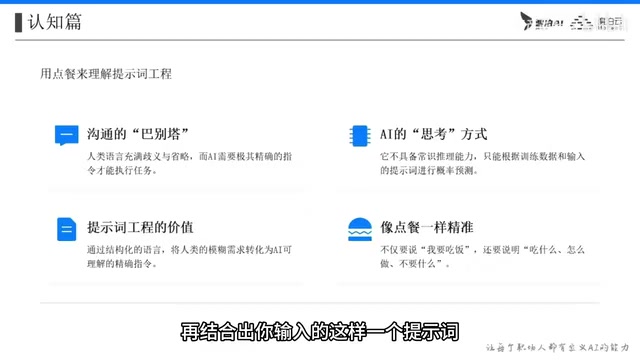
This explains why asking the same question in a different way can produce wildly different answers. The quality of AI's output depends entirely on the quality of your input prompt.
What's the Difference Between a Prompt and Prompt Engineering?
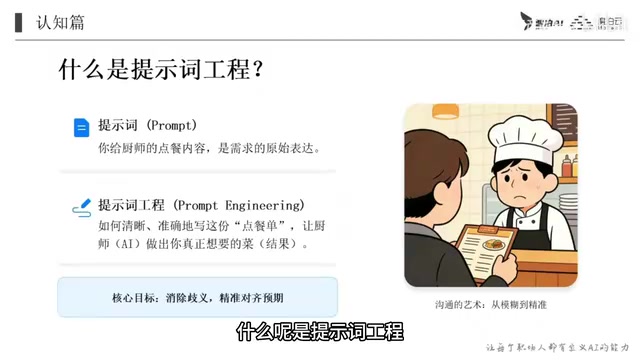
Prompt: Your Raw Request to AI
A prompt is simply the text you input to AI. For example, "I want Yu Xiang Rou Si (fish-flavored shredded pork)" — this is the most basic prompt — simple and direct, but often not precise enough.
Prompt Engineering: Refining Your Request to Perfection
Prompt Engineering is a systematic methodology that studies how to describe your requirements clearly and accurately so that AI can precisely output the results you want.
As a formal research field, prompt engineering gained widespread attention after OpenAI released GPT-3 in 2020. Early researchers discovered that merely changing the wording and structure of input text could produce differences of dozens of percentage points in the same model's performance. The "Chain-of-Thought Prompting" proposed by Google's research team in 2022 was a milestone in this field, demonstrating that guiding models to reason step-by-step can significantly improve accuracy on complex tasks. Today, prompt engineering has evolved from a personal skill into enterprise-level engineering practice. Top AI companies in Silicon Valley have even established dedicated "Prompt Engineer" positions with salaries reaching hundreds of thousands of dollars annually. Stanford, MIT, and other top universities have also incorporated it into their AI curricula, highlighting its importance in both industry and academia.
Using the restaurant analogy:
- ❌ Vague prompt: "I want to eat"
- ✅ Precise prompt: "Mildly spicy, low-salt, no cilantro fish-flavored shredded pork, with a bowl of rice"
When you describe your requirements specifically enough — what you want, how it should be made, what you don't want, what specifications — only then can the chef make the dish you actually want. Dealing with AI works exactly the same way.
The Core Goal of Prompt Engineering: Eliminate Ambiguity, Achieve Precise Alignment
Prompt engineering has one core goal: Eliminate ambiguity and precisely align AI's output with your expectations.
Put simply, it's about turning the vague ideas in your head into unambiguous, information-complete instructions so that AI's output matches what you have in mind as closely as possible. This is essentially an art of communication — moving requirements from vague to precise.
You can think of yourself as a "translator" between AI and your requirements:
- Input side: Structurally express vague human intentions
- Output side: Guide AI to generate high-quality content that meets expectations
Prompt Engineering Learning Path: From Beginner to Practitioner
This tutorial is divided into six progressive sections:
- Cognitive Foundation: Understanding why AI can't understand you (this article)
- Beginner Level: A universal formula for quickly crafting basic prompts
- Intermediate Level: Three frameworks covering all use cases
- Advanced Level: Three techniques to double AI output quality
- Pitfall Avoidance: The most common mistakes beginners make
- Hands-on Practice: Step-by-step guide to writing a top-tier prompt
Summary: Mastering Prompt Engineering Starts with Changing Your Mindset
Understanding how AI works is the first step to mastering prompt engineering. Remember these key insights:
- AI isn't "understanding" you — it's making probabilistic predictions
- Ambiguity and omissions in human language are the root cause of AI "errors"
- Prompt engineering is essentially structured communication that eliminates information gaps
- Input quality determines output quality
When you stop treating AI as an "all-knowing sage" and start treating it as an "executor that needs precise instructions," you've already taken the first step in prompt engineering. All subsequent techniques and frameworks are built upon this cognitive foundation.
Key Takeaways
- AI doesn't think — it makes probabilistic predictions based on training data, lacking true common-sense reasoning
- The core goal of prompt engineering is to eliminate ambiguity and precisely align expectations; it's essentially an art of structured communication
- Communicating with AI is like ordering food — you need to clearly specify what you want, how you want it, what you don't want, and what specifications to follow
- A prompt is the raw expression of a requirement; prompt engineering is the methodology for making that expression clear and accurate
- Input quality determines output quality — position yourself as the translator between requirements and AI
Related articles
 Tutorials
ChatGPT Plus Subscription Guide: Are GPT-5.5, image-2, and Codex Worth the Upgrade?
A detailed look at ChatGPT Plus features — GPT-5.5, image-2, and Codex — with a Plus vs Pro comparison and a complete step-by-step subscription guide for users outside the US.
 Tutorials
Harness AI Engineering in Practice: Using Claude Code to Master Enterprise-Level E-Commerce Development
Deep dive into Harness AI Engineering: master enterprise e-commerce development with Claude Code using the Rules, Skills, Wiki, and Changes framework.
 Tutorials
Cursor + Codex Dual-IDE Collaboration: A Practical Methodology for Open-Source Project Customization
A complete methodology for open-source project customization based on real-world experience, detailing the Cursor+Codex dual-IDE workflow, seven-stage process, MVP validation, and AI source code reading techniques.