iPhone Duo Hands-On: Simplified Face Unlock Feels More Intuitive Than Touch ID

iPhone Duo tests simplified face unlock—trading security for convenience, with a better experience than Touch ID.
The article covers the simplified face unlock Apple is testing for the iPhone Duo. It's not full Face ID—instead of TrueDepth's 3D structured light, it takes a lightweight path with slightly lower security but lower hardware requirements and faster response. In practice, picking up the phone and glancing at the screen unlocks it seamlessly, a clear advantage over Touch ID when hands are occupied. Apple imposes security restrictions, requiring stricter verification for highly sensitive scenarios—a tiered strategy consistent with its conservative stance. Face unlock also compensates for the limited fingerprint sensor coverage on the Duo's foldable/dual-screen form factor and serves as a differentiator from mainstream iPhones. The feature is still in testing; security boundaries, third-party access, and edge-case performance are worth watching.
Apple is testing a face unlock feature for the iPhone Duo—not a full Face ID, but a simpler, slightly less secure solution. From the current hands-on experience, this approach works well: even with security restrictions Apple has deliberately put in place, it makes the Duo faster and more convenient than relying on Touch ID every time.
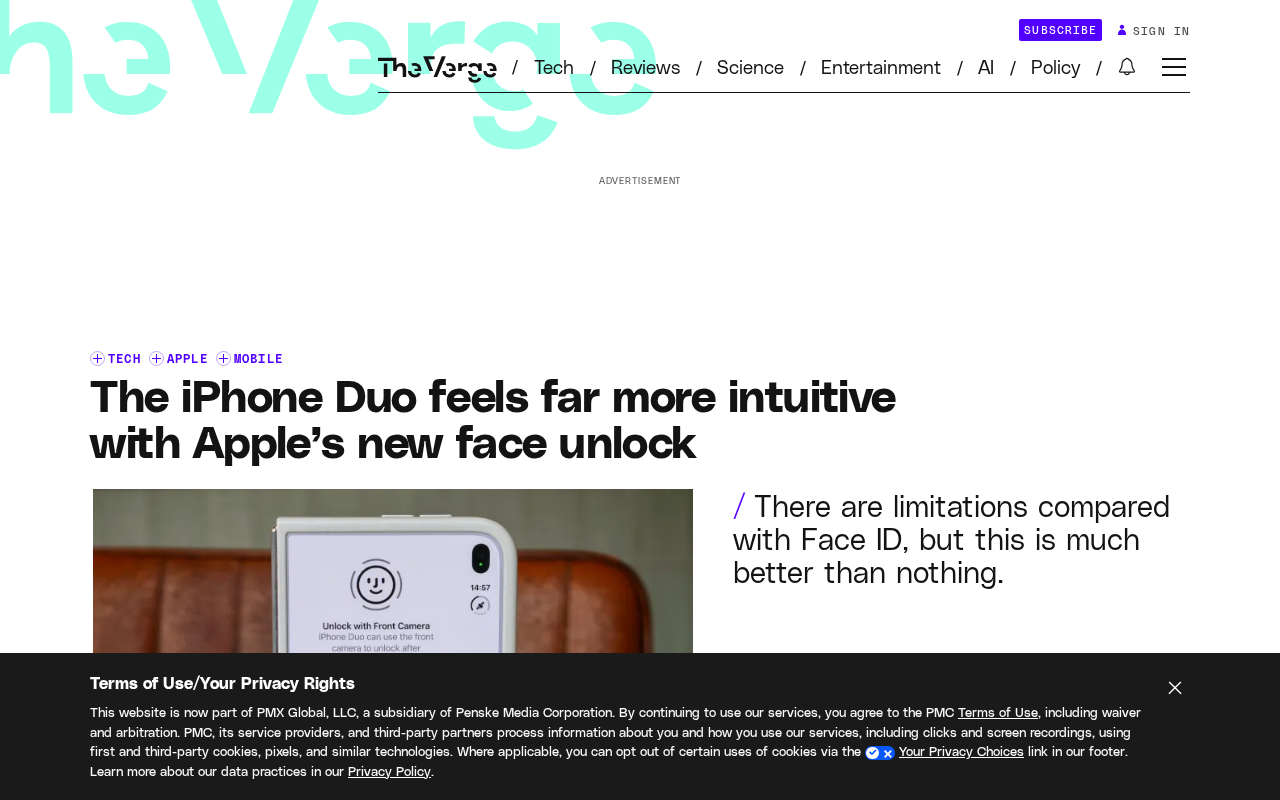
Not Face ID, but Good Enough
According to test feedback, the face unlock on the iPhone Duo is deliberately feature-trimmed. Instead of the complex 3D structured-light setup of the TrueDepth camera, it takes a lighter-weight path. That means it can't match Face ID in security, but in exchange it lowers the hardware barrier and delivers faster response times.
In real use, this unlock logic aligns closely with user intuition. Pick up the phone, glance at the screen, and unlocking happens almost imperceptibly. Compared with Touch ID—which requires precisely locating the fingerprint sensor and keeping your finger dry and clean—face unlock has a clear advantage when your hands are occupied or you're wearing gloves. This also explains why testers feel the Duo's "intuitiveness improved dramatically" once this feature was added.
The TrueDepth Camera is the hardware foundation of Face ID, consisting of an infrared lens, a flood illuminator, and a dot projector. The dot projector casts over 30,000 invisible infrared dots onto the user's face to build a 3D depth map, which is then compared against the 2D image captured by the infrared lens. This structured-light approach is costly and bulky, but it effectively resists 2D attacks such as photos and masks. Simplified face unlock typically relies only on an ordinary RGB camera or a single-point infrared sensor, performing recognition through 2D image comparison—lowering both hardware requirements and power consumption. As a result, its anti-spoofing capability is weaker than Face ID's, and it generally needs liveness detection or restricted usage scenarios to compensate.
Security Restrictions: A Compromise, and a Reasonable One
Apple has imposed several security restrictions on this simplified face unlock. The original article doesn't detail the specific terms, but judging from product logic, these restrictions most likely cover payment verification, access to sensitive apps, and similar scenarios—meaning these steps still need to fall back on stricter biometrics or passcode verification.
This tiered strategy is hardly surprising. Apple has consistently taken a conservative stance on biometrics: Face ID handles high-security scenarios, while the simplified solution takes on the convenience role of everyday unlocking. For a product positioned like the Duo, trading some security for smoother experience is a trade that adds up. The testers' attitude is clear too: even with these restrictions, the overall experience is still more comfortable than pressing Touch ID every time.
Biometric security levels are typically measured by the False Acceptance Rate (FAR)—the probability that the system incorrectly accepts someone else's biometric data. Apple has publicly stated that Face ID's FAR is roughly one in a million, while Touch ID's is about one in fifty thousand. If simplified face unlock uses a 2D approach, its FAR could rise further. That's precisely why the industry widely adopts a tiered strategy: low-risk operations (unlocking the screen, viewing notifications) may use lower-tier biometrics, while high-risk operations (payments, password management, in-app purchases) mandate higher-tier biometrics or the device passcode. This design, which draws trust boundaries by scenario, achieves an acceptable balance between convenience and security.
What It Means for the Duo's Positioning
The iPhone Duo's form factor itself dictates that interaction methods need rethinking. Foldable or dual-screen devices have very different grip postures when opened versus closed, and a fixed-position fingerprint sensor often struggles to cover all usage postures. Face unlock fills exactly this structural gap.
From a competitive standpoint, simplified face unlock is also one of the ways the Duo differentiates its experience from mainstream iPhones. It doesn't need the most premium hardware stacked on, yet it delivers smooth feedback for high-frequency everyday actions. This "good enough" strategy aligns with the Duo's product philosophy aimed at lightweight scenarios.
Biometric design for foldables and dual-screen devices has inherent difficulties. When a device is closed, open, or half-folded, the position and angle of the user's gripping fingers vary greatly—a side fingerprint sensor that's handy in one posture may be hard to reach in another. Under-display fingerprint sensors don't take up extra space, but they're difficult to implement on the flexible substrates of foldable screens and are equally limited by the need for a finger to touch a designated area. Face unlock doesn't rely on physical contact—as long as the camera can capture the face, it works—making it better suited to devices with changing form factors. This is also why many foldable products opt for a dual approach of side fingerprint plus facial recognition.
What to Watch Next
The feature is still in testing, and Apple hasn't announced an official rollout date. Points worth watching include: how exactly the boundaries of the security restrictions will be drawn, whether third-party apps can access this unlock capability, and how it performs in edge cases such as low light or when wearing a mask.
If Apple can find the right balance between security and convenience, this simplified face unlock could well become one of the most perceptible upgrades in the Duo's user experience. At least judging from the hands-on feedback so far, the direction is right.
Related articles

Why Voice AI Can't Understand Kenyans' Everyday Conversations
Swahili speech recognition hits 3.24% error on read text, but everyday Kenyan speech mixes English, Sheng slang, and accents—leaving mainstream voice AI struggling.

Data Centers Build Their Own Natural Gas Plants: AI Compute's Breakout Around a Decade-Long Grid Wait
Grid interconnection approvals can take a decade, so xAI and others are building off-grid natural gas plants to power AI clusters. This article analyzes the drivers, costs, and impact of behind-the-meter generation on AI infrastructure.

2035 Arrives Early: AI Coding Assistants Are Reshaping Developer Workflows
"2035 Came Early" sparks Hacker News debate: how AI coding assistants reshape developer workflows—from writing to reviewing code, speed vs. verification cost, and toolchain relayering.