Is AI-Assisted Programming Just Slop? Unpacking the Tech Community's Bias and Anxiety Around AI Coding

Unpacking why the tech community's blanket rejection of AI-assisted programming is an emotional overreaction.
A Reddit developer's frustration with AI haters reveals a deeper tension in the tech community. This article examines why using AI coding tools doesn't equal producing slop, draws parallels to historical resistance against abstraction layers in software engineering, and argues that judging work should focus on results and intent—not whether AI was involved.
A Debate About "AI Slop"
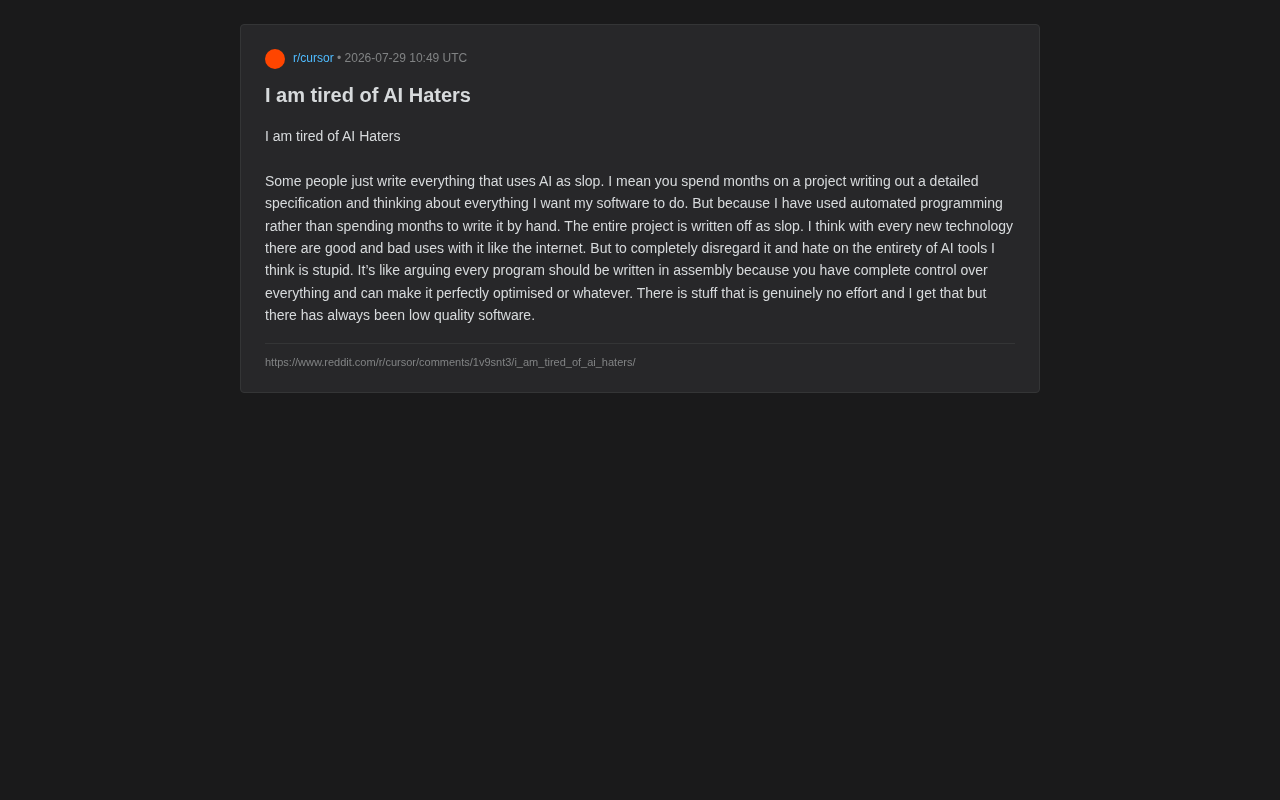
Recently, a developer posted a fairly representative complaint on Reddit: "I am tired of AI Haters." Their core frustration was that as soon as a project uses AI-assisted programming, certain people will indiscriminately slap the label "slop" on it—even if the developer spent months beforehand writing detailed specifications and carefully thinking through every feature of the software.
The word "slop" became a core term in AI criticism by 2024, originally stemming from social media users' frustration with the flood of AI-generated content. It specifically refers to low-quality content mass-produced by AI without human review or creative input—including articles, images, code, and videos. The word's popularity reflects a collective anxiety about declining content quality, similar to how "spam" spread in the early days of the internet. However, when "slop" is applied indiscriminately to all AI-assisted creation, it degenerates from a useful critical concept into a simple tool of stigmatization.
This post resonated because it touches on an increasingly sharp divide in today's tech community: one side views AI tools as an efficiency revolution, while the other sees everything AI-generated as cheap, soulless "filler." This black-and-white attitude is precisely what this developer opposes.
"Using AI-Assisted Programming" Doesn't Mean "No Effort Was Made"
The developer's first point deserves careful consideration: using AI coding tools does not mean the project itself lacks value or investment.
In fact, a high-quality AI-assisted project often requires developers to invest significant mental energy upfront—clarifying requirements, designing architecture, writing exhaustive specifications, and repeatedly reviewing generated output. Today's AI-assisted programming tools have formed a complete technical ecosystem: from GitHub Copilot's code completion, to AI-native IDEs like Cursor and Windsurf, to the programming capabilities of general-purpose large models like Claude and ChatGPT. Developers can receive AI support across the entire workflow from requirements analysis to code generation, test writing, and documentation. The underlying technology of these tools is primarily based on Large Language Models (LLMs), trained on massive code corpora to understand context and generate syntactically and logically correct code snippets. But the key point is that the output quality of these tools is highly dependent on the quality of context provided by the user—clear requirement descriptions, sound architectural design, and rigorous code review remain indispensable human contributions. AI is an accelerator at the execution layer, not a replacement at the thinking layer. Using "whether every line of code was hand-written" as the sole criterion for judging a project's value is inherently biased.
The developer made an apt analogy: it's like insisting that all programs should be written in assembly language because assembly provides complete control over hardware and enables maximum optimization. But the reality is that the vast majority of software is written in high-level languages, sacrificing a bit of performance for development efficiency and maintainability—and this has been proven to be the right trade-off.
Behind this analogy lies an entire history of abstraction layer evolution in software engineering. In the 1950s, programmers coded directly in machine code; then assembly language provided the first layer of abstraction; in the 1960s-70s, high-level languages like C and FORTRAN freed developers from worrying about specific register operations; in the 1980s-90s, object-oriented programming and garbage collection further lightened developers' cognitive load; after the 2000s, frameworks, libraries, and cloud services allowed developers to focus on business logic. Every elevation in abstraction level has encountered similar resistance—assembly programmers looked down on high-level languages as "inefficient," C programmers questioned Java's performance overhead, and traditional operations engineers harbored doubts about Serverless architecture. AI-assisted programming can be seen as the latest link in this evolutionary chain. Those who resist AI coding are, to some extent, repeating the historical resistance to every previous elevation in abstraction.
AI Coding Tools: Every New Technology Can Be Used Well or Poorly
Another rational point is that technology itself is neutral—what matters is how it's used.
The author draws an analogy to the internet—the internet gave rise to knowledge sharing and global collaboration, but also bred spam, scams, and low-quality content. Yet no one would deny the value of the entire internet because of this. AI coding tools are the same:
- Valuable uses: Assisting with prototyping, automating repetitive work, rapidly validating ideas, lowering the barrier to programming;
- Low-quality uses: Mindlessly mass-generating content, piling up code without review, using AI to mask genuine laziness.
The author also candidly acknowledges that "zero-effort" AI slop products do exist. But they emphasize a frequently overlooked fact: low-quality software has always existed. Before AI appeared, people could just as easily write terrible, redundant, worthless programs. AI simply speeds up production—it amplifies human intent without creating an entirely new category of "garbage."
The Professional Anxiety Behind AI Coding Bias
Why does such intense "AI hatred" exist? Behind it lies a tangle of multiple anxieties.
Part of it comes from job security—developers, designers, and writers worry about their skills being devalued. This anxiety is not unfounded. According to Stack Overflow's 2024 Developer Survey, over 70% of developers are already using or planning to use AI tools at work, yet a significant proportion simultaneously worry about AI's long-term impact on the job market. Multiple tech companies mentioned AI-driven efficiency gains in their 2023-2024 layoff announcements. However, historical data offers some reassurance: automation typically transforms rather than eliminates professions—ATMs didn't eliminate bank tellers (in fact, by enabling more branch openings, they increased the total number), and spreadsheets didn't eliminate accountants. AI is more likely to reshape what developers do—shifting from "code writers" to "system designers and AI output reviewers"—rather than simply replacing the entire profession.
Part of it stems from aesthetic and value judgments—people instinctively believe that "effort" is proportional to "value," and therefore harbor natural suspicion toward "effortless output." And part of it comes from genuine concerns about homogenization and the flood of low-quality content.
These anxieties are not entirely without merit. But converting them into wholesale rejection of an entire technology category is an emotional overreaction. As the author puts it, "Completely ignoring and hating the entire AI tool ecosystem is stupid."
The Right Attitude Toward AI-Assisted Programming
From this discussion, we can perhaps distill a more mature approach to technology:
- Judge work by its results and the effort behind it, not the tools used. Using AI isn't a sin—being careless is.
- Beware of black-and-white judgments. Technology has always been a spectrum, not a switch.
- Distinguish between the tool and the user. The blame for garbage code lies with the user's attitude, not the tool's existence.
- Embrace the elevation of abstraction layers. From assembly to high-level languages to AI-assisted programming—this is the consistent direction of software engineering evolution.
Conclusion
This developer's "exhaustion" is actually the shared sentiment of many creators who use AI coding tools seriously. In the early stages of technological change, there are always polarized labels and emotional debates. But what truly drives progress is never tribal love or hatred—it's the rational ability to distinguish between valuable creation and careless accumulation.
AI won't automatically produce great work, nor will it turn everything into slop. It simply hands the choice back to humans—more completely than ever before.
Related articles

Go Microservices in Practice: Detailed Architecture for E-Commerce, AI Agent, and IM System Integration
Deep dive into integrating e-commerce, AI Agent, and IM systems under Go microservices architecture, covering unified auth, gRPC, componentized Agent engines, and group chat bots.

X Platform's Recommendation Algorithm Caught Filtering Brazilian Election Content, Reigniting Algorithm Transparency Debate
X (formerly Twitter) was found filtering Brazilian election content in its For You feed, sparking debate over algorithm transparency and free speech.

Poison-Resistant Concept Anchoring: A New Approach to Defending Against AI Data Poisoning
Deep dive into Poison-Resistant Concept Anchoring, defending against data poisoning via signed anchors and bounded updates. Experiments show 62% poison isolation with 0% false rejection rate.