Is Cheap Cursor Pro Top-Up Reliable? Exposing the Real Risks Behind the Discounts
Cheap Cursor Pro top-up services are gray-market account sharing schemes with serious hidden risks.
This article exposes how low-price Cursor Pro top-up services actually work — through bulk account pool sharing and rotation — and analyzes the risks including account bans, code data security vulnerabilities, and service interruptions. It also offers practical alternatives such as official subscriptions and open-source tools like Continue and Cline.
How Tempting Are Low-Price Cursor Pro Top-Up Services
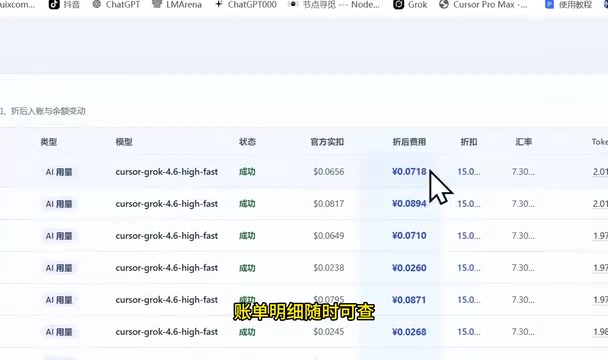
Recently, platforms like Bilibili have seen a surge of third-party top-up services marketing themselves with taglines like "official discounts," "subscribe to Cursor Pro at as low as 25% of the price," and "full power, no degradation." These promotions feature eye-catching price tags — pay 100 RMB and get 1,000 RMB worth of official usage credits, effectively bringing the cost down to just 10-25% of the official price.
Cursor is an AI-powered code editor developed by Anysphere, deeply customized on top of the open-source VS Code architecture. It has built-in capabilities for calling large language models like GPT-4 and Claude, offering intelligent code completion, code generation, bug fix suggestions, and natural language conversational programming while you write code. Cursor Pro is its paid subscription tier, providing higher model call quotas and more powerful AI capabilities. With the AI programming tool market exploding in 2024-2025, Cursor has quickly become one of the most popular AI programming tools among developers thanks to its excellent editor experience and deeply integrated AI capabilities, directly competing with GitHub Copilot.
For developers who need to make heavy use of AI programming assistants every month, Cursor's official subscription fees are admittedly not cheap. That's why these "pay-as-you-go, balance never expires" top-up services seem like an incredible deal. But as technology professionals, we need to calmly analyze how these services actually work, understand the hidden risks, and avoid getting into bigger trouble by chasing small savings.
This article provides an objective analysis of the technical reality, marketing tactics, and potential pitfalls of these services based on a typical promotional post.
How Cursor Top-Up Services Actually Work
Based on the promotional content, the core model of these platforms can be summarized as follows:
- Dedicated legitimate Pro account allocation: They claim to assign each user a Pro account with "official legitimate credentials," distinguishing themselves from temporary trial accounts that only last a few days.
- Pay-as-you-go billing: Instead of selling fixed-duration monthly or quarterly passes, they charge based on actual token consumption, with account balances that "never expire." Tokens here refer to the basic unit of measurement that large language models use when processing text — in English, one token corresponds to roughly 4 characters or 0.75 words; in Chinese, a single character is typically split into 1-3 tokens. When users interact with AI models through Cursor, both the input prompts and the model's responses consume tokens. Token pricing varies significantly between models — for example, GPT-4o is priced far higher than GPT-3.5-turbo, and Claude 3.5 Sonnet has its own distinct pricing structure. Pay-as-you-go pricing is widely used in API services from model providers like OpenAI and Anthropic, but there is no way legitimate pay-as-you-go costs could be as low as 10% of official pricing.
- No client modification: They claim to only handle "intelligent account allocation" and "billing record keeping," with users still running the original Cursor client and able to update directly when official new versions are released.
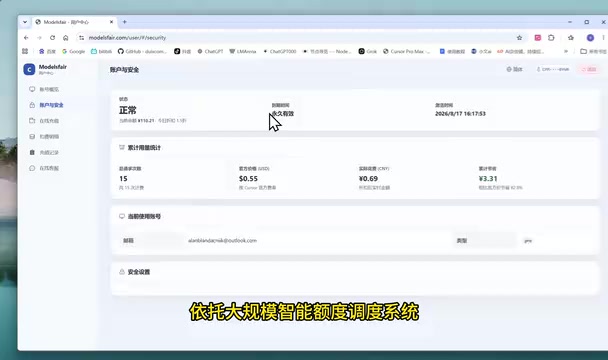
- Massive account pool rotation: Powered by a "large-scale intelligent quota scheduling system," the service automatically rotates to backup accounts when it detects an account is idle or its quota has been blocked.
From a technical perspective, this model is essentially account pool sharing and bulk reselling. The platform bulk-purchases or registers large numbers of Pro accounts, dynamically allocates them across multiple users through a scheduling system, and undercuts pricing by claiming "bulk costs are far lower than individual costs," pocketing the service margin.
More specifically, Account Pool Sharing is a common technical architecture in gray-market operations. The core principle is: the platform operator holds a large number of paid accounts in bulk and uses a self-built scheduling system (typically based on load balancing and status monitoring) to dynamically route user requests to different available accounts. When an account's usage quota nears its limit or gets flagged by the platform's risk control system, the system automatically switches traffic to other accounts. Technically, this implementation resembles the concept of a reverse proxy or API gateway, but its essence is a systematic violation of terms of service. Similar gray-market models have appeared widely in subscription services like Netflix and Spotify, most of which were eventually curbed by platforms through device fingerprinting, IP detection, usage behavior analysis, and other risk control measures.
Key Red Flags in Top-Up Service Marketing
The promotional content repeatedly emphasizes "transparent billing," "cross-verifiable with official backend," and "comprehensive data tracking systems" to allay users' concerns about data manipulation and security.

However, upon closer examination, several glaring logical contradictions emerge:
The Contradiction Between "Permanent Balance" and Account Bans
The marketing promises "balances that never expire" while simultaneously admitting that "the system automatically rotates when an individual account's quota gets blocked." This actually exposes the core risk — these accounts are inherently at high risk of being banned by the official platform. If the accounts were legitimately sourced, why would frequent rotation be necessary?
The Contradiction Between "Official Legitimate" and "Bulk Procurement"
Cursor does not offer any bulk distribution channel for resellers. The claim of "holding a massive pool of legitimate account resources" most likely means these accounts are obtained through gray-market methods such as bulk registration, stolen payment information, or exploiting regional pricing loopholes. Once identified by official risk control systems, these accounts can be terminated at any time.

Modern SaaS platform risk control systems typically employ multi-dimensional anomaly detection strategies to identify such violations. Common detection signals include: a single account logging in from multiple different IP addresses or geographic locations within a short period, frequent switching of device fingerprints (including OS, browser version, hardware characteristics, etc.), statistically anomalous API call patterns (such as sudden spikes in call frequency or patterns exhibiting non-human regularity), and geographic inconsistencies between payment information and usage behavior. As a client-side application, Cursor can theoretically collect richer environmental information for risk control decisions. Once risk control rules are triggered, consequences range from rate limiting to outright account bans with tracing of associated accounts. This explains why top-up platforms need to maintain massive "account pools" — they're essentially fighting an ongoing war of attrition against the official risk control system.
The "No Degradation" Promise Is Unverifiable
The marketing claims "the underlying pipeline is completely identical to the official one" and "there is no degradation in model performance." But since accounts are shared among multiple users, the possibility of requests being rerouted or throttled cannot be ruled out. The "full power, no degradation" claim is more of a marketing slogan that lacks credible third-party verification.
Real Risks Faced by Users of Cursor Top-Up Services
Even if these services work in the short term, developers choosing to use them still face multiple risks:
Account and Code Data Security Risks
Shared accounts mean your code context and project information may coexist with other users under the same account environment. For code involving trade secrets or personal privacy, this is an unacceptable security vulnerability.
Risk of Service Interruption at Any Time
The account pool model is heavily dependent on the platform continuously "replenishing" new accounts. If Cursor strengthens its risk controls, bans large batches of violating accounts, or the platform simply disappears, users' prepaid balances will instantly become worthless — the so-called "permanent balance" has zero legal protection.
Risk of Account Bans for Violating Terms of Service
Using such services may itself violate Cursor's terms of service. If the official platform detects abnormal account sharing behavior, your ongoing development work could be disrupted at any moment.
Practical Advice: How to Properly Control AI Programming Tool Costs
For developers who truly rely on AI programming tools, rather than risking shady top-up services, consider weighing the following options:
Prioritize official subscriptions. The official Pro subscription may be pricier, but it offers stable service, data security guarantees, and continuous feature updates. For professional developers who use it as a productivity tool, this investment is usually well worth it.
Evaluate open-source alternatives. If budget is limited, consider open-source AI programming plugins like Continue or Cline, paired with your own API keys obtained through official channels (such as pay-as-you-go pricing). This approach is both transparent and compliant. Continue is an open-source AI programming assistant plugin that supports VS Code and JetBrains IDEs, allowing users to connect any LLM API (including OpenAI, Anthropic, locally deployed Ollama models, etc.) to enable code completion, conversational programming, and more. Cline (formerly Claude Dev) is another open-source AI programming agent plugin focused on enabling AI to autonomously execute more complex programming tasks, such as creating files, running terminal commands, and more. The advantages of these open-source solutions are: users have full control over their own API keys and data flow, pay based on actual API usage, and face no middleman markups or account security issues. The downsides are that they require manual configuration, and the integration depth and user experience may not be as polished as all-in-one products like Cursor. Additionally, Windsurf (formerly Codeium), the Zed editor, and others offer varying degrees of AI programming capabilities, giving developers more options to choose from.
Be wary of prices that seem "too good to be true." When a service's price is far below cost, the difference is usually paid by users in the form of compromised security, stability, or compliance. Behind "official credits" at 10% or 25% of the price, it's nearly impossible for a legitimate business model to exist.
Conclusion
Low-price Cursor top-up services exploit developers' cost sensitivity toward AI tools, using buzzwords like "legitimate," "transparent," and "permanent" to package what is essentially a gray-market account sharing business. But from both a technical and business model perspective, these services simply don't add up.
As rational technology professionals, we should recognize that: the value of a tool lies in its ability to reliably serve production needs, not in saving a little money in gray areas. Choosing compliant payment methods or open-source alternatives is the sustainable path forward.
Related articles

Python 3.15 New Feature: Is the sentinel Type Better Than None?
Python 3.15 adds the sentinel type, using named unique sentinel objects to replace None and bare object(), resolving confusion among missing values, explicit emptiness, and invalid input while avoiding type hint failures.

Deep Learning's Three Architectures and the Universal Approximation Theorem: A Complete Guide to MLPs, CNNs, and Transformers
Explaining the inductive bias differences among MLP, CNN, and Transformer, the existence meaning of the Universal Approximation Theorem (UAT), and the role of Taylor expansion in approximation analysis, while clearing up common misconceptions.

GitLab Emergency Patch Release: Analysis of Critical Security Fixes
GitLab releases critical patch 19.5.1, sparking 355 points of discussion on Hacker News. This article analyzes the background, upgrade steps for self-hosted instances, and verification points to help DevOps teams respond quickly to security updates.