Is GPT-5.5 Instant Real? Exposing Fake AI Project Scams on GitHub

The "GPT-5.5 Instant" GitHub repository is a fake traffic-bait scam—OpenAI never released this model.
A GitHub repository named "gpt5.5instant" claims GPT-5.5 has been officially released and offers a "direct access guide for China," but OpenAI has never released such a model. The project has only 1 Star, no code, and extremely abnormal metrics. "Direct access in China" is a classic scam tactic potentially involving proxy promotion, data harvesting, or phishing attacks. Users should verify information through official channels and never trust or provide sensitive data to unknown sources.
Overview: A Fake "GPT-5.5 Instant" Repository Appears on GitHub
Recently, a repository named xianyu110/gpt5.5instant appeared on GitHub, claiming that "GPT-5.5 Instant has been officially released" and providing a so-called "direct access guide for users in China." After in-depth analysis, this project contains numerous red flags and is very likely a disinformation project—potentially involving traffic generation schemes or outright fraud.
This article will deconstruct this scam from multiple angles and help you identify fake information in the AI space.
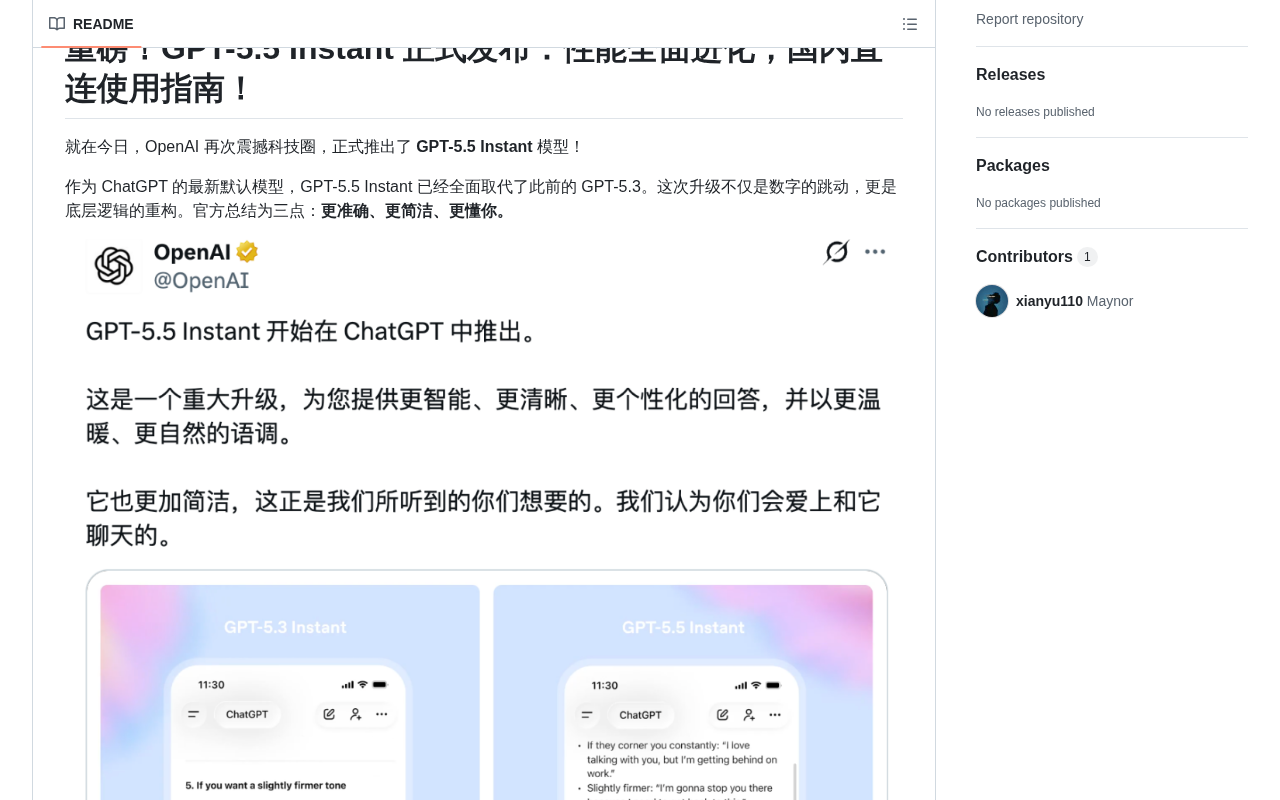
Why GPT-5.5 Instant Is a Fake Project
OpenAI Has Not Released Any GPT-5.5 Model
As of now, OpenAI has not released any model called "GPT-5.5 Instant." OpenAI's latest model developments can be confirmed through their official blog, Twitter/X account, and API documentation. Any major model release would be formally announced through official channels—never debuted through a personal GitHub repository.
Notably, OpenAI's model naming follows a consistent pattern and evolutionary path. From GPT-3 to GPT-3.5 to GPT-4, each generation's release has been accompanied by detailed Technical Reports, performance benchmark results, and simultaneous announcements from partners. For example, GPT-4's release was preceded by months of Red Teaming and safety evaluations. The "Instant" suffix has never appeared in OpenAI's naming system—OpenAI uses suffixes like "turbo" (e.g., GPT-3.5-turbo) and "mini" (e.g., GPT-4o mini) to differentiate model variants across performance tiers. Any "new model" that deviates from this naming convention should raise immediate suspicion.
Extremely Abnormal Project Metrics
The repository has only 1 Star, 0 Forks, and contains no actual code (Language shows as None). Think about it—if this were truly a groundbreaking AI model release, how could it have virtually zero attention on GitHub? By comparison, OpenAI's official open-source projects typically have thousands or even tens of thousands of Stars.
To understand why these metrics are so anomalous, you need to understand how GitHub works. As the world's largest code hosting platform with over 100 million developers, GitHub's Star mechanism functions like a "like" button on social media, reflecting community recognition of a project. Forks indicate that other developers have copied the project for further development, serving as an important measure of project influence. For reference, OpenAI's official open-source projects like Whisper (speech recognition model) has over 70,000 Stars, and CLIP has over 25,000 Stars. A Language field showing None means the repository contains no source code files recognizable by GitHub's language detection system—extremely abnormal for a project claiming to release an AI model, since even inference scripts or configuration files would be detected as Python, JSON, or other languages.
"Direct Access in China" Is a Classic Traffic-Bait Scam Tactic
The phrase "direct access guide for users in China" in the title is a very typical traffic-generation keyword. Since OpenAI's services cannot be directly accessed from mainland China, many bad actors exploit users' urgent needs by using phrases like "direct connection" or "no VPN needed" to attract clicks. Their ultimate goals may include:
- Promoting third-party proxy services that charge exorbitant fees
- Collecting personal information, including sensitive data like API Keys
- Distributing malware or phishing links
- Pure traffic monetization by gaining followers through false information
For context: Due to geopolitical and regulatory factors, OpenAI has explicitly restricted API access from mainland China IP addresses since 2023, further tightening these policies in 2024. This restriction has spawned numerous gray-area "relay services" and "mirror sites," many of which carry extremely high compliance risks. The legitimate approach is to access GPT models through enterprise-grade channels like Azure OpenAI Service provided by Microsoft, or to use compliant domestic large model alternatives (such as Baidu's ERNIE Bot, Alibaba's Qwen, or Zhipu's ChatGLM). Third parties claiming to offer "direct access" often pose data security risks—users' conversation content and API keys may be intercepted and misused by intermediaries.
The Account Name Reveals True Intent
The GitHub account is named xianyu110—"Xianyu" (闲鱼) is a well-known second-hand trading platform in China. This naming suggests the account is likely associated with some form of commerce or promotional activity, rather than belonging to a serious technical developer or research institution.
How to Identify Fake Information in the AI Space
During the AI boom, Social Engineering attacks have taken on new characteristics. Attackers exploit people's curiosity about cutting-edge AI technology and FOMO (Fear of Missing Out) psychology to package seemingly credible fake projects. Common tactics include: fabricating model demo videos, creating counterfeit official documentation pages, and manufacturing fake discussion buzz on social media. Once an API Key is leaked, attackers can use the victim's account credits to make massive API calls, generating enormous charges, while the victim's usage data also faces exposure risks.
Step 1: Verify Official Sources
For any major AI model release, your first action should be checking official channels:
- OpenAI Official Blog: https://openai.com/blog
- OpenAI's official Twitter/X account
- Reports from authoritative tech media (such as The Verge, TechCrunch, etc.)
If only some obscure GitHub repository is "announcing" a release while official sources and mainstream media are completely silent, you can safely conclude it's fake news.
Step 2: Evaluate GitHub Project Credibility
When assessing whether a GitHub project is trustworthy, focus on these indicators:
- Star and Fork counts: Popular projects typically have substantial community engagement
- Code content: Whether there are substantive code commits
- Contributor information: Whether well-known developers are involved
- Issue and PR activity: Real projects usually have active community discussions
- Account history: The publisher's other projects and activity records
Step 3: Be Wary of "Too Good to Be True" Information
When you see highly attractive headlines like "major release," "direct access," or "free to use," you should be even more vigilant. In the AI space, misinformation and exaggerated claims have become a serious problem, exploiting people's desire to chase new technology.
The Real State of OpenAI Models in 2024-2025
As of now, OpenAI's main publicly available models include the GPT-4o, GPT-4o mini, o1, o3, and o4-mini series. Regarding next-generation model releases, OpenAI has not provided a clear timeline.
OpenAI's current model architecture is divided into two major series: the GPT series (focused on general conversation and text generation) and the o series (focused on deep reasoning). GPT-4o is the multimodal flagship model released in May 2024, where "o" stands for "omni," supporting unified processing of text, images, and audio. GPT-4o mini is its lightweight version, optimized for cost and speed. The o1 series, released in September 2024, introduced a Chain of Thought reasoning mechanism that enables internal reasoning before responding. o3 and o4-mini are updated iterations released in 2025. All these models have undergone rigorous safety testing processes, with capability boundaries and known limitations detailed in official Model Cards.
Users should obtain the most accurate model information through the official API documentation (https://platform.openai.com/docs) rather than trusting claims from unknown third parties.
Conclusion: Stay Rational, Stay Away from AI Scams
In today's era of rapid AI development, discerning truth from falsehood has become especially important. When encountering messages like "GPT-5.5 released," we should:
- Stay rational and not get swept up by clickbait
- Verify through official channels to confirm the source
- Check project authenticity by examining data metrics
- Protect personal information and never provide API Keys to untrusted services
Remember: Do not click links from unknown sources, and do not provide your API Key or personal information to untrusted third-party services. A moment of curiosity could lead to irreversible losses.
Key Takeaways
- A repository on GitHub claims "GPT-5.5 Instant officially released," but OpenAI has not released this model—it is disinformation
- The project has only 1 Star, 0 Forks, and no code whatsoever, completely inconsistent with a genuine AI model release
- "Direct access guide for China" is a classic traffic-bait tactic, potentially involving proxy promotion, data collection, or phishing attacks
- To identify fake AI information, verify official sources, check project credibility, and be wary of overly sensational headlines
- Users should obtain model information through OpenAI's official channels and never provide sensitive data to untrusted third parties
Related articles
 Tech Frontiers
A Rare Quiet Day in AI: Recursive Self-Improvement Stirs Beneath the Surface
A rare quiet day in AI sees multiple sources go silent simultaneously. Behind the calm, Recursive Self-Improvement (RSI) research continues. What this means for the industry.
 Tech Frontiers
Reve 2 vs. Ideogram 4: A Deep Dive into Layout Control in AI Image Generation
A deep comparison of Reve 2 and Ideogram 4's layout control capabilities, covering technical approaches, real-world use cases, and industry trends for designers and creators.
 Tech Frontiers
In the Weights: Check Your Influence Score in the AI World
In the Weights is an AI influence search engine that quantifies your presence in the AI world with a score. Explore how it evaluates practitioners and what it means for digital identity.