Is Imagination the New Productivity? Rethinking the Boundaries of Creativity in the Age of AI

Generative AI shifts the creative bottleneck from execution to imagination — making judgment and vision the new scarce resources.
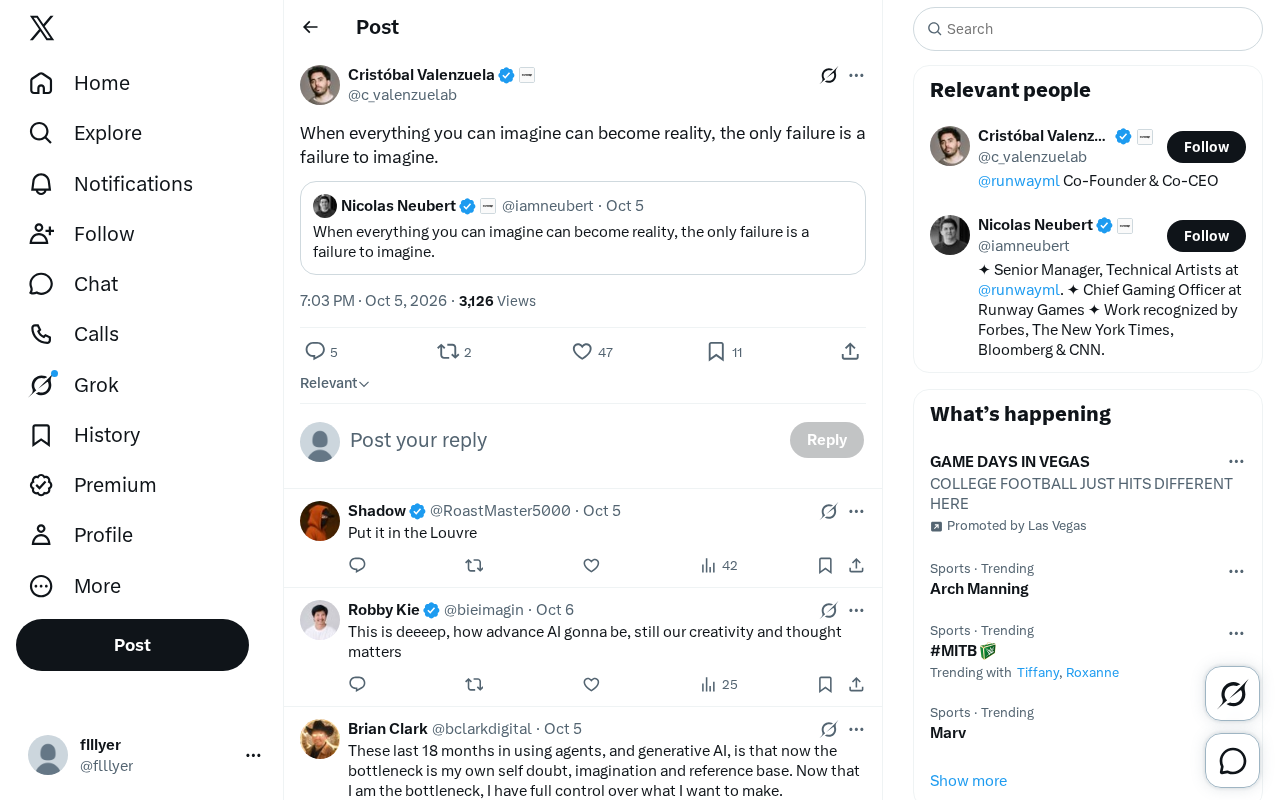
A tweet — "When everything you can imagine can become reality, the only failure is a failure to imagine" — frames the core question of the generative AI era: as the cost of producing text, images, and code approaches zero, the bottleneck shifts from execution to conception. The article affirms the motivational value of this idea while identifying three blind spots: AI still has real limits in controllability; quality imagination depends on deep domain knowledge; and once generative capability is widespread, taste and judgment become the true differentiators. For practitioners, the takeaways are clear: sharpen your ability to articulate needs, maintain domain expertise, and redirect attention from repetitive execution toward problem definition and creative exploration.
A Tweet That Captures a Defining Question of Our Time
A short line circulating on Twitter has sparked considerable discussion: "When everything you can imagine can become reality, the only failure is a failure to imagine."
The tweet came without much context, yet it cuts to the heart of a central anxiety — and opportunity — in the current wave of generative AI: as technical barriers continue to fall, the truly scarce capability is shifting from how to build to what to build.
From Execution Bottleneck to Imagination Bottleneck
For decades, turning a creative idea into reality was constrained by resources, skills, and time. Writing code required mastering a programming language. Producing a design required proficiency in professional software. Making a video required a whole team. These execution-layer barriers naturally filtered out the many people who had ideas but lacked the means to realize them.
Generative AI is changing this dynamic. Text, images, code, audio, video — an ever-growing range of outputs can now be produced from natural language descriptions. As the cost of making something approaches zero, the bottleneck shifts upstream to conceiving something. In other words, the question is no longer whether you can build it — it's whether you can imagine it clearly enough in the first place.
That's the core logic the original tweet is pointing toward: failure no longer stems from a lack of ability, but from a failure of imagination.
What is Generative AI? Generative AI refers to artificial intelligence systems that can automatically produce text, images, code, audio, and even video based on natural language descriptions or other forms of input prompts. The underlying technology typically relies on large language models (LLMs) or diffusion models. Unlike traditional AI, which is primarily used for classification and prediction, generative AI's core capability lies in creation — producing content that previously only humans could make. Tools like ChatGPT, Midjourney, and GitHub Copilot are representative examples. The reason these systems have sparked discussions about lowering execution barriers is simple: users no longer need expertise in programming, design, or video production. They simply describe their intent in natural language, and the system handles a significant portion of the actual production work.
The Optimism — and the Blind Spots
Statements like this carry a clear streak of technological optimism. At the level of motivation, that has real value — it encourages bold thinking and frees people from feeling constrained by their tools. But taking it as a complete description of reality requires a few caveats.
First, "everything you can imagine can become reality" is still hyperbole. AI-generated outputs have real limits in accuracy, controllability, and physical feasibility. Bringing complex systems to life still requires substantial engineering work and rigorous validation.
Second, imagination itself doesn't come from nowhere. High-quality imagination is typically grounded in deep domain knowledge, aesthetic judgment, and a sharp sense of what problems are worth solving. Someone with no background in a field will struggle to "imagine" a genuinely valuable solution in that space. The claim that "all you need is imagination" risks undervaluing the foundational knowledge that makes meaningful imagination possible.
Third, when generative capability becomes widespread, scarcity gets redistributed. When everyone can generate content, discernment, taste, and a sense of direction become the new sources of competitive differentiation.
Practical Takeaways for Creators and Professionals
Setting aside the rhetorical flourish, the tweet still offers real guidance for personal development in the AI era.
Develop the ability to articulate needs clearly. In human-AI collaboration, prompt engineering, requirement decomposition, and precise expression of intent are becoming increasingly important. Thinking clearly and communicating precisely is the prerequisite for translating imagination into high-quality output.
Maintain deep expertise in your domain. Tools can lower the execution barrier, but they cannot substitute for judgment. A knowledgeable person using AI is far more effective; someone without domain expertise may be misled by outputs that appear plausible but are fundamentally wrong.
Shift your time from execution to conception. As repetitive labor gets automated, human attention should flow toward problem definition, creative exploration, and evaluation of results — precisely the areas where machines remain weakest.
What is Prompt Engineering? Prompt engineering refers to the methodology and practical skill of crafting natural language instructions for AI systems in order to guide them toward outputs that better match intended results. It goes well beyond simple keyword stacking — it involves breaking down goals, establishing context, assigning roles, and specifying constraints. In current human-AI workflows, the same underlying need expressed in different ways can yield dramatically different output quality. This has elevated "clear articulation of needs" from a soft skill to a measurable, trainable hard skill. Some companies have already incorporated prompt engineering into employee training programs, and several universities are exploring adding it to their curricula — a trend that underscores the article's point that thinking clearly and expressing precisely is becoming a core driver of productivity in the AI age.
Closing Thoughts
This tweet reads more like a rallying cry for our times than a rigorous claim. Its value lies in the reminder it offers: beneath the wave of technological opportunity, what determines the ceiling is rarely the tool — it's the scope of imagination and depth of judgment of the person wielding it. As the path from imagination to reality grows shorter, what was never scarce was the ability to execute. What remains scarce is the idea worth executing in the first place.
Related articles

NVIDIA's 30,000 Developers Use Cursor, Code Commit Volume Triples
Cursor engineer Chris Diaz breaks down five organizational gaps blocking enterprise AI coding scale—strategy, risk tiering, governance, metrics, and operating model. NVIDIA's 30,000 developers use Cursor daily, tripling code commits while defect rates stay flat. The key: rewrite the SDLC, not add tools.

Ponytail: Giving AI Coding Agents a Senior Engineer's Mindset
Ponytail is a free GitHub tool that injects a senior engineer's mindset into AI coding agents, making them ask whether code is even necessary first. According to TamilDeck, it can compress 200 lines of AI-generated code to 30, cutting token costs, with support for Cursor rules and Claude Code skill integration—though security review still requires human oversight.

Complete Guide to Connecting Cursor AI to the GitHub MCP Server
A step-by-step guide to connecting Cursor AI to the GitHub MCP server: create a personal access token, configure mcp.json, store the token in the ENV block, and verify with a PR query.