Is It Too Late to Get Into AI? Developers Are at a 2005 Moment
AI today is like the web in 2005—fear is the biggest risk, and the real opportunity has only just begun.
Responding to the fear of falling behind as AI refreshes your feed daily, the article offers an alternative frame: likening the present to the 2005 starting point of web development, when some also declared "the web is too crowded," yet trillions in revenue and countless jobs followed. Avoiding AI out of fear becomes a self-fulfilling prophecy, and those who refuse to adapt are left behind first. The article proposes a "double paradox": avoiding learning means falling behind as workflows modernize, while universal automation shrinks execution roles—yet the barrier to building drops sharply, turning tool masters from bystanders into leverage orchestrators. Jobs aren't vanishing but morphing into new roles in AI orchestration, domain deployment, and evaluation/governance. Finally, comparing Meta's market cap at three points in time against total tech market cap shows the tech sandbox expanding exponentially—the hype land-grab phase is over, but the real game has only just begun.
Where the Anxiety Comes From: When AI Tools Refresh Your Feed Every Day
Every morning you wake up to a feed packed with new AI tools, automated workflows, and model updates. A natural anxiety creeps in: "Has everyone already left me behind?" "Is my job going to be wiped out before it even starts?"
That pressure is understandable, but it's built on the wrong frame of reference. To really see where you stand, you need a different coordinate system—one that compares today with the starting point of web development in 2005.
The 2005 Parallel: Did You Really Miss the Web Development Train?
Imagine 2005: Facebook had just started spreading across college campuses, early web frameworks were beginning to gain traction, and the modern web was taking shape. If someone had said then, "Social media has already been built, the web is too crowded, I missed the web development train," that judgment would look absurd in hindsight.
Because after 2005, trillions of dollars in revenue, entirely new industries, and billions of tech jobs were created. Not everyone needed to build a Facebook-scale platform to have a successful software career.
The original author's core metaphor is direct: AI today is web in 2005. We're not at the finish line—we're at the starting line of a decades-long transformation.
The LAMP stack was the most representative technology combination in 2000s web development, made up of four layers: Linux (operating system), Apache (web server), MySQL (database), and PHP (server-side scripting language). All of its components were open-source software with extremely low deployment costs, making it the default choice for early social networks, blogs, and e-commerce sites—Facebook in its early days ran on PHP/LAMP. The significance of LAMP lies not just in the technology itself, but in how it lowered the barrier to "building a usable web application" from requiring expensive commercial software and dedicated operations staff down to a single ordinary server plus a few developers. This was precisely the technical precondition that let the 2005 "web development train" carry a large number of ordinary engineers, and it's also the key background for understanding the argument that "lowering barriers is what drives large-scale value creation."
The Self-Fulfilling Prophecy: Fear Itself Is the Biggest Risk
There's a paradox in how people respond to AI. Worrying that "AI will replace my industry" often leads people to freeze up and simply avoid learning these tools. But as industries modernize and adopt automated workflows, those who refuse to adapt are the ones most likely to be left behind.
This creates a self-fulfilling prophecy: refusing to engage with AI out of fear is equivalent to guaranteeing you'll be skipped over by this transformation.
This psychological mechanism deserves serious attention. It explains a phenomenon: many people say they're paying attention to AI but avoid it in their behavior, ending up with neither accumulated tool skills nor a real understanding of AI's capability boundaries.
The Double Paradox: The Baseline Is Shrinking, the Ceiling Is Rising
Looking deeper into this transformation reveals a structural irony that holds on both sides at once.
The "lose-lose" trap: Avoiding learning AI out of fear means falling behind as workflows modernize; but if everyone automates tasks with AI at scale, the number of people needed for baseline execution shrinks. Both paths lead to the same outcome—traditional execution-oriented roles contract.
The "win-win" frontier: Task automation lowers demand for routine tasks, but it dramatically lowers the barrier to building. Today one engineer can deliver a product that used to require a ten-person team. For those who master AI tools, the identity shifts from "bystander who might be replaced" to "orchestrator who builds leverage."
The net effect: the baseline of traditional execution is shrinking, but the ceiling for individual leverage and creativity has never been higher.
The term "leverage" that appears repeatedly in the article is borrowed from a general concept in software engineering and finance, referring to the ability to get multiplied output from the same input. In the AI context, leverage comes from roughly three sources: first, tool leverage, i.e., using models to automate repetitive work (boilerplate code, documentation, testing, data cleaning); second, orchestration leverage, i.e., chaining multiple models and tools into a pipeline so a single design decision gets reused repeatedly; third, knowledge leverage, i.e., codifying domain experience into executable prompts, evaluation sets, or retrieval corpora. Understanding leverage helps clarify the divide between "lose-lose" and "win-win": lose-lose happens when AI is only used as a tool to complete existing tasks faster, producing linear output growth while headcount demand falls; win-win happens when leverage changes the structure of the task itself, reinvesting saved time into defining problems, validating quality, and expanding boundaries, so that individual output grows non-linearly.
Jobs Don't Disappear—They Morph
Automation changes how traditional tasks are executed, but the AI ecosystem is creating job categories that didn't exist three years ago:
- AI systems and orchestration: Building context pipelines, retrieval systems, and secure application boundaries around foundation models.
- Domain-specific AI translation: Safely landing raw AI capabilities in specialized fields like healthcare, legal tech, finance, and education.
- Evaluation and governance: Auditing model reliability, data quality, and system security in production environments.
These opportunities haven't shrunk—they're morphing into high-leverage roles. For developers, this means the center of gravity of the skill set shifts from "writing more code" to "defining problems, designing pipelines, and validating output."
Context pipelines and retrieval-augmented generation (RAG) are the core technical objects of "AI systems and orchestration" roles. A large model itself only holds the static knowledge from its training data, and its context window is limited, so it can't directly access a company's internal documents, the latest data, or users' private information. RAG works like this: first split external materials into chunks, vectorize them, and store them in a retrieval database; when a user asks a question, retrieve the most relevant fragments, stitch them together with the question into a prompt, and hand it to the model to generate an answer. Around this process, you also need to handle engineering problems like chunking strategy, retrieval quality, prompt templates, citation tracing, and hallucination suppression. This work doesn't involve training the model itself, but it determines whether an AI application is reliable and usable—and it's exactly the part where traditional backend and application development experience transfers directly.
AI evaluation and governance (eval & governance) became a standalone role because of the probabilistic nature of large-model output: the same input can produce different results, and errors often appear in the form of "sounds reasonable," which traditional unit tests can't fully cover. Evaluation practice typically includes building test sets that match the real business distribution, defining metrics like accuracy/faithfulness/safety, running offline batch evaluations and online A/B comparisons, and introducing human review and red-team testing. Governance involves data source compliance, privacy de-identification, auditability of model behavior, and defining boundaries of responsibility. In regulated fields like healthcare, law, and finance, this capability is often a prerequisite for whether an AI application can go to production, so demand for related talent rises as deployment deepens rather than falling as automation spreads.
A Data Perspective: The Tech Sandbox Is Expanding Exponentially
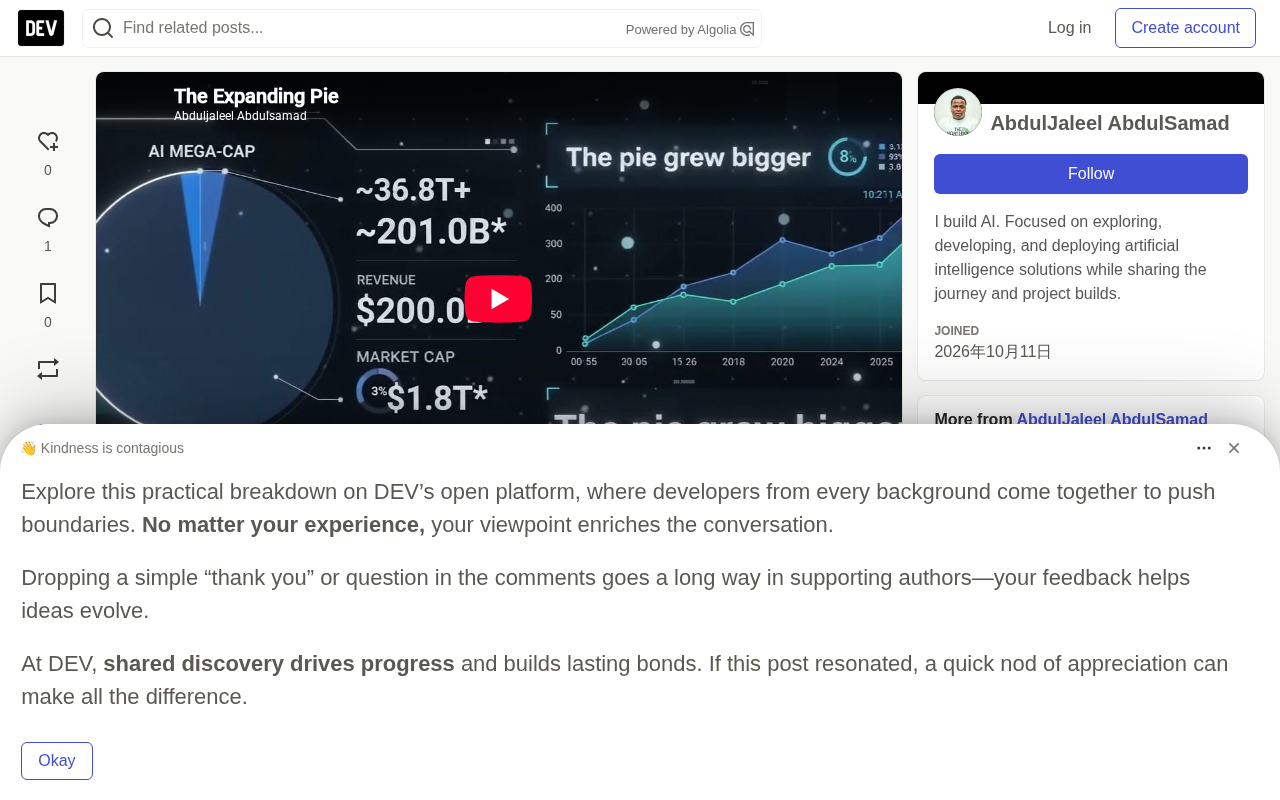
The original author used a comparison chart to quantify this, placing three points in time side by side: 2005, 2015, and 2025:
- In 2005, Meta (then Thefacebook) had revenue of about $9 million and a valuation of about $100 million, running on the PHP/LAMP stack; the entire public tech market was worth about $1.8 trillion, and Facebook accounted for less than 0.01%.
- In 2015, Meta had revenue of $17.93 billion and a market cap of about $300 billion, roughly 4.6% of the ~$6.5 trillion tech market cap.
- In 2025, Meta has revenue of about $201 billion and a market cap of about $1.8 trillion—exactly equivalent to the total market cap of the entire public tech market in 2005. But by now total tech market cap exceeds $32 trillion, and Meta accounts for only about 5.6%; the remaining $30+ trillion (about 94.4%) belongs to AI infrastructure, cloud platforms, developer tools, enterprise SaaS, and vertical-domain tools.
The conclusion this chart aims to show: tech is not a zero-sum game. Headline-dominating monopolists grab the attention, but the underlying market's sandbox is expanding far faster than any single player's growth, so the value and leverage available today for new software builders is greater than it was twenty years ago.
It should be noted that the financial data above all comes from the original author's chart compilation and represents single-source estimates and aggregations; the 2005 revenue figure is labeled as an estimate, and this caveat should be preserved when citing it.
So, Are You Late?
Short answer: Yes, you missed the initial hype wave—the early land-grab phase is over.
The real answer: No, because the real game has only just begun. The engine has only just warmed up, tools are becoming easier to access, the barrier to entry is falling, and the real value lies in how creatively and effectively you use these tools to solve real problems.
The train hasn't left the station yet. Get on now, and you can still find your seat before it picks up speed.
Are you feeling AI fatigue, or are you using it to build something new? Where is the biggest opportunity emerging in your field?
One-line Summary
AI today is like the web in 2005—fear is the biggest risk, and the real opportunity has only just begun.
Paragraph Summary
Responding to the "falling behind" anxiety that comes from AI refreshing your feed every day, the article offers an alternative frame of reference: likening the present to the starting point of web development in 2005—when some also declared "the web is too crowded," yet trillions in revenue and massive numbers of jobs followed. The author points out that avoiding AI out of fear creates a self-fulfilling prophecy, and those who refuse to adapt are the first to be left behind. The article further proposes a "double paradox": avoiding learning means falling behind as workflows modernize, while universal automation shrinks the baseline of execution roles; but at the same time, the barrier to building drops dramatically, and those who master the tools shift from bystanders to leverage orchestrators. Jobs aren't disappearing but morphing, giving rise to new roles in AI system orchestration, domain deployment, and evaluation/governance. Finally, a comparison of Meta's market cap at three points in time against total tech market cap shows the tech sandbox is expanding exponentially—the conclusion being that the hype land-grab phase is over, but the real game has only just begun.
Related articles

OpenAI Partners with Shield: How the Astra Agent Revolutionizes IT Troubleshooting
OpenAI and Shield launch the Astra agent, which autonomously logs into computers and legacy systems to fix IT issues in real time, 35-40% faster than traditional models, with humans involved only when judgment is needed.

iPhone Duo Battery Life Tested: One Charge a Day Is Unavoidable, and the Large Screen Is the Culprit
iPhone Duo battery test: heavy use needs at least one charge a day, and about 30% remains after 6.5 hours of screen-on time. How often the large screen is unfolded is key; a MagSafe battery pack helps, and long-term degradation is also worth watching.

Kimi K3.1 Pro Open-Sourced: 2.8 Trillion Parameters Close In on Opus
Moonshot releases the open-source MoE model Kimi K3.1 Pro, with 2.8T total parameters and 104B activated, trailing Opus 5.5 by under 1 point on Terminal Bench 4.0.