Is It Worth Tearing Down a Microduck Robot Just for Parts? A Detailed Cost Breakdown of Servos and Sensors
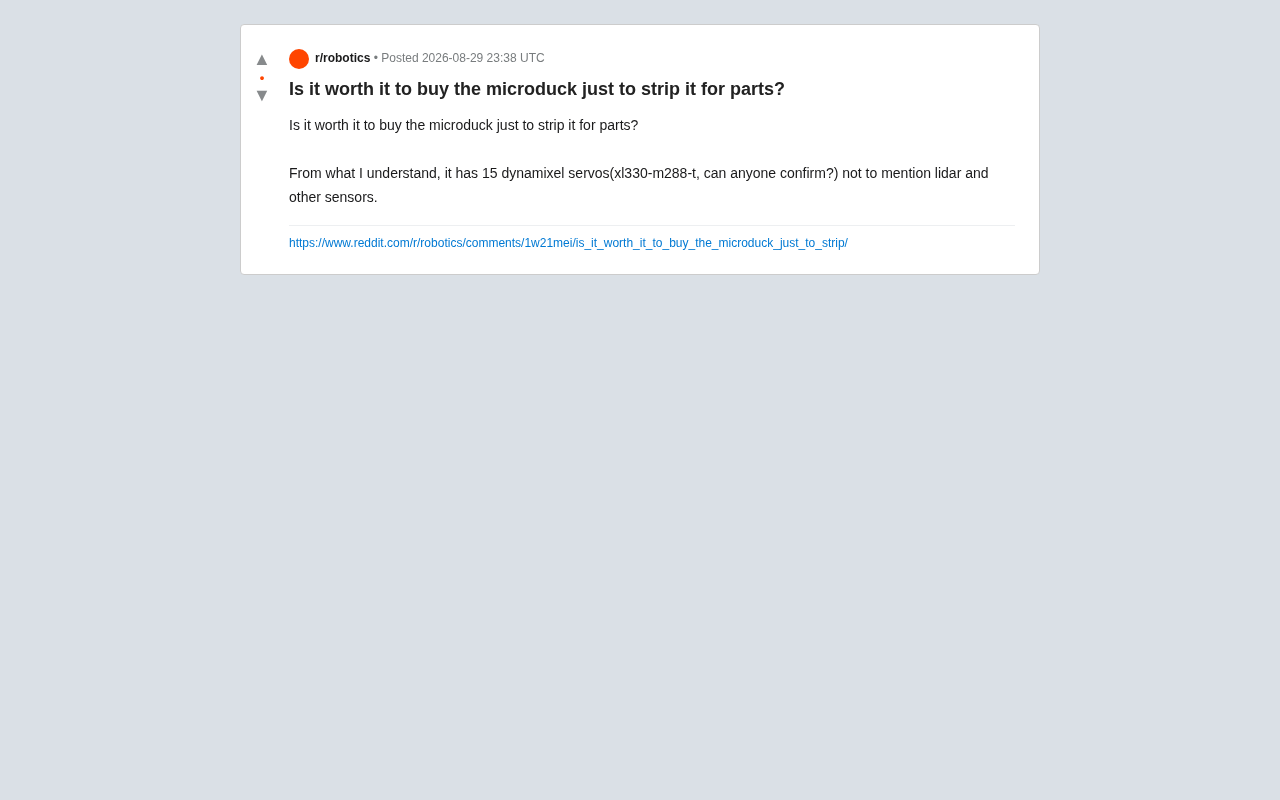
Breaking down whether buying a Microduck robot just to harvest its Dynamixel servos and LiDAR makes financial sense.
This article analyzes the economics of purchasing a Microduck robot solely to strip its 15 Dynamixel XL330 servos and LiDAR sensor. While the parts' combined retail value ($360–450 for servos alone) could exceed the robot's price, practical factors like model verification, teardown difficulty, connector damage risk, and proprietary firmware complicate the equation. The piece also explores broader supply chain dynamics that make this arbitrage possible.
Starting with an Unusual Question
In the robotics hobbyist community, a seemingly unconventional question has sparked a heated discussion: is it actually worth buying a Microduck robot just to tear it down and harvest the components inside?
This question reflects a typical mindset among DIY and open-source hardware enthusiasts — when a finished robot's core components (especially high-value servo motors and sensors) are prohibitively expensive to buy individually, could the complete robot itself be a better deal as a "parts kit"? This line of thinking isn't uncommon in consumer electronics and open-source hardware. Historically, there have been cases where the flash memory chips inside an Apple iPod Touch had a retail value exceeding the price of the device itself, leading some companies to bulk-purchase the units for chip recovery. In the robotics field, since smart servos and sensors carry high retail margins, while finished robots may adopt aggressive pricing strategies to break into the education or consumer market (even selling hardware at a loss and profiting from software and curriculum services), a price inversion between parts and finished products can emerge.
According to one Reddit user's analysis, the Microduck reportedly contains as many as 15 Dynamixel servos (suspected model: XL330-M288-T), along with an integrated LiDAR (Light Detection and Ranging) sensor and various other sensors. If these specifications are accurate, the economic discussion around "buying a robot to strip for parts" becomes quite interesting.
Dynamixel XL330 Servos: Why They're the Core of the Teardown Value
The Role of Smart Servos in Robotics Projects
Dynamixel is a widely recognized smart servo brand in the robotics field, manufactured by the South Korean company Robotis. Founded in 1999 and headquartered in Seoul, Robotis is a global leader in smart servos and educational robotics. The Dynamixel product line spans from entry-level AX/XL series to industrial-grade PH/PM series, with torque ranges from 0.2 N·m to 44.7 N·m, covering virtually every application scenario from desktop education to industrial research.
Unlike conventional PWM servos, the Dynamixel series uses bus-based communication (TTL/RS485), enabling precise feedback and control of position, speed, and current. This makes them a go-to choice for building high-DOF (Degrees of Freedom) robots such as bipeds, quadrupeds, and robotic arms. Traditional PWM (Pulse Width Modulation) servos can only receive one-way control signals, require an independent signal wire for each servo, and cannot report their current state back to the controller. In contrast, the TTL and RS485 serial communication protocols used by Dynamixel allow multiple servos to be daisy-chained on a single bus, with each servo assigned a unique ID address. This means a controller can manage dozens of servos through a single data line while reading each servo's position, speed, load, temperature, and input voltage in real time. This bidirectional communication capability makes complex closed-loop motion control possible and is the fundamental reason Dynamixel is so widely adopted in research-grade and competition-grade robots.
Around the Dynamixel servo ecosystem, Robotis has built a comprehensive suite of hardware and software tools: on the hardware side, dedicated controller boards like OpenCR and OpenRB, plus the U2D2 communication converter; on the software side, the Dynamixel SDK (supporting C/C++/Python/Java/MATLAB and more) and the Dynamixel Wizard 2.0 firmware management tool. Additionally, Robotis has released open-source robot platforms based on Dynamixel, such as TurtleBot3 (an official ROS-recommended mobile robot platform) and the OpenManipulator robotic arm, establishing Dynamixel as a de facto standard in robotics education and research.
XL330-M288-T: A Miniaturized Powerhouse
The XL330-M288-T belongs to the Dynamixel X series, designed for micro-scale robots and released around 2020. In the model name, "M288" refers to a stall torque of approximately 0.288 N·m, and "T" indicates a TTL communication interface. Weighing just 18 grams with dimensions of 20×34×26mm, this servo packs in a 12-bit magnetic encoder, a 32-bit ARM Cortex-M processor, a three-axis accelerometer, and a temperature sensor. It supports Dynamixel Protocol 2.0 with communication speeds up to 4.5Mbps and operates within a voltage range of 3.7V to 5V (compatible with a single lithium battery cell).
This miniaturized design makes it particularly well-suited for desktop educational robots and micro biomimetic robotics projects. Its unit price typically falls in the $24 to $30 range. If the robot truly contains 15 of these servos, the market procurement cost for the servos alone would reach approximately $360 to $450 — already a substantial sum.
Running the Numbers on a Teardown
From a pure parts-value perspective:
- 15 XL330 servos: At an estimated unit price of $24–30, the total comes to roughly $360–450. This is by far the highest-value component in the robot.
- LiDAR module: LiDAR (Light Detection and Ranging) works by emitting laser pulses and measuring the time-of-flight of reflected light to build a distance map of the surrounding environment. In robotics, small 2D LiDAR sensors (such as SLAMTEC's RPLiDAR series or LDRobot's LD series) typically cost between $60 and $200, and can scan a full 360-degree environment at thousands of sample points per second. LiDAR is one of the core sensors for implementing SLAM (Simultaneous Localization and Mapping) algorithms, which allow a robot to simultaneously build a map of an unknown environment and determine its own position while moving — a foundational technology for autonomous navigation. Within the ROS ecosystem, LiDAR data can be directly fed into mature SLAM frameworks like Cartographer and GMapping, significantly lowering the development barrier.
- Other sensors: Auxiliary components like IMUs (Inertial Measurement Units) and encoders also have some recovery value.
If the robot's retail price is lower than the combined cost of purchasing these parts separately, then "buying the whole robot to strip for parts" could theoretically be the better deal. This is a common arbitrage approach among DIY enthusiasts when hardware costs run high. At a deeper level, this phenomenon reflects the fragmentation of the robotics parts supply chain — the unit price for small-batch component purchases is far higher than the cost of scaled integration, and individual developers bear a disproportionate hardware cost burden. Some Dynamixel servos may retail at 3 to 5 times their estimated manufacturing cost, while finished robot manufacturers can leverage bulk purchasing to dramatically reduce per-component costs.
Practical Considerations for the Teardown Approach: It's Not Just About the Price Gap
Confirming the Model Is the First Hurdle
The original poster was also seeking confirmation — are the servos really XL330-M288-T units? This is critical. The Dynamixel product line includes multiple models that look similar but differ significantly in specifications. For example, the XL330-M077-T, which belongs to the same XL330 series, is externally identical but has a stall torque of only 0.077 N·m — roughly one-quarter that of the M288 variant — making it suitable for entirely different applications. Different Dynamixel servo models have notable differences in torque, communication protocols, and firmware. If the actual model doesn't match expectations, the entire economic calculation falls apart.
Teardown Difficulty and Parts Damage Risk
Components in finished robots often feature customized wiring harnesses, firmware configurations, and structural mounting. The following issues may arise during disassembly:
- Damaging connectors or cables — Dynamixel servos use proprietary JST connectors, and these small connectors are extremely prone to damage during repeated insertion/removal or forceful disassembly
- Encountering proprietary interfaces or non-standard firmware — manufacturers may have customized the servo's Control Table, locked certain parameters, or changed the default communication baud rate, requiring tools like Dynamixel Wizard 2.0 for firmware recovery
- Extracted servos may not be directly compatible with other projects — mechanical mounting methods, cable lengths, and ID configurations may all need to be reconfigured
These hidden costs are easy to overlook but can, in practice, turn a seemingly "good deal" into a net loss.
Don't Underestimate the Value of the Complete Robot
If the Microduck is a fully functional, well-designed robot platform, tearing it down into parts is essentially a "downgrade" in how you use it. For robotics learning and research, keeping the robot intact for secondary development may offer greater long-term value than a pile of loose parts. A complete platform integrating motion control, environmental perception, and autonomous navigation capabilities has engineering integration value that far exceeds the sum of its parts' prices. From a software perspective, if the Microduck provides ROS-compatible drivers and interfaces, developers can directly validate algorithms and run experiments on it, saving the enormous time cost of building a hardware platform from scratch.
The Cost Dilemma in Open-Source Robotics Hardware
This discussion also highlights a common tension in the current open-source robotics hardware ecosystem: the cost of core components — especially smart servos and LiDAR — often accounts for the vast majority of a robot's total cost.
For individual developers and small teams, finding lower-cost ways to obtain these high-value components is a persistent pain point. In comparison, the prices of 3D-printed structural parts and single-board computers (like Raspberry Pi and Jetson Nano) have dropped dramatically, but the price decline for precision actuators and high-performance sensors lags far behind Moore's Law's effect on computing chips. In recent years, some emerging manufacturers (such as Feetech and Waveshare) have released low-cost smart servos that are Dynamixel-compatible or offer similar functionality, attempting to challenge Robotis's market dominance. However, gaps remain in reliability, ecosystem completeness, and community support.
The very emergence of the "teardown for parts" approach signals that retail pricing for core robotics components still has significant room for optimization. It also serves as a reminder to the industry that when component retail pricing shows a significant inversion relative to finished product pricing, the business model itself may need rethinking.
Conclusion: Whether It's Worth It Depends on Your Specific Situation
Returning to the original question — is it worth buying a Microduck robot just to strip it for parts?
The answer depends on several key variables:
- The gap between the robot's actual retail price and the total market value of the parts — you need to precisely calculate the current market price of every component, including servos, LiDAR, controller boards, cables, and structural parts
- Whether the servo model is confirmed — verification that they are indeed XL330-M288-T units is a prerequisite, which can be done through product teardown reviews, official spec sheet comparisons, or community feedback
- Feasibility and risk of the teardown — whether your hands-on skills and tools are adequate, and whether you have experience with Dynamixel firmware recovery and reconfiguration
- Your actual need for these parts — whether you have a specific project in mind, such as building a robot requiring 10 or more degrees of freedom
If you happen to need a large number of Dynamixel servos and a LiDAR sensor, and the robot's price is significantly lower than the parts total, then the teardown could indeed be a smart deal. But if you're driven purely by curiosity or speculation, considering the teardown risks and potential component damage, purchasing the parts you need directly from official channels is a safer bet.
Ultimately, this is a "cost-effectiveness equation" that requires weighing specific prices, actual needs, and hands-on capability.
Related articles

OpenAI Partners with Shield: How the Astra Agent Revolutionizes IT Troubleshooting
OpenAI and Shield launch the Astra agent, which autonomously logs into computers and legacy systems to fix IT issues in real time, 35-40% faster than traditional models, with humans involved only when judgment is needed.

iPhone Duo Battery Life Tested: One Charge a Day Is Unavoidable, and the Large Screen Is the Culprit
iPhone Duo battery test: heavy use needs at least one charge a day, and about 30% remains after 6.5 hours of screen-on time. How often the large screen is unfolded is key; a MagSafe battery pack helps, and long-term degradation is also worth watching.

Kimi K3.1 Pro Open-Sourced: 2.8 Trillion Parameters Close In on Opus
Moonshot releases the open-source MoE model Kimi K3.1 Pro, with 2.8T total parameters and 104B activated, trailing Opus 5.5 by under 1 point on Terminal Bench 4.0.