Is Open-Weight AI Banned? A Debate Over AI Regulation

Open-weight AI isn't banned yet, but the regulatory debate over safety and national security is intensifying.
The question "Is open-weight AI banned?" captures a core tension in AI governance. Open-weight models like Meta's Llama series let anyone download, locally deploy, and modify model parameters — a fundamental departure from closed cloud APIs and a key driver of today's AI startup ecosystem. Regulatory concerns come from two directions: safety guardrails can be stripped at low cost with no recall mechanism once released, and geopolitical competition raises fears of leaking technological advantage. Proponents of openness argue that transparency enhances safety and that restrictions would consolidate AI power among a few giants. No comprehensive ban currently exists, but evaluation requirements and potential restrictions on frontier models are increasingly central to policy debates worldwide.
A Sharp Question
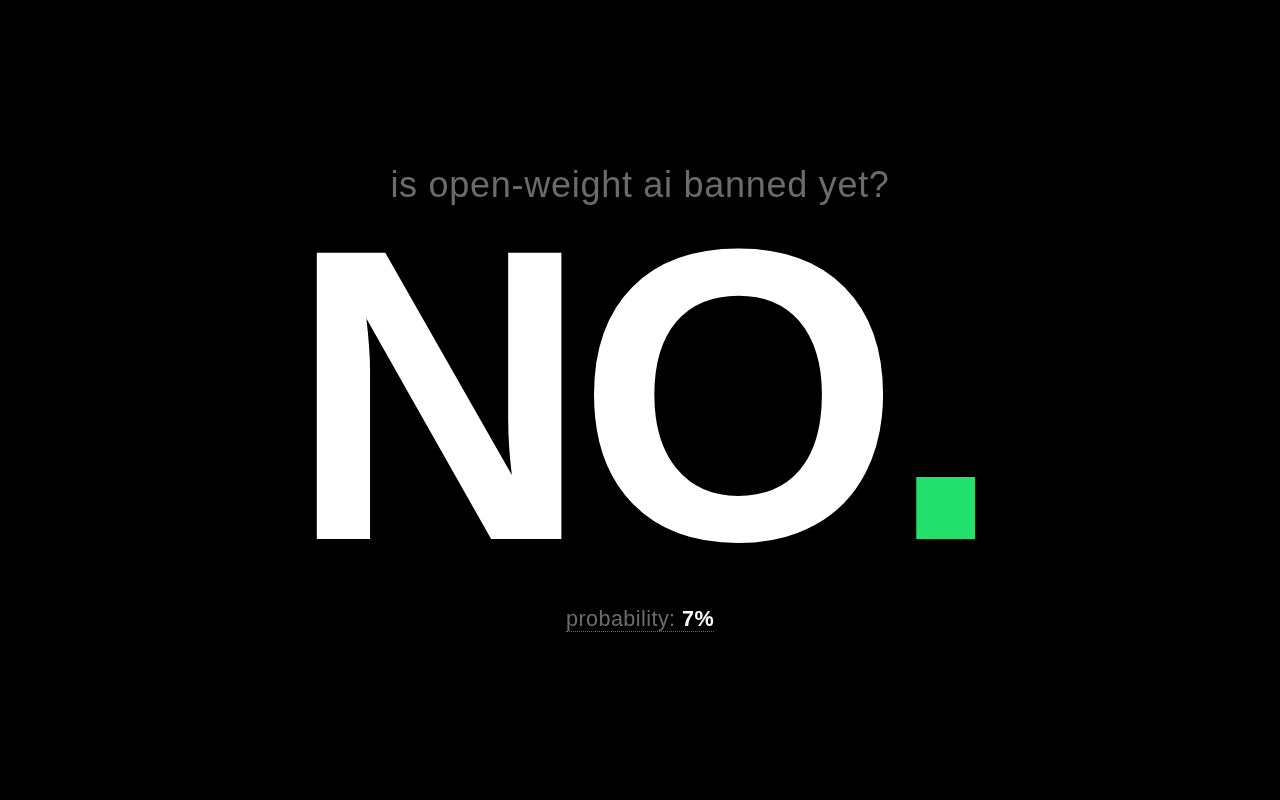
Recently, a topic titled "Is open-weight AI banned yet?" appeared on Hacker News. Though it hasn't gained much traction, it cuts to one of the most contentious issues in AI governance today — the regulation and survival of open-weight AI models.
Behind this seemingly simple question lies deep tension between technical openness, national security, commercial interests, and the freedom to innovate. It reflects a widespread anxiety in the open-source AI community: as large models grow ever more capable, is the regulatory sword of Damocles hanging over open-weight models?
What Is Open-Weight AI?
To understand the debate, we first need to clarify what "open-weight" actually means. An open-weight model is one whose trained parameters (weights) are publicly available — downloadable and deployable locally. Meta's Llama series, Mistral, and several models from Chinese labs all fall into this category.
It's worth distinguishing "open-weight" from "fully open-source." Open-source typically means training code, datasets, and weights are all public, whereas open-weight usually refers only to releasing the model parameters — the training data and full pipeline may remain proprietary. Even so, open-weight models grant developers enormous freedom: they can run models locally, fine-tune them, and build on top of them without depending on any vendor's API or cloud service.
This openness is a foundational pillar of today's thriving AI ecosystem. Countless startups, research institutions, and independent developers have been able to build applications at low cost precisely because open-weight models exist.
In terms of real-world impact, open-weight models have fundamentally shifted the power dynamics of AI. Before their emergence, running a high-performance language model meant paying for API access from OpenAI, Anthropic, or Google — your data would pass through third-party servers, and usage terms were set unilaterally by the platform. When Meta released the Llama series in 2023, developers could for the first time run a model approaching GPT-3.5 performance entirely on local hardware, even on consumer-grade GPUs. The significance of this shift wasn't just "free" — it was about data sovereignty, offline availability, and freedom from platform policy constraints. As a result, open-weight models have achieved penetration rates in data-sensitive industries like healthcare, law, and government that closed APIs can't match, and they've become an important gateway for Global South countries and resource-limited research institutions to enter the AI field.
Where Do Regulatory Concerns Come From?
The regulatory debate around open-weight AI stems from concerns at several levels.
Safety and Misuse Risks
The argument regulators cite most often is safety. Once model weights are public, anyone can download them and strip out their safety guardrails — using the model to generate harmful content, assist with cyberattacks, or even aid in acquiring information related to sensitive areas like biology and chemistry. Unlike closed API models, open-weight models cannot be "recalled" once released, and vendors have no backend lever to pull to stop misuse.
The technical barrier to removing safety guardrails is far lower than most people assume. Common methods include targeted fine-tuning of open-weight models (overwriting alignment training with a small number of harmful samples) or using system prompt engineering to bypass output filters. Multiple academic studies in 2023 demonstrated that "jailbreak fine-tuning" on models like Llama can be completed with just a few hundred samples and a few hours on a consumer GPU. This reality lends credibility to the "release means losing control" concern. However, the other side has compelling data too: research into extreme scenarios like bioweapon synthesis shows that open-weight models provide negligible informational uplift — far less than specialist textbooks or existing online resources. The genuine "dual-use" risk is concentrated in a tiny number of frontier models at the capability frontier, not the mainstream open-weight versions already in wide circulation.
The National Security Angle
In a geopolitical context, some policymakers worry that making advanced model weights public erodes a nation's technological edge or gives competitors a free ride. This elevates the open-weight debate beyond a purely technical discussion into the realm of national strategy.
This perspective has already had tangible policy effects in the United States. The U.S. Commerce Department's 2024 export controls on advanced AI chips (primarily targeting training hardware like the H100) and the open-weight regulation debate form a complementary policy package — the former tries to restrict other countries' training capacity at the compute source, while the latter debates whether to limit the distribution of weights themselves. Some policy researchers invoke a "nuclear nonproliferation" framework, arguing that model weights above a certain capability threshold should be treated as "strategic assets" subject to controls. Critics point out a fundamental flaw in this analogy: nuclear materials are physically scarce, whereas model weights are infinitely replicable digital files. Once leaked or published, no regulatory mechanism can truly control access. Overzealous controls may simply shift compliance costs onto law-abiding domestic companies while doing nothing to constrain actual bad actors.
The Case for Openness and Innovation
The other side firmly defends the value of open-weight models. They argue that openness is an accelerant for safety, not an enemy of it — public models can be scrutinized by researchers worldwide, vulnerabilities can be discovered and collectively fixed, and this "transparency in the open" is more trustworthy than opaque, closed systems. At the same time, restricting open-weight models would stifle innovation among smaller developers and consolidate AI capabilities in the hands of a few giants.
The Current State: Not Banned — Yet
Back to the original question: is open-weight AI banned? Based on the current public record, the answer is no — there is no comprehensive ban on open-weight models. Mainstream open-weight models continue to be released and iterated, and the developer community remains active.
That said, the boundaries of regulation are being continuously debated and tested. Regulatory frameworks for AI are still taking shape across countries and regions, with evaluations, reporting obligations, and potential restrictions on highly capable frontier models at the center of policy discussions. Whether open-weight models will face targeted constraints in the future remains an open question.
Why This Debate Matters
The Hacker News post itself has modest engagement and zero comments — but the question it raises is deeply representative. It reminds us that the development of AI is not just a technology race; it is a values contest between "open" and "closed."
Open-weight models represent a decentralized, collaborative path for technological evolution, while regulatory pressure reflects society's instinctive defense against the risks of losing control. The tug-of-war between these two forces will shape the trajectory of the AI ecosystem for a long time to come.
For developers and companies, staying on top of regulatory developments and understanding the compliance boundaries around open-weight models has become essential homework. For the industry as a whole, the challenge of preserving the spark of open innovation while ensuring safety remains a hard problem with no standard answer.
Related articles

Gemini 4 Argon Hands-On: AI Builds Board Games, Constructs Temples, and Trains Robots Autonomously
Gemini 4 Argon hands-on roundup: AI autonomously builds a desk racetrack and temple in Blender, writes a ray tracing engine, trains a humanoid robot to sink 7 shots, plus API pricing and developer access.

The Magic Octagonal Coin: Why Only 9% of People Can Predict Its Flip?
Only 9% of people can correctly predict the Magic Octagon coin flip. This article explains its spatial rotation mechanism, common cognitive pitfalls, and a new hypothesis based on Relevance Theory, exploring the limits of human spatial reasoning.

Sam Altman: AI Is Entering the Era of Scientific Discovery — Math Breakthroughs Will Replicate in Biology and Energy
Sam Altman says AI is entering the era of scientific discovery — math breakthroughs will replicate in biology, materials science, and energy to help develop new drugs and energy sources.