Is Perplexity Pro Worth Subscribing To? A Practical Comparison Guide for Major AI Tools

A practical guide to choosing between Perplexity Pro, ChatGPT Plus, and Claude Pro based on your actual use case.
This article breaks down whether Perplexity Pro is worth the subscription fee by examining its RAG-based architecture, credit consumption issues, and how it stacks up against ChatGPT Plus, Claude Pro, and Google Gemini. It offers scenario-based recommendations for research, writing, coding, and knowledge retention to help users make smarter AI tool choices.
One Perplexity Pro User's Real Dilemma
In AI tool communities, almost every popular product attracts both devoted fans and vocal critics. A recent Reddit post sparked widespread discussion — the user openly admitted he was one of the few people in his community who actually liked Perplexity, yet the overwhelming wave of negative reviews had started to make him second-guess his own judgment.
His background is fairly relatable: his company mandated ChatGPT Enterprise, which he never quite clicked with; he tried Claude's free tier, found it decent but unimpressive; and eventually subscribed to Perplexity Pro, sticking with it for several months. In his view, Perplexity helped him build the foundation of his online business — multiple Deep Research conversations covered a wide range of topics, and hallucinations were relatively rare.
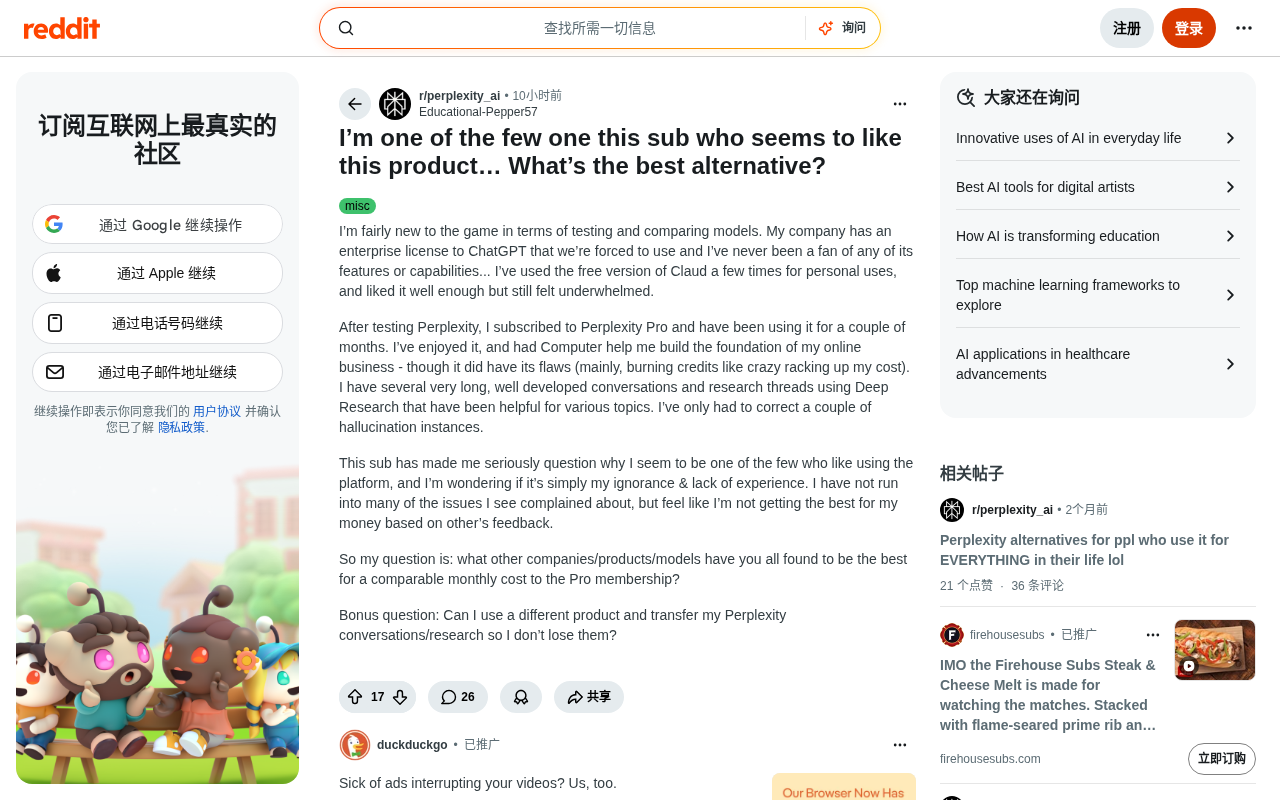
His real question was: Is he simply inexperienced and missing something? Is the money well spent? This dilemma cuts to the heart of a common pain point in today's AI tool landscape.
Why Your Experience Might Diverge Sharply From Community Reviews
Use Case Determines Experience
AI tool reviews are highly context-dependent. This user's core need was deep research and information retrieval — exactly what Perplexity is built for.
Founded in 2022, Perplexity AI's core architecture differs fundamentally from traditional AI assistants. It's built on Retrieval-Augmented Generation (RAG) technology: every response involves real-time search engine queries to fetch the latest web content, which is then summarized and synthesized by a large language model, with traceable citations attached. This is fundamentally different from how ChatGPT or Claude default to relying on their training data cutoff dates.
RAG technology emerged around 2020, systematically introduced in a paper by Meta AI researchers. Its core idea is to separate "memory" from "reasoning" — rather than compressing all knowledge into model weights, the LLM dynamically retrieves from external knowledge bases or the internet at inference time, using retrieved snippets as context to generate answers. This architecture faces two major engineering challenges: retrieval quality (how precisely relevant passages are located from vast amounts of web content directly affects accuracy) and context integration (information from multiple sources may contradict each other, requiring the model to identify authoritative sources and make reasonable trade-offs). Perplexity has invested heavily in optimizing both stages, which is the fundamental reason it outperforms traditional LLMs on information freshness and citation transparency. RAG's advantages — strong information timeliness and relatively lower hallucination rates (constrained by actual sources) — make Perplexity essentially an "AI search engine," with strengths in real-time web retrieval, source citation, and multi-source information synthesis.
Many community critics use Perplexity as a general-purpose conversational assistant or coding tool, so naturally they find it inferior to ChatGPT or Claude. No tool is universally better or worse — what matters is whether it fits your needs. If your core use case is research-oriented tasks, a positive experience is completely valid, and there's no reason to be swayed by others' complaints.
The Real Pain Point: Credit Burn Rate
The user mentioned a specific issue — using Agent features to build his business "burns through credits insanely fast, causing costs to spike." This is a common complaint among Perplexity Pro users: advanced features (especially Agent and Deep Research) consume quota far faster than expected, leaving far fewer usable instances than anticipated.
This makes technical cost sense: the RAG architecture requires real-time search API calls and processing of multiple web pages on every query, layered on top of LLM inference — meaning the compute cost per call is far higher than ordinary conversation. Specifically, a single Deep Research task often requires parallel crawling of dozens of pages, vectorizing each page, and then running multiple rounds of reasoning over the aggregated content — computational load that can easily exceed ten times that of a regular conversation. This explains why "unlimited" subscriptions must impose soft quota limits in practice — allowing high-frequency RAG calls would be economically unsustainable for providers. This is also a major source of negative reviews: users pay and then discover that "unlimited" isn't truly unlimited, with strict limits on premium model calls.
Side-by-Side Comparison of Major AI Tools
Addressing the question of "what are better alternatives at the same monthly price," let's compare from different angles. Most mainstream paid products are priced around $20/month, placing them in the same tier.
General Conversation and Reasoning: ChatGPT Plus vs. Claude Pro
For general conversation, writing, coding, and complex reasoning, ChatGPT Plus and Claude Pro are typically considered first-tier options. Claude in particular has an outstanding reputation for long-document processing, writing quality, and coding ability — many heavy users feel its output is "more human" with less filler.
It's worth noting that Anthropic's Claude product line has a clear model tiering system: the free tier typically only grants access to the lighter Haiku or Sonnet models, while Pro subscriptions unlock the flagship Opus model. This naming system isn't arbitrary — Anthropic uses gemstone and poetic terms to differentiate capability levels: Haiku (a brief, light poem) represents fast and lightweight; Sonnet (fourteen lines) sits in the middle; Opus (a body of work) symbolizes the fullest creative capability. The naming itself signals product positioning. Technically, the gap between the three tiers reflects differences in model parameter count, training compute, and RLHF (Reinforcement Learning from Human Feedback) fine-tuning depth — flagship models typically show order-of-magnitude improvements in complex reasoning, nuanced writing, and long-context understanding. The three tiers differ significantly in reasoning depth, writing finesse, and contextual comprehension — analogous to economy versus flagship variants from the same brand. This tiered strategy is common across major AI vendors: OpenAI's GPT-4o vs. GPT-4o mini, and Google's Gemini Ultra vs. Gemini Flash follow the same pattern.
The user mentioned that Claude's free tier felt "decent but unimpressive" — which is a bit of a shame, since the free tier only accesses weaker models with limited quota. Claude Opus on the paid tier is a meaningful step up and is worth revisiting.
AI Search and Research: Perplexity vs. Emerging Competitors
In Perplexity's home turf — search and research — competitors are moving in fast:
- ChatGPT Search: Now has built-in web search and Deep Research. If your company already has ChatGPT Enterprise, you may not need to pay separately for search capabilities.
- Google Gemini: Backed by Google Search's data advantage, its Deep Research feature is equally powerful and deeply integrated with the Google ecosystem.
- Perplexity: Still maintains an edge in "clear source citations and a search-focused interface."
For this user, a practical suggestion is: since the company already pays for ChatGPT Enterprise, seriously evaluate whether its Deep Research can replace Perplexity for research tasks before deciding whether to continue a personal subscription.
Coding and Agent Use Cases
If your business-building involves significant coding and automation, Claude (with Claude Code) or dedicated tools like Cursor will be more efficient and cost-effective than Perplexity's general-purpose Agent. Perplexity's Agent is positioned as "handy for casual use" rather than "professional-grade."
The Practical Problem of Data Portability
The user also raised a very practical question: can conversation history and research records be migrated from Perplexity to other platforms to avoid losing accumulated work?
Unfortunately, there are currently no standardized migration channels between major AI products — conversation history is locked to each platform's own ecosystem. Viable alternatives include:
- Manually exporting important research threads (Perplexity supports exporting responses as documents or copied text);
- Organizing key conclusions into a standalone knowledge base (such as Notion or Obsidian), achieving tool-agnostic knowledge retention;
- For long-term important research, developing the habit of "landing conclusions in local documents" rather than relying on any platform's cloud history.
Notion and Obsidian represent two mainstream philosophies of personal knowledge management, and their differences are particularly evident at the technical architecture level. Notion uses a cloud database model — all content is stored as structured Blocks on Notion's servers, with advantages in real-time multi-device sync, team collaboration, and relational database features, at the cost of surrendering data ownership to the platform: if the service goes down or your account is suspended, your content becomes immediately inaccessible. Obsidian takes the opposite philosophy: all notes are stored as plain-text Markdown files on the user's local disk, with the software itself serving only as a rendering and indexing tool. Even if Obsidian the company ceased to exist tomorrow, your files would remain intact on your hard drive, openable with any text editor. This "file as data" design philosophy holds particular strategic value in an era of rapid AI tool turnover — consolidating important AI-generated research conclusions into local Markdown files effectively builds a firewall against platform risk. Against the backdrop of rapidly shifting AI tools, depositing AI-generated research conclusions into tools like these is an "antifragile" strategy: even if an AI product shuts down, raises prices, or degrades its service, your personally accumulated knowledge assets remain intact.
This is an important reminder for all AI tool users: don't entrust your core assets entirely to any platform's conversation history — products iterate, subscriptions lapse, and policies change.
AI Tool Selection Advice for Everyday Users
Taken together, this user's dilemma reflects a common misconception — equating mainstream community opinion with "the right answer." That's simply not how it works.
First, trust your own actual experience. If Perplexity Pro genuinely works well in your research use case and produces valuable output, it's a good tool for you — no need to be swayed by others' complaints.
Second, fully leverage what you already have. ChatGPT Enterprise that your company is already paying for is quite comprehensive — evaluate whether it can cover your needs before deciding to continue a personal subscription.
Third, combine tools by use case. Rather than chasing the "perfect single tool," assign tasks based on strengths: Perplexity or Gemini for research, Claude for writing, dedicated tools for coding. At the same monthly cost, one subscription combined with free-tier access often delivers better value than a single Pro subscription.
Fourth, invest in knowledge retention. Move important conclusions into a standalone knowledge base so your accumulated knowledge isn't locked to any single tool.
In this era of rapid AI tool iteration, maintaining an open mindset for experimentation and flexibly combining tools based on need is more valuable than blindly following community reputation.
Related articles

The Truth Behind Codex 'Build a Website in 5 Minutes': AI Isn't Creating Sites—It's Helping You Copy Them
Exposing the truth behind viral Codex 5-minute website videos: creators aren't building original sites with AI—they're copying shared prompts or scraping others' work. Learn AI coding tools' real limits.

Getting Started with AI Agent Development: A Complete Guide from Concept to Practice
A comprehensive guide to AI Agent architecture and development, covering automated marketing, intelligent customer service, and investment analysis scenarios with single and multi-agent collaboration.

The Truth Behind Codex 'Build a Website in 5 Minutes': AI Isn't Creating Sites — It's Helping You Copy Them
Exposing the truth behind viral Codex 5-minute website videos: creators aren't building original sites with AI — they're copying shared prompts or scraping others' work.