Is Symbolic AI Dead? New Research Is Bringing It Back Into the Mainstream

Symbolic AI is not dead but returning invisibly through neuro-symbolic hybrid architectures, with self-instantiation and feedback loops as its real bottlenecks.
Starting from a Reddit discussion on whether symbolic AI is dead, this article reviews its rise and fall and signs of return. Symbolic AI, centered on logical rules and knowledge graphs, peaked in the 1970s but faded after neural networks rose, due to the knowledge acquisition bottleneck—rules required manual coding, were hard to scale, and couldn't handle ambiguity. Yet fading out isn't death: neuro-symbolic reasoning, program synthesis, knowledge graph augmentation, and explainable AI keep reintroducing symbolic structures into machine learning, with hybrid architectures where neural networks handle perception and symbolic modules handle reasoning and constraints. The article notes that for symbolic AI to truly return, two bottlenecks must be solved: self-instantiation and feedback loops—especially the lack of a general solution for cleanly mapping continuous neural outputs to discrete symbols. The conclusion: symbolic AI is more likely to return invisibly embedded in neural networks rather than as an independent paradigm revival.
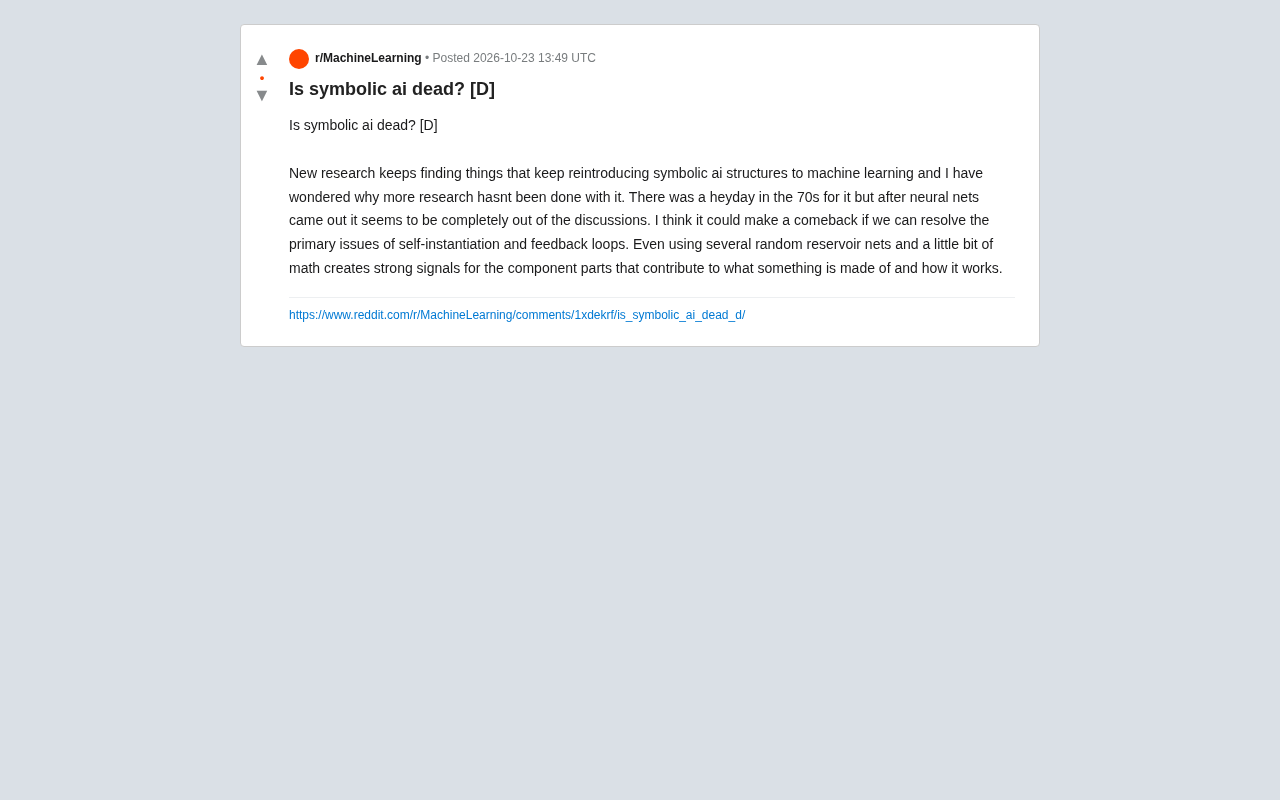
Symbolic AI was hugely popular in the 1970s, but as neural networks rose to prominence, it seemed to vanish from mainstream discussion. Recently, a Reddit user's question sparked heated debate: "Is symbolic AI dead?" [D] The poster noticed that new research keeps reintroducing symbolic structures into machine learning and wondered why more research isn't pursuing this direction. This article starts from that discussion and examines the current state of symbolic AI, signs of its return, and key bottlenecks.
The Golden Age and Decline of Symbolic AI
Symbolic AI, centered on logical rules, knowledge graphs, and explicit reasoning, reached its golden age in the 1970s. Expert systems were once synonymous with artificial intelligence, but they soon hit the knowledge acquisition bottleneck: rules had to be written by hand, were hard to scale, and couldn't handle real-world ambiguity. The revival of neural networks led researchers to shift toward data-driven learning, and symbolic methods gradually faded from mainstream conferences and papers. The poster's observation is accurate—"after neural networks emerged, symbolic AI seemed to completely drop out of the discussion."
However, fading out doesn't mean dying. Over the past few years, symbolic structures have reappeared in new forms, just rarely under the name "symbolic AI."
The knowledge acquisition bottleneck was the core challenge of the expert system era: building a usable expert system required domain experts and knowledge engineers to communicate repeatedly, transcribing the experts' tacit experience into "if-then" rules one by one. A mid-sized medical diagnosis system often needed hundreds to thousands of rules, and each rule had to undergo consistency checks to prevent conflicts or circular reasoning between rules. What's more, real-world knowledge has fuzzy boundaries and frequent exceptions; once a rule base expands, it becomes hard to maintain, and new rules often break existing reasoning chains. This was precisely the technical root of symbolic AI's commercial setbacks in the late 1980s, and an important motivation for machine learning's later shift to a data-driven approach.
Traces of Symbolic Approaches in New Research
The poster pointed out that "new research keeps discovering certain things, repeatedly reintroducing symbolic structures into machine learning." This is no illusion. From neuro-symbolic reasoning to program synthesis, from knowledge graph augmentation to explainable AI, symbolic thinking is making a comeback.
A typical example is hybrid architectures: neural networks handle perception and pattern recognition, while symbolic modules handle reasoning and constraints. The "random reservoir network plus a bit of math" mentioned by the poster is a microcosm of this approach—using simple mathematical structures to extract strong signals between components, thereby understanding what something is made of and how it works. This is essentially expressing causal and compositional relationships in a symbolic way.
Cross-validation of multiple sources shows that researchers are no stranger to this direction, but the poster's question still stands: why isn't more research directly pursuing the symbolic direction?
Neuro-symbolic reasoning refers to a hybrid paradigm that combines the perceptual capabilities of neural networks with the logical reasoning capabilities of symbolic systems. There are two typical approaches: first, neural networks extract entities, relations, or predicates from raw data, then hand them to a symbolic reasoning engine (such as logic programs or constraint solvers) for deduction; second, logical constraints are encoded as differentiable loss terms, letting neural networks "learn" to satisfy rules during training. Representative work of the former includes generating scene graphs from images and then performing logical queries; the latter is commonly seen in regularizing model outputs with first-order logic constraints. The key difficulty in this direction lies in the interface between discrete symbols and continuous representations: symbolic reasoning requires precision and composability, while neural network outputs are noisy probability distributions—mapping between the two often requires additional discretization or soft logic approximations.
Two Major Bottlenecks: Self-Instantiation and Feedback Loops
The poster believes that for symbolic AI to truly return, two core problems must be solved.
Self-instantiation: Symbolic systems need to be able to autonomously generate new symbols and rules, rather than relying on manual encoding. This directly touches on the old problem of the knowledge acquisition bottleneck.
Feedback loops: How symbolic reasoning can form a stable closed loop with learning systems, avoiding rules spiraling out of control or degrading through iterations. This is especially tricky in hybrid architectures—how the continuous outputs of the neural part can be cleanly mapped to discrete symbols still lacks a general solution.
Without solving these two problems, symbolic AI can only exist as an auxiliary module and will struggle to independently handle complex tasks.
Program synthesis offers an operational path toward "self-instantiation": instead of manually writing rules, the system automatically searches for programs or rule sets that satisfy specifications from input-output examples. Its core is the search space and pruning strategies—enumerating all possible programs is exponential, so researchers use type systems, version space algebras, or neural network-guided search to narrow the candidate set. The relationship between program synthesis and symbolic AI lies in the fact that synthesized programs are themselves explicit, composable symbolic structures that can be verified and reused, contrasting with the implicit weights of neural networks. If self-instantiation is to truly materialize, the question of "where do specifications come from" in program synthesis still needs to be resolved: specifications themselves often need to be inferred from data or interaction, which brings us back to the old problem of how symbols and learning can form a closed loop.
Key Signals of a Return
Despite the obvious bottlenecks, the "strong signals" mentioned by the poster are worth taking seriously. Even using multiple random reservoir networks paired with a few mathematical tools can extract clear structural information about component composition and operation. This means the cost of extracting symbolic structures may be declining.
Combined with recent trends, symbolic AI's return is more likely to happen in an "invisible" way: it will no longer be promoted as an independent paradigm, but embedded in the training, reasoning, and explanation stages of neural networks. The poster's judgment—"if self-instantiation and feedback loops can be solved, it may make a comeback"—points to a pragmatic middle path rather than a simple revival of the old ways.
Random reservoir networks (often referring to Echo State Networks) are a special type of recurrent neural network: the internal connection weights are randomly initialized and then fixed, with only the linear readout of the output layer being trained. Because the hidden layer maps inputs into a high-dimensional dynamic state space, simple linear regression can read out complex temporal patterns. The reason "random reservoir networks plus a bit of math" can extract strong signals about component composition and causal relationships is that the reservoir's high-dimensional state naturally encodes the short-term history of input sequences and the coupling between components; combined with a small amount of linear algebra or statistical tools, it becomes possible to separate which components drive which behaviors. The appeal of such methods lies in their extremely low training cost and relatively strong interpretability, but their expressive power for long-term dependencies and discrete structures remains limited.
Conclusion
Symbolic AI is not dead—it has simply changed its identity. Less discussion doesn't mean the method has perished; when new research repeatedly brings symbolic structures back into machine learning, the real question is no longer "is it dead" but "when will we face its return."
One-line Summary
Symbolic AI is not dead but returning in the invisible form of neuro-symbolic hybrid architectures, with its real bottlenecks being self-instantiation and feedback loops.
Paragraph Summary
Starting from a Reddit discussion titled "Is symbolic AI dead?", this article examines the rise, fall, and signs of return of symbolic AI. Centered on logical rules and knowledge graphs, symbolic AI reached its golden age in the 1970s but faded from the mainstream after the rise of neural networks due to the knowledge acquisition bottleneck—rules had to be written by hand, were hard to scale, and couldn't handle ambiguity. However, fading out doesn't mean dying: neuro-symbolic reasoning, program synthesis, knowledge graph augmentation, and explainable AI are all continually reintroducing symbolic structures into machine learning, with neural networks handling perception and symbolic modules handling reasoning and constraints in hybrid architectures. The article points out that for symbolic AI to truly return, two major bottlenecks must be solved: self-instantiation and feedback loops—especially since there is still no general solution for cleanly mapping continuous neural outputs to discrete symbols. The conclusion is that symbolic AI is more likely to return in an invisible way embedded in neural networks, rather than as an independent paradigm revival.
Related articles

OpenAI Partners with Shield: How the Astra Agent Revolutionizes IT Troubleshooting
OpenAI and Shield launch the Astra agent, which autonomously logs into computers and legacy systems to fix IT issues in real time, 35-40% faster than traditional models, with humans involved only when judgment is needed.

iPhone Duo Battery Life Tested: One Charge a Day Is Unavoidable, and the Large Screen Is the Culprit
iPhone Duo battery test: heavy use needs at least one charge a day, and about 30% remains after 6.5 hours of screen-on time. How often the large screen is unfolded is key; a MagSafe battery pack helps, and long-term degradation is also worth watching.

Kimi K3.1 Pro Open-Sourced: 2.8 Trillion Parameters Close In on Opus
Moonshot releases the open-source MoE model Kimi K3.1 Pro, with 2.8T total parameters and 104B activated, trailing Opus 5.5 by under 1 point on Terminal Bench 4.0.