Is Ubuntu's Security Response Too Slow? Community Discussion Draws Attention
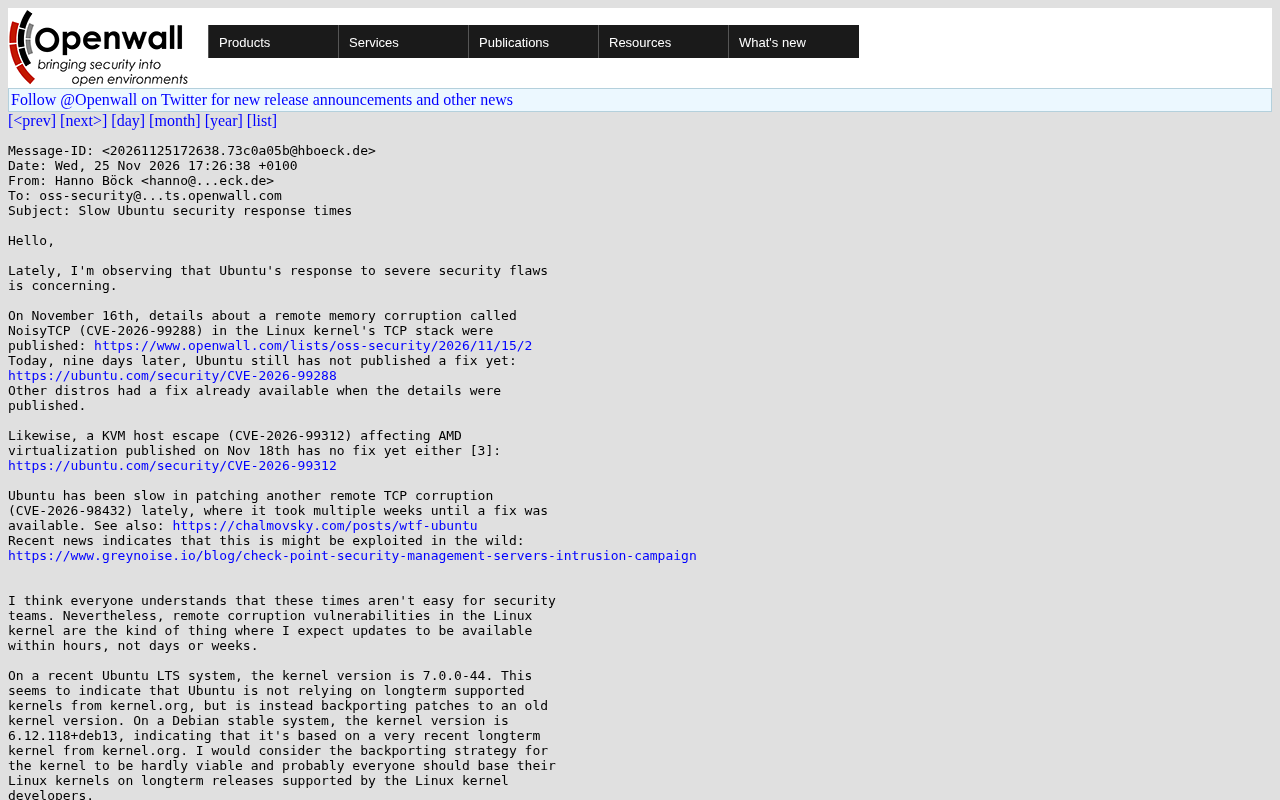
An oss-security email sparks controversy over Ubuntu's security response speed, drawing 269 points on HN and heated developer discussion.
A post on the oss-security mailing list whose title directly called out "slow Ubuntu security response times" was submitted to Hacker News, where it gained 269 points and 120 comments, prompting widespread questioning in the open-source community about Ubuntu's security response speed. The article analyzes why response speed is critical for enterprise-grade distributions: after an upstream vulnerability is disclosed, the distribution must complete reproduction, patch backporting, regression testing, and distribution, and any delay stretches the user's risk exposure window—while Ubuntu LTS is widely used in server and cloud environments, where user expectations are higher. Community discussion centers on the transparency of security fixes and process efficiency, and Ubuntu's commercial background also exposes it to debate over "commercial interests versus community responsibility." The article concludes by reminding operations personnel not to rely entirely on official updates and to establish their own vulnerability monitoring and incident response mechanisms.
Ubuntu, one of the most popular Linux distributions, is facing community scrutiny over the speed of its security response. Recently, a post on the oss-security mailing list sparked widespread discussion and later gained 269 points and 120 comments on Hacker News—clear evidence of how sensitive this topic is.
How It Started: A Single Email Ignites the Debate
According to the original link, the discussion originated from a post on the oss-security mailing list at openwall.com, with a title that directly called out "slow Ubuntu security response times." The post was subsequently submitted to Hacker News, quickly drawing a large number of developers into the conversation.
Although the source material does not disclose the specific details of the email body, the title alone says enough: security researchers or users are dissatisfied with the timeliness of Ubuntu's handling of security vulnerabilities. In the open-source community, security response speed directly affects the risk exposure window for downstream users, so complaints of this kind often trigger a chain reaction.
Why Security Response Speed Matters So Much
For enterprise-grade Linux distributions, the timeliness of security updates is a core metric. When an upstream project (such as the kernel or OpenSSL) discloses a vulnerability, the distribution team must complete a series of steps: reproduction, patch backporting, regression testing, building, and pushing. Any delay in any of these steps leaves users exposed to a known attack surface.
Ubuntu LTS versions are widely used in server and cloud environments, and users have high expectations for the response cadence of its security team. The high level of engagement in this discussion reflects that some users believe there is a gap between Ubuntu's actual performance and their expectations.
Patch backporting is a key step in the security process of a distribution. Upstream projects (such as the Linux kernel or OpenSSL) typically fix vulnerabilities on the latest development branch, but distributions often maintain older stable versions that cannot simply be upgraded to the new release. Maintainers need to "port" the fix patch from the new version back to the older codebase and resolve conflicts caused by code differences. This process requires a deep understanding of the root cause of the vulnerability and the code context; the workload is far greater than simply applying a ready-made patch, and it is also one of the common sources of delays in security response.
Regression testing is equally indispensable. Security patches can change program behavior, and pushing them without adequate testing may cause service crashes or compatibility issues whose impact can sometimes be as serious as the vulnerability itself. Distributions must balance "fix as soon as possible" against "ensure stability," and this tension is precisely the core of the debate over security response speed.
Community Concerns: Transparency and Process Efficiency
Judging from the comment activity on Hacker News, the discussion likely focused on two areas: first, the transparency of security fixes—whether users can clearly understand the progress of vulnerability handling; second, process efficiency, including the time window between vulnerability reporting and patch release.
The open-source community is no stranger to this kind of issue. Distributions such as Debian and Fedora have also been publicly discussed over their security response speeds. The difference is that Ubuntu's commercial background leads outsiders to expect greater resource investment; once its response cadence is perceived as slow, it easily sparks debate over "commercial interests versus community responsibility."
Ubuntu's security update mechanism deserves a closer look. Ubuntu divides security updates into the main repository (with official security support from Canonical) and the universe repository (community-maintained, with limited security support), and the response speeds of the two differ significantly. In addition, Canonical offers an ESM (Expanded Security Maintenance) subscription service that continues to provide security patches for LTS versions beyond the standard support period, but for a fee. This model of "free basic security, paid extended support" is exactly the background often cited when outsiders discuss "commercial interests versus community responsibility."
CVE and the vulnerability disclosure process also affect the response cadence. Vulnerabilities are usually publicly disclosed through CVE identifiers and are subject to an embargo period, which restricts public disclosure until the upstream fix is released. Distributions must complete their preparations during the embargo and push patches promptly after it ends. If a distribution fixes the issue long after the embargo ends, the user's risk exposure window is stretched out—and this is precisely an important benchmark by which the security community measures response speed.
Practical Impact on Users
For operations personnel, the speed of a distribution's security response directly affects patch management strategy. If official fixes lag, teams may need to assess risk themselves, apply temporary patches, or adjust firewall rules—undoubtedly adding to the operational burden.
This discussion also reminds users that no matter which distribution they use, they should not rely entirely on official security updates but should establish their own vulnerability monitoring and incident response mechanisms.
Conclusion
The discussion about Ubuntu's security response speed is still brewing in the community. For Canonical, improving the transparency and efficiency of its security process will be key to maintaining user trust. For users, this incident is also a reminder: paying attention to a distribution's security response capabilities is just as important as paying attention to feature updates.
One-line Summary
An oss-security email sparks controversy over Ubuntu's security response speed, drawing 269 points on HN and heated discussion among developers.
Paragraph Summary
A post on the oss-security mailing list whose title directly called out "slow Ubuntu security response times" was submitted to Hacker News, where it gained 269 points and 120 comments, prompting widespread questioning in the open-source community about Ubuntu's security response speed. The article analyzes the critical importance of security response speed for enterprise-grade distributions: after an upstream vulnerability is disclosed, the distribution must complete reproduction, patch backporting, regression testing, and distribution, and any delay stretches the user's risk exposure window—while Ubuntu LTS is widely used in server and cloud environments, where user expectations are higher. Community discussion centers on two aspects: the transparency of security fixes and process efficiency; Ubuntu's commercial background also exposes it to debate over "commercial interests versus community responsibility." The article concludes by reminding operations personnel not to rely entirely on official updates and to establish their own vulnerability monitoring and incident response mechanisms.
Related articles

Nothing CMF Buds 2A Drops to $17.89 on Black Friday: A New Low for ANC Earbuds
Nothing CMF Buds 2A wireless earbuds Black Friday deal: just $17.89 on Amazon, about $11 off retail and a record low. ANC earbuds at an entry-level price.

When AI Creation Gets Accused of "Spitting": Hacker News Heats Up Over the Glaude Controversy
A Hacker News post, "Spitting in the Face of Glaude," sparks debate on AI creation transparency and attribution ethics. This analysis examines the blurred creator identity behind the controversy and offers practical advice for AI content production.

Akai Embraces Custom Firmware: MPC Sample 1.4 Lets Users AI-Program Their Sampler
Akai embraces the modding community with MPC Sample 1.4 firmware, supporting vibe-coded custom firmware and effects. We analyze the impact of this open strategy on music hardware and AI-assisted programming.