Is Whiteboard Thinking Still Useful in AI and DSP Work? An Engineer's Guide to Deep Thinking

Why whiteboard thinking remains a powerful tool for engineers in the AI and DSP era.
A Reddit discussion among DSP engineers sparked a broader reflection: in an era of AI coding assistants and deep learning, is whiteboard thinking still relevant? This article argues that whiteboards reduce cognitive load, force clarity, and enable rapid hypothesis testing — all critical when the cost of failed experiments is high. It proposes a four-step workflow from whiteboard to code, and explains why 'slow thinking' is more important than ever when compute is expensive.
A Forgotten Thinking Tool
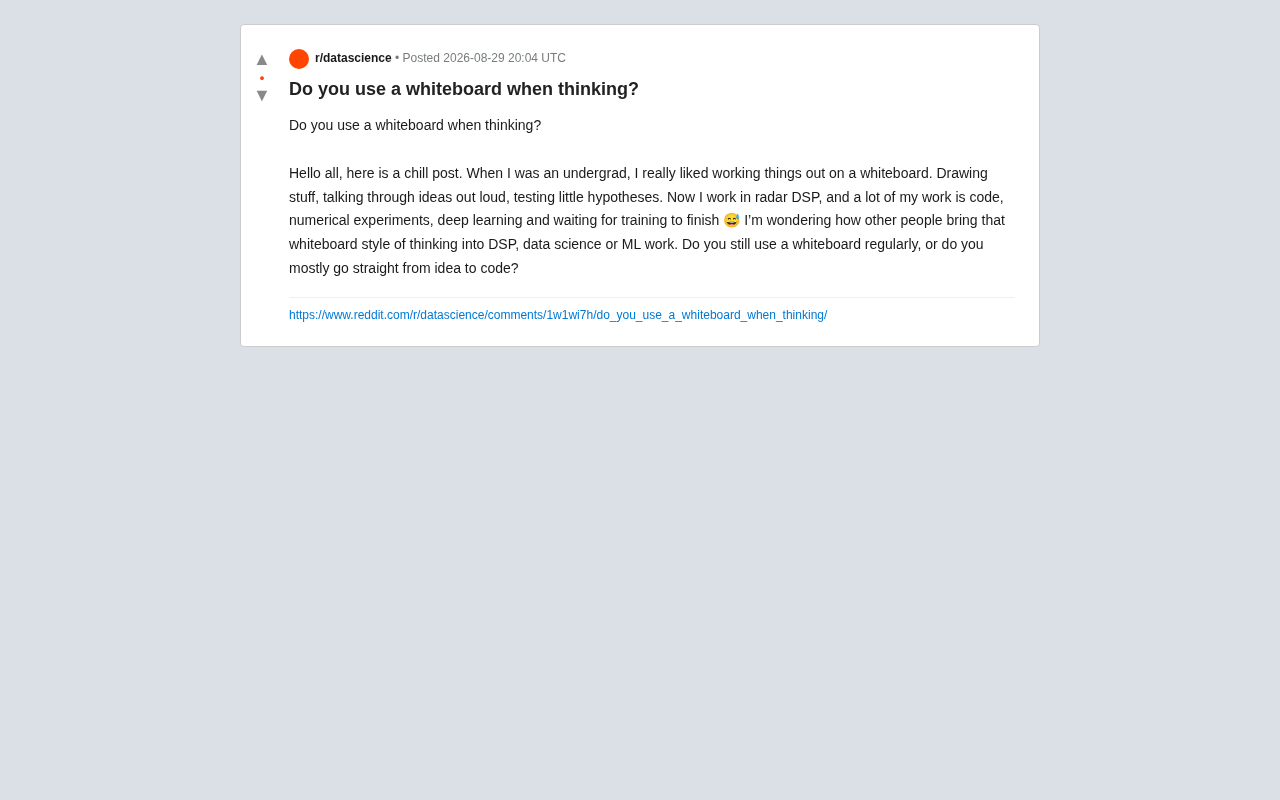
An engineer working in radar digital signal processing (DSP) sparked a lighthearted yet thought-provoking discussion on Reddit: In an era dominated by code, numerical experiments, and deep learning, do we still need whiteboards?
It's worth clarifying first that digital signal processing (DSP) is a discipline that uses digital methods to acquire, transform, filter, analyze, and reconstruct signals. It's widely applied in radar, communications, audio, imaging, and biomedical fields. In radar systems, DSP is responsible for extracting target range, velocity, and angle information from noisy echo signals, involving a series of complex algorithms such as matched filtering, pulse compression, Doppler processing, and constant false alarm rate detection (CFAR). These algorithms are often built on mathematical foundations like Fourier transforms, convolution, and the sampling theorem, and they have highly visual characteristics — frequency response curves, signal flow diagrams, and constellation diagrams are objects engineers deal with daily. For this reason, DSP engineers have a long tradition of working things out on whiteboards or paper, since much of the intuition in signal processing can only be built through graphical representation.
The original poster recalled that during college, he loved working through problems on a whiteboard — drawing diagrams, talking through his reasoning out loud, and quickly testing small hypotheses. Now, his daily work consists of writing code, running numerical experiments, training deep learning models, and waiting for training to complete. He asked curiously: do others working in DSP, data science, or machine learning still bring this kind of "whiteboard thinking" into their work, or do they jump straight from idea to code?
This seemingly simple question actually touches on a universal dilemma for modern technical professionals: As tools become increasingly powerful and automated, is the way we think about problems quietly changing as well?
The Essence of Whiteboard Thinking: The Power of Slowing Down
Why Whiteboards Still Matter in Engineering Work
The value of a whiteboard was never about the whiteboard itself — it's about the deep thinking state it forces you into. When you're standing in front of a whiteboard drawing diagrams, writing formulas, and scribbling revisions, you're actually doing several things that deep learning and code can't easily replace:
First, reducing cognitive load. Human working memory has limited capacity, typically handling only 4 to 7 chunks of information simultaneously. This claim has solid psychological backing: Cognitive Load Theory was proposed by educational psychologist John Sweller in the 1980s, with the core idea that human working memory capacity is extremely limited. Psychologist George Miller's famous "magical number 7±2" study showed that people can hold only about 5 to 9 information units in short-term memory at once, and subsequent research further revised the effective capacity to about 4 chunks. When you draw intermediate steps, variable relationships, and signal flow diagrams on a whiteboard, you're essentially "outsourcing" part of your memory burden, freeing up cognitive resources to think about more fundamental questions. This phenomenon is known in cognitive science as "distributed cognition."
Second, forcing clarity of expression. In the DSP field, a filter's frequency response, a signal processing chain, or a convolution kernel's effective range often only becomes intuitive once drawn out on paper or a whiteboard. When you're forced to "concretize" your ideas with graphics and symbols, gaps and leaps in your reasoning are immediately exposed.
Third, encouraging hypothesis-driven exploration. The original poster's mention of "testing little hypotheses" is at the core of scientific thinking. The low cost and immediacy of a whiteboard let you sketch out a hypothesis, disprove it, and draw a new one in seconds — this kind of rapid iteration often requires a much longer feedback cycle in a coding environment.
Why Writing Code Directly Can't Fully Replace Whiteboards
Jumping straight from idea to code might seem efficient, but it conceals hidden pitfalls. When you open an IDE and start typing, your attention is inevitably consumed by implementation details like syntax, API calls, and data types. You might spend two hours debugging a piece of code, only to realize that your initial modeling of the problem was wrong in the first place.
Here's another important detail: in deep learning workflows, "waiting for training to complete" means the feedback cycle is stretched extremely long. A distinctive feature of modern deep learning is the highly asymmetric cost of experimentation: training a large neural network can require hours to days of GPU time, consuming massive compute and energy. Take Transformer models as an example — a single full training run may involve millions to billions of parameter updates, and any mistake in data preprocessing, loss function design, or hyperparameter settings can render an entire training run worthless. This is fundamentally different from the second-level "run—error—fix" feedback loop in traditional programming. Because the validation cost in deep learning is so high, a single wrong hypothesis can waste hours or even days of compute. If you first work through the network architecture, data flow, and loss function design logic on a whiteboard before getting started, you can often save a tremendous amount of trial-and-error cost — and this is the deeper reason why whiteboard-style "slow thinking" is actually more important than ever in the AI era.
How to Integrate Whiteboard Thinking into Modern Workflows
Physical Whiteboards vs. Digital Whiteboard Tools
For many engineers, physical whiteboards remain irreplaceable. They offer low writing resistance, a wide field of view, and support for multi-person collaboration, making them especially suitable for deriving mathematical formulas or discussing system architecture. In DSP work, the intuitive advantage of physical whiteboards is particularly obvious when drawing signal flow diagrams, spectrum illustrations, and state machines.
But digital whiteboard tools are catching up fast. iPads with Apple Pencil, saveable electronic whiteboards (such as Miro, Excalidraw, and tldraw), and similar tools allow whiteboard thinking to be recorded, searched, and shared. For remote teams, digital whiteboards are practically a necessity.
A Four-Step Workflow from Whiteboard to Code
Drawing on experiences that repeatedly surfaced in community discussions, we can distill a layered process for going from "idea to code":
-
Whiteboard Stage (Diverge): Start by mapping out the problem boundaries, known conditions, assumptions, and expected results on a whiteboard. Don't rush for precision — the focus is on building a big-picture view.
-
Draft Stage (Converge): Organize the validated ideas from the whiteboard into pseudocode or mathematical expressions, clearly defining the inputs and outputs of each step.
-
Code Stage (Implement): Only enter actual coding once the logic has been walked through on paper. At this point, code is more about "translating" than "thinking."
-
Experiment Stage (Validate): Run numerical experiments or train models, then feed the results back to the whiteboard to revise your original assumptions.
The key to this cycle is: Let thinking happen where it's cheap (the whiteboard), and let validation happen where it's expensive (compute).
A Deeper Insight: How Tools Shape Our Thinking
The reason this Reddit discussion resonated so widely is that it reflects a broader trend. As AI coding assistants and automated experimentation platforms become widespread, more and more technical professionals have grown accustomed to the instant-feedback mode of "think of something and have AI generate it." This approach certainly boosts efficiency, but it may also erode our ability to deeply model problems.
Whiteboards represent a form of "slow thinking" — figuring things out before taking action. Modern tools, on the other hand, often encourage "fast action" — get something running first, then figure it out. The two aren't opposites. Truly effective engineers know when to switch: when the problem definition is fuzzy and the direction is uncertain, go back to the whiteboard; when the direction is clear and rapid validation is needed, embrace the tools.
For those working in DSP, data science, and machine learning, the answer may not be "whether to use a whiteboard," but when to use one. When you're facing a complex signal processing chain, a counterintuitive experimental result, or a deep learning problem that needs re-modeling, that whiteboard might still be your most powerful thinking tool.
Conclusion
Technology advances and tools evolve, but the fundamental laws of human thinking haven't changed. The whiteboard endures not because it's advanced, but because it aligns with how our brains process complex problems. In this age of instant feedback, perhaps what we need most is to occasionally pause, pick up a marker, and relearn the art of "slowing down to think."
Related articles

Why Does the Tesla Roadster Need to Fly? A Deep Dive into Musk's Wild Demo
Tesla's Roadster launch showed wall-climbing, upside-down driving, and flying stunts—but The Vergecast notes the demo car may lack a battery, the Rocket version is invite-only and not street-legal, and the website terms don't guarantee delivery. After nine years of delays, why does this car still need to exist?

AI Is Not a Replacement: Human-AI Collaboration Through the Lens of Factory Root Cause Analysis
Starting from factory root cause analysis, this article explains how AI accelerates evidence chain construction rather than replacing human experts, exploring the pragmatic implementation logic and business value of 'AI supporting people rather than replacing them.'

AI Agent Decision Auditing: Building an Evidence Chain in Regulated Workflows
Starting from a Reddit discussion, this article analyzes three core issues in AI agent decision auditing within regulated workflows: what fields audit records should contain, how to handle feedback latency for erroneous decisions, and how to continuously calibrate LLM judge consistency with human judgment.