ISBO: A New Scalable Bayesian Optimization Framework for Spatio-Temporal Point Processes
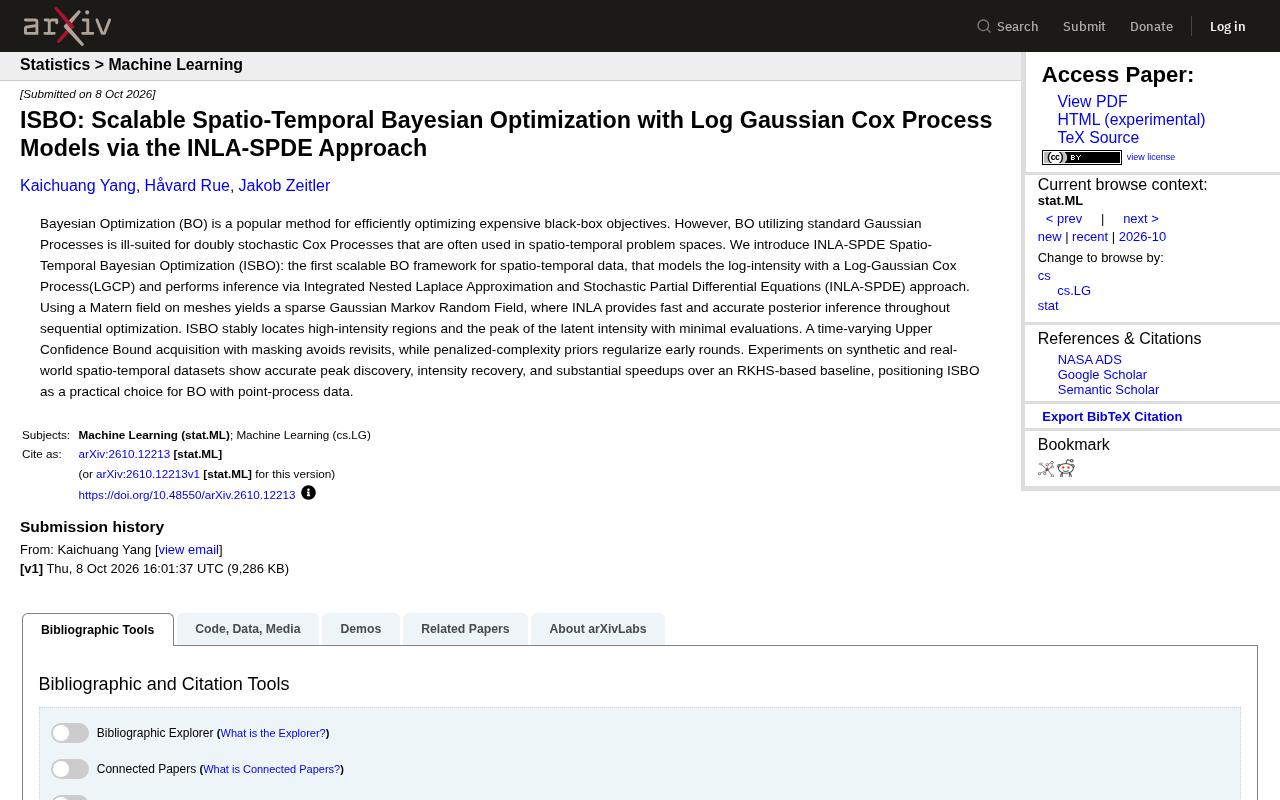
ISBO uses LGCP to model spatio-temporal point process intensity and combines it with INLA-SPDE sparse inference for scalable Bayesian optimization.
This article introduces the ISBO framework from a new paper, addressing the failure of standard Gaussian process Bayesian optimization on spatio-temporal point process data. Spatio-temporal point processes are backed by doubly stochastic Cox processes: observations are discrete event points, while the event intensity itself is a random field, and ordinary GP regression neither captures the spatial correlation structure of the intensity field nor avoids computational explosion as the grid becomes finer. ISBO models the latent log-intensity as a Log-Gaussian Cox Process and adopts the INLA-SPDE method to approximate the Matérn field on a grid as a sparse Gaussian Markov Random Field, thereby continuously obtaining fast and accurate posterior inference during sequential optimization. On the acquisition side, it uses a time-varying UCB and adds a masking mechanism, while using a complexity-penalizing prior to stabilize the unstable posterior when early samples are sparse. Experiments show that ISBO can accurately discover high-intensity regions and latent intensity peaks, recover the overall intensity field, and significantly speed up compared to the RKHS baseline.
Bayesian Optimization (BO) has long been a mainstream tool for optimizing expensive black-box functions. But when the objective function is backed by a doubly stochastic Cox process—the kind of point process data commonly seen in spatio-temporal settings—standard Gaussian process BO falls short. A new paper proposes ISBO (INLA-SPDE Spatio-Temporal Bayesian Optimization), which combines a Log-Gaussian Cox Process (LGCP) with the INLA-SPDE inference method to provide a scalable optimization framework for spatio-temporal point process data.
Why Standard BO Fails on Spatio-Temporal Point Processes
Standard BO typically models the objective function with a Gaussian process, under the core assumption that observation noise is approximately stationary and independent. But the data-generating mechanism of spatio-temporal point processes is entirely different: what is observed are discrete event points, and their intensity is itself a random field. In other words, there are two layers of randomness in the data—the randomness of the point process itself, and the randomness of the underlying intensity field. This is what is known as a "doubly stochastic Cox process."
Under this setting, directly feeding event counts into ordinary GP regression neither correctly captures the spatial correlation structure of the intensity field, nor remains computationally tractable as the data scale grows rapidly with finer grids. The paper points out that using standard GP-based BO for such problems is "not suitable," and this is precisely the gap ISBO aims to fill.
Point Processes and Cox Processes: A point process is a statistical model used to describe where random events occur in time or space; the observed object is not a continuous value but a set of discrete event locations (such as where cases appear or when crimes occur). A Cox process (also known as a doubly stochastic Poisson process) is a generalization of point processes that assumes the intensity of event occurrence is itself a random field—first a random intensity function is generated, then event points are generated according to that intensity. Thus the randomness of the data has two sources: the randomness of the intensity field and the randomness of event points under that intensity, which is the meaning of "doubly stochastic." When the logarithm of the intensity field follows a Gaussian process, we obtain a Log-Gaussian Cox Process (LGCP), one of the most commonly used models in spatial statistics for fitting event clustering patterns. Unlike ordinary regression, the likelihood of an LGCP involves an integral over the random intensity field, which usually has no analytical form and must rely on numerical or approximate inference methods—this is the fundamental reason why standard GP BO cannot be directly applied.
ISBO's Core Approach: LGCP + INLA-SPDE
ISBO's approach is to model the latent log-intensity as a Log-Gaussian Cox Process. The advantage of LGCP is that it writes the intensity field as a Gaussian process after an exponential transformation, which both preserves the constraint that intensity must be positive and allows the use of Gaussian process posterior inference tools.
The real scalability comes from the inference step. The paper adopts the INLA-SPDE method (Integrated Nested Laplace Approximation with Stochastic Partial Differential Equations): by using a Matérn field on a grid, the originally dense Gaussian process can be approximated as a sparse Gaussian Markov Random Field (GMRF). The sparse structure means INLA can provide fast and accurate posterior inference throughout the sequential optimization process without having to redo expensive full covariance computations each time.
This is the basis for ISBO's claim of being "the first scalable spatio-temporal Bayesian optimization framework"—it truly connects point process modeling with scalable inference.
What Are INLA and SPDE: INLA (Integrated Nested Laplace Approximation) is an approximate inference method for Bayesian hierarchical models that replaces MCMC sampling with Laplace approximations, yielding approximate posterior distributions at far lower computational cost. The prerequisite for INLA's efficiency is that the random effects in the model have a conditionally independent structure, i.e., they can be represented by a Gaussian Markov Random Field (GMRF) whose precision matrix is sparse, thereby supporting fast sparse linear algebra operations. The SPDE method solves the problem of "how a Gaussian process on continuous space becomes a GMRF": Lindgren et al. showed that a Gaussian process with a Matérn covariance function can be represented as the solution of a stochastic partial differential equation, and after discretization on a triangular mesh using finite element methods, its coefficients form exactly a GMRF. Thus "a Gaussian process defined on continuous space" is approximated as "a sparse GMRF defined on mesh nodes," preserving the flexible covariance structure of the Matérn field while gaining the scalability brought by sparsity. This is the key to ISBO's ability to repeatedly perform posterior inference throughout the sequential optimization loop without computational explosion.
Acquisition Function and Stability Design
Fast inference alone is not enough; BO also needs an acquisition strategy that balances exploration and exploitation. ISBO uses a time-varying Upper Confidence Bound (UCB) acquisition function and adds a masking mechanism to prevent the optimization process from repeatedly visiting already-explored regions.
In addition, the paper introduces a complexity-penalizing prior to regularize the early rounds of optimization. This is crucial in spatio-temporal problems: when early samples are sparse, the posterior of the latent intensity field is often overconfident or highly volatile, and penalizing complexity can suppress this instability, allowing the search to converge more smoothly to high-intensity and latent intensity peak regions.
UCB and the Exploration-Exploitation Trade-off: The acquisition function determines where BO should sample next. The Upper Confidence Bound (UCB) approach adds the posterior mean and posterior standard deviation with a weight, i.e., "mean + κ × standard deviation." The mean term represents the region currently believed most likely to have high intensity (exploitation), while the standard deviation term represents the region with the greatest uncertainty (exploration), and the coefficient κ controls the relative weight of the two. ISBO's use of a time-varying UCB means this weight adjusts with optimization rounds—early on it favors exploration to cover unknown regions, and later it favors exploitation to refine peak localization. The masking mechanism masks out visited regions or confirmed low-value regions after each sampling round, preventing the optimizer from repeatedly returning to the same point due to slow posterior updates. This combination is especially important in spatio-temporal settings, because data acquisition for spatio-temporal point processes is costly and each evaluation can only observe one time period or one region, so sampling efficiency directly determines whether the method is practical.
Experimental Results: Peak Discovery and Speedup
The paper validated ISBO on both synthetic and real-world spatio-temporal datasets. The results show that ISBO can reliably locate high-intensity regions and peaks of the latent intensity, while completing optimization with fewer evaluations.
More interesting is the speed comparison: compared to an RKHS (Reproducing Kernel Hilbert Space)-based baseline method, ISBO achieved a "significant speedup." The paper also reports the accuracy of intensity recovery, showing that it is effective not only at the goal of finding peaks but also has usable accuracy in recovering the entire intensity field. For a framework that must handle both inference and decision-making simultaneously, both aspects are indispensable.
What This Means for Spatio-Temporal Optimization
The significance of ISBO lies in combining two previously separate research threads—Bayesian inference for point processes and sequential black-box optimization—into a practical framework. For spatio-temporal data that naturally appear as event points, such as epidemic spread, crime hotspots, traffic incidents, and ecological observations, directly using ordinary BO often requires first doing coarse count aggregation, which loses spatial structure information; ISBO, by contrast, models directly at the point process level, which in theory is closer to the data-generating mechanism.
Of course, INLA-SPDE itself relies on grid partitioning and the prior specification of the Matérn field, and the impact of grid resolution and the choice of prior parameters on results still deserves further investigation. The paper positions ISBO as "a practical choice for BO under point process data," a relatively restrained positioning that is also more consistent with the current experimental scale. If future work can verify the upper limits of its scalability in higher-dimensional and larger-scale real-world scenarios, the scope of this framework will become clearer.
One-line Summary
ISBO models spatio-temporal point process intensity with LGCP and combines it with INLA-SPDE sparse inference to achieve scalable Bayesian optimization.
Paragraph Summary
This article introduces the ISBO framework proposed in a new paper, addressing the failure of standard Gaussian process Bayesian optimization on spatio-temporal point process data. Spatio-temporal point processes are backed by doubly stochastic Cox processes: observations are discrete event points, while the event intensity itself is a random field, and ordinary GP regression neither captures the spatial correlation structure of the intensity field nor avoids computational explosion as the grid becomes finer. ISBO models the latent log-intensity as a Log-Gaussian Cox Process and adopts the INLA-SPDE method to approximate the Matérn field on a grid as a sparse Gaussian Markov Random Field, thereby continuously obtaining fast and accurate posterior inference during sequential optimization. On the acquisition side, it uses a time-varying UCB and adds a masking mechanism, while using a complexity-penalizing prior to stabilize the unstable posterior when early samples are sparse. Experiments show that ISBO can accurately discover high-intensity regions and latent intensity peaks, recover the overall intensity field, and significantly speed up compared to the RKHS baseline.
Related articles

Claude Code + Codex Multi-Agent System Tested: The Real Problem Behind a 98% Cache Rate
Developer shares 7-day test of a Claude Code + Codex multi-agent system: 98% cache rate, 354:1 input/output ratio, but stuck on orchestration and output share.

Cursor SDK New Feature: Real-Time Steering of Running AI Agents
Cursor SDK adds run.steer(), letting developers inject messages in real time while an AI agent runs to adjust its direction. Subagents move to the background on steer.

AI Tools Are "Invading" Retro Games: A Game of Creativity vs. Copyright
AI tools are dramatically lowering the barrier to retro game porting—browser-based Halo, iPhone Wind Waker, and MR Smash Bros. are going viral, but sparking copyright disputes and regulatory concerns.