Italian Legislative Process Dataset: LLM Extracts 5,000 Bills and 100,000 Events

An Italian legislative process dataset uses LLM extraction for 5,346 laws and 100,000+ events to support computational law research.
This study builds a structured dataset covering all 5,346 Italian laws across legislatures IX through XIX from 1985 to 2026, with 101,413 procedural events. A controlled LLM extraction pipeline validated by manual annotation converts unstructured parliamentary records into ordered, date-stamped event sequences, each recording activity type, date, chamber, and available procedural details. The dataset averages about 19 events per law and preserves intermediate steps such as committee review and plenary deliberation, enabling cross-term comparisons of legislative paths and timing. Its method is transferable but limited by source text quality, term coverage, and event modeling granularity, offering a reusable foundation for quantitative research in computational law and legislative processes.
Italian Legislative Process Dataset: LLM Extracts 5,000 Bills and 100,000 Events
The Italian legislative process has long been scattered across institutional websites in the form of parliamentary records, mostly as unstructured text that is difficult to use systematically. A new study uses a controlled LLM extraction pipeline to convert these texts into ordered, date-stamped event sequences, building a unified dataset covering all 5,346 laws from 1985 to 2026 with a total of 101,413 events, providing a reusable foundational resource for computational law and legislative research.
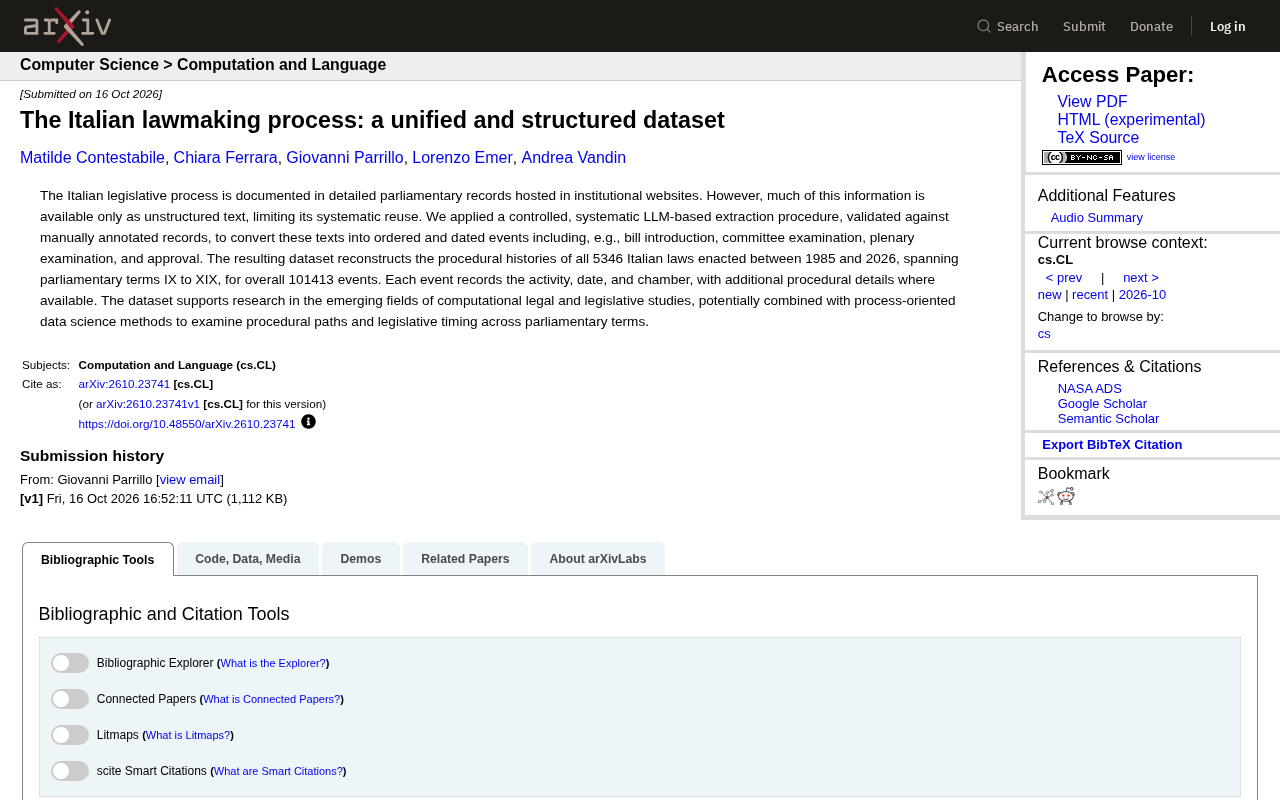
Dataset Construction: From Unstructured Text to Structured Events
The research team designed a controlled, systematic LLM extraction pipeline and validated it against manually annotated records to ensure extraction quality. The method converts parliamentary texts into ordered, date-stamped events covering key legislative stages such as bill introduction, committee review, plenary review, and approval. Each event records the activity type, date, and chamber, and supplements procedural details when available.
The core value of this pipeline lies in its verifiability: LLM extraction is not a black-box operation but is calibrated against manual annotations, reducing noise in the automated conversion. The dataset ultimately reconstructs the procedural history of all 5,346 Italian laws across legislatures IX through XIX between 1985 and 2026, with a total of 101,413 events—a scale and time span that stand out among comparable resources.
Validation methods for LLM extraction: A controlled LLM extraction pipeline typically employs a closed loop of "manual annotation—model extraction—result verification." In this study, the team first manually annotated a portion of parliamentary records as ground truth, then had the LLM perform event extraction on the same texts, calibrating model output by computing metrics such as accuracy and recall. This validation approach can identify systematic biases in the LLM's date parsing and activity classification and correct them through prompt engineering or rule-based post-processing, thereby ensuring the reliability of large-scale automated extraction.
Data Scale and Coverage
5,346 laws and 101,413 events amount to an average of about 19 procedural events per law. This density indicates that the dataset records not only final approval outcomes but also preserves intermediate steps such as committee deliberation and plenary deliberation, reflecting the real rhythm of the legislative process. Covering legislatures IX through XIX means researchers can compare legislative procedure paths and temporal changes across terms and examine differences in legislative efficiency under different political cycles.
In terms of time span, 1985 to 2026 covers more than four decades and spans multiple stages of the evolution of Italy's political system. The structured date and chamber fields provide a basis for longitudinal analysis, while the supplementary procedural details allow finer-grained path characterization.
Legislative terms and the Italian Parliament: The Italian Parliament is bicameral, and legislative terms typically last five years. Term IX began in 1983, and Term XIX continued past 2022. Bill numbering, committee structures, and rules of procedure may be adjusted slightly within each term, so cross-term data require aligned event definitions. The dataset's coverage of Terms IX through XIX means researchers can observe how legislative procedures evolved from the 1980s to the 2020s in terms of committee review duration, plenary debate frequency, and more, providing panel data for institutional change analysis.
Application Prospects: Computational Law and Process Data Science
The dataset directly serves the emerging fields of computational law and legislative research. Researchers can analyze legislative procedure paths based on event sequences, identify common deliberation patterns and bottleneck stages, or combine process-oriented data science methods to examine changes in legislative timing across parliamentary terms. For example, they can quantify the distribution of time spent in committee versus plenary stages, compare the procedural trajectories of different bill types, and even explore the relationship between procedural features and legislative outcomes.
The dataset's structured design also enables cross-institutional and cross-national comparative research. Although this paper focuses on the Italian case, its event modeling approach—activity, date, chamber, plus procedural details—is transferable and can serve as a reference for procedural datafication in other legislative bodies.
Process-oriented data science: Process Data Science draws on Process Mining methods from business process management to reconstruct actual execution paths from event logs and discover bottlenecks and variants. In the legislative context, each law's event sequence can be viewed as a "case," activity types as "tasks," and dates as "timestamps." Process mining algorithms can automatically generate legislative flowcharts, calculate dwell times at each stage, and identify anomalous paths (such as repeated referrals back to committee), thereby quantifying procedural efficiency and consistency.
Significance and Limitations
The main contribution of this work is converting scattered parliamentary records into computable event sequences, lowering the barrier to legislative process research. Manual validation enhances data credibility, while large-scale coverage increases the power of statistical analysis.
Limitations also exist. LLM extraction depends on the quality and format consistency of source texts, and the completeness of procedural details is constrained by the level of detail in original records. The data cover Terms IX through XIX; earlier legislative history is not included. In addition, the choice of event modeling granularity affects the angle of subsequent analysis, and researchers need to adjust their use according to specific questions.
Overall, the dataset provides a solid foundation for quantitative research on the legislative process, and its construction method offers useful lessons for structuring legal texts. As computational law develops, such resources are expected to promote a more systematic and transparent understanding of legislative procedures.
Computational law and legislative research: Computational Law is an emerging field at the intersection of law and data science, emphasizing the use of computational methods to analyze legal texts, judicial decisions, and legislative processes. Legislative research has traditionally relied on qualitative case analysis and manual coding, with limited sample sizes. Structured event datasets make large-scale quantitative analysis possible, for example testing hypotheses such as "whether committee review time is correlated with the probability of bill passage." Note, however, that correlation in event sequences does not equal causality, and researchers should design identification strategies in light of institutional context.
One-line Summary
An Italian legislative process dataset uses LLM extraction to capture 5,346 laws and over 100,000 events, supporting computational law research.
Paragraph Summary
This study constructs a structured dataset covering all 5,346 laws across Italian legislatures IX through XIX from 1985 to 2026, with a total of 101,413 procedural events. Through a controlled LLM extraction pipeline supplemented by manual annotation validation, unstructured parliamentary records are converted into ordered, date-stamped event sequences, with each event recording activity type, date, chamber, and available procedural details. The dataset averages about 19 events per law and preserves intermediate steps such as committee review and plenary deliberation, supporting cross-term comparisons of legislative paths and timing. Its method is transferable but limited by source text quality, the range of terms covered, and event modeling granularity, providing a reusable foundational resource for quantitative research in computational law and the legislative process.
Related articles

Gemini 4 Argon Hands-On: AI Builds Board Games, Constructs Temples, and Trains Robots Autonomously
Gemini 4 Argon hands-on roundup: AI autonomously builds a desk racetrack and temple in Blender, writes a ray tracing engine, trains a humanoid robot to sink 7 shots, plus API pricing and developer access.

The Magic Octagonal Coin: Why Only 9% of People Can Predict Its Flip?
Only 9% of people can correctly predict the Magic Octagon coin flip. This article explains its spatial rotation mechanism, common cognitive pitfalls, and a new hypothesis based on Relevance Theory, exploring the limits of human spatial reasoning.

Sam Altman: AI Is Entering the Era of Scientific Discovery — Math Breakthroughs Will Replicate in Biology and Energy
Sam Altman says AI is entering the era of scientific discovery — math breakthroughs will replicate in biology, materials science, and energy to help develop new drugs and energy sources.