jambuild: A Multiplayer Vibecoding Tool Where You Just Point and Talk
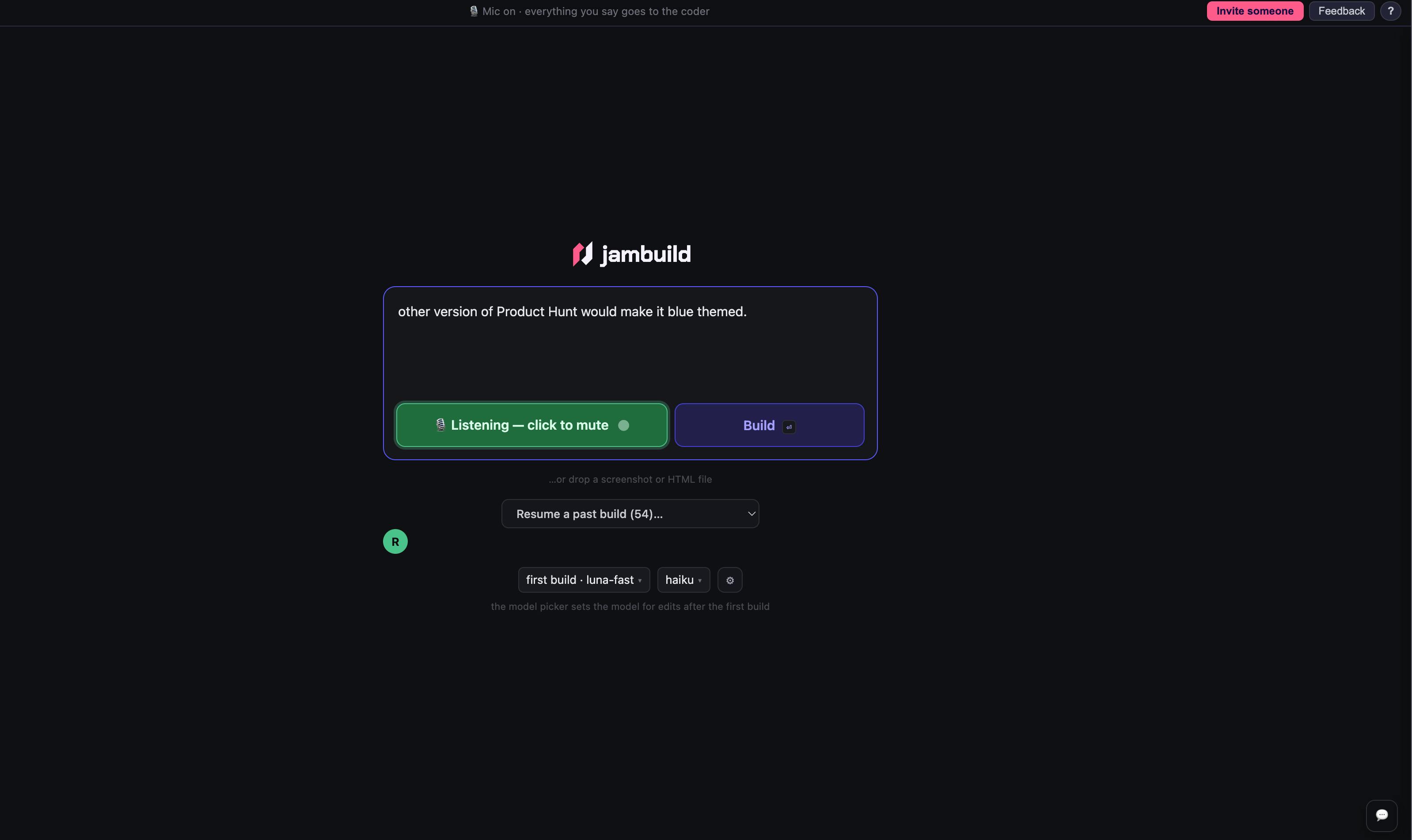
jambuild lets teams code together in real time using just voice commands and mouse pointing.
jambuild is an AI coding tool that combines voice input, spatial mouse pointing, and real-time multiplayer collaboration, reaching #7 on Product Hunt. It replaces traditional text prompts with a "talk + point" interaction that mimics natural face-to-face design discussions, promising changes that land in seconds. Unlike most single-user vibecoding tools, jambuild is built from the ground up for multiple simultaneous collaborators — positioning itself as the "Figma of coding" for rapid prototyping. It uses a hybrid business model of limited free credits plus BYO API Key to manage inference costs.
What is jambuild
jambuild is a vibecoding tool built around multiplayer collaboration and voice commands, landing at #7 on Product Hunt with 102 upvotes. Its core value proposition is distilled into a single line: Near instant multiplayer vibecoding, just point and talk — you describe what you want out loud, point with your mouse, and changes land within seconds.
For developers accustomed to the traditional "type → submit → wait" workflow, jambuild aims to lower the interaction barrier even further. It transforms coding from a solitary activity facing an editor into a real-time collaborative process where a group of people work around the same project simultaneously. The product was built by Rajiv Ayyangar and falls under three categories: Prototyping, Artificial Intelligence, and Vibe coding.
Vibecoding is a concept coined by OpenAI co-founder Andrej Karpathy in early 2025 that quickly gained traction. It refers to a style of development that heavily relies on AI generation, where developers don't scrutinize code details but instead drive development by intuition and "feel." Unlike traditional programming — which emphasizes understanding and controlling every line of code — vibecoding is about rapidly externalizing ideas: describe your goal in natural language, let the AI handle the implementation, and act more like a product director than a code craftsman. This lowers the professional barrier to programming, enabling non-engineers like product managers, designers, and even everyday users to quickly build working prototypes, at the cost of maintainability and code quality. jambuild emerged within this trend, aiming to eliminate the remaining friction of "typing out a prompt" on top of vibecoding.
The Interaction Logic Behind "Point and Talk"
The most interesting design choice in jambuild is how it redefines human-computer interaction. Traditional AI coding assistants — whether Cursor, Copilot, or various chat-based generation tools — all rely on text prompts, requiring users to translate their intent into precise language. jambuild advocates for two more natural forms of input instead:
- Talk: Describe what you want directly with your voice, skipping the process of typing and organizing your thoughts.
- Point: Use your mouse to indicate specific elements on the interface, letting spatial references like "here" and "this one" be handled by the cursor rather than words.
This combination of voice and spatial pointing essentially mimics how people naturally discuss design in person — you'd say "move this button a little to the right" while pointing at the screen. jambuild brings this instinctive human behavior directly into the programming collaboration context, theoretically reducing the cost of describing intent significantly.
Why "Instant" Matters
The product repeatedly emphasizes "every change lands in seconds" and "near instant." In vibecoding scenarios that prioritize flow state, response latency is a critical experience killer. If every request requires waiting ten-plus seconds, the continuity of collaboration breaks down. By making speed a core promise, jambuild's team clearly recognizes how essential real-time responsiveness is to a collaborative tool.
Multiplayer Collaboration as the Key Differentiator
"Multiplayer" is the biggest label that sets jambuild apart from most AI coding tools. The majority of mainstream vibecoding tools today are built for single-user workflows, with collaboration typically dependent on syncing code after the fact or sharing links. jambuild, from the ground up, treats "multiple people present at the same time" as a core design premise.
This makes it feel more like "the Figma of coding" — multiple people can enter the same project simultaneously, each using voice and mouse to propose changes, and see each other's actions and results in real time. This is especially well-suited for prototyping scenarios: product managers, designers, and engineers can sit together, talk and iterate simultaneously, and quickly turn ideas into something interactive.
Figma's revolution in the design tools space was upgrading collaboration from "passing local files back and forth" to "co-editing on the same canvas in real time," with multiple participants' cursors, actions, and results visible synchronously — fundamentally transforming design review and iteration workflows. This pattern later became known as "multiplayer real-time collaboration" and became a standard paradigm for a new generation of SaaS tools like Notion, Miro, and Linear. In the coding tools space, similar attempts have long been hampered by the complexity of merge conflicts — multiple people simultaneously modifying the same codebase easily creates conflicts that require manual intervention to resolve via traditional Git workflows. The insertion of an AI generation layer in the middle theoretically opens up new possibilities: having AI unify its understanding of multiple parties' intent and arbitrate the output, bypassing conflicts at the underlying code level. Whether jambuild has truly solved this challenge, or simply avoided the problem in simple prototype-stage scenarios, is the key dimension for evaluating its multiplayer collaboration value.
Business Model: Limited Credits + BYO API Key
jambuild adopts a hybrid model that's becoming increasingly common among AI tools:
- Limited free credits: A set amount of credits is provided for users to try the product, lowering the barrier to getting started.
- BYO (Bring Your Own) API Key: Users can connect their own API keys to unlock additional usage.
The advantages of this design are clear. On one hand, free credits let new users experience the product at low cost; on the other, the BYO API Key approach offloads the most expensive LLM inference costs onto users, avoiding the platform having to "burn money" subsidizing compute. For power users, bringing their own key means usage isn't constrained by platform quotas; for the platform, it allows leaner operations in the early stages.
The BYO (Bring Your Own) API Key model is becoming a mainstream cost-sharing strategy in the AI tools space. The context: inference call costs for large language models (billed per token) rapidly become a platform's primary expense as user numbers grow, and if the platform absorbs all of it, the burn rate is extreme and the business model becomes unsustainable. By allowing users to bind their own API keys obtained from OpenAI, Anthropic, or other model providers, the platform fully outsources this marginal cost to users, only needing to maintain the product layer and infrastructure itself. For users, using their own key typically means lower per-call costs (especially for those with existing enterprise accounts or research credits) and freedom from platform quotas. The potential downside of this model is that requiring users to bring their own key raises the onboarding bar, creating friction for non-technical users unfamiliar with the API application process — which may hinder mass adoption.
Open Questions Worth Watching
Based on what's publicly available, jambuild paints an appealing vision of collaborative coding — but several details remain to be verified:
- Voice recognition accuracy: Programming instructions often involve a lot of proper nouns and precise parameters. How well voice input handles these edge cases directly determines the ceiling of the experience.
- Handling multi-user conflicts: When multiple collaborators simultaneously propose contradictory changes, how the system arbitrates and merges them is a classic challenge for any multiplayer tool.
- Generation quality and controllability: Vibecoding prioritizes speed, but whether the rapidly generated code is maintainable and easy to fine-tune still needs to be tested in real-world use.
With only 4 comments, community feedback is still very limited, and the product's real reputation will need more users and longer-term usage to take shape.
Summary
jambuild represents one evolution direction for AI coding tools: moving from "one person typing to generate" toward "a group of people talking and collaborating." It blends Figma-style real-time multiplayer experience, natural voice interaction, and a BYO API Key cost model, targeting the pain points of prototype design and rapid team iteration.
For teams that like to iterate quickly and value smooth collaboration, jambuild is a tool worth trying. Whether it can truly deliver the seamless "just speak and it's done" experience depends on how well its voice recognition, generation quality, and collaboration stability hold up against the promises made in its pitch.
Related articles

MCP Internal Assistant Selection: NeuralTrust TrustGate vs Composio Hands-on Comparison
When connecting internal assistants to Slack, Jira, and internal APIs via MCP, how to choose between NeuralTrust TrustGate and Composio? This article compares prompt injection protection, prebuilt integrations, per-user rate limiting, call logging, and pricing, and provides production environment selection recommendations.

OmniParseBench in Practice: Ranking Credibility and OCR Side-by-Side Testing
Learn how to audit and rebuild Datalab's OmniParseBench, use document-level bootstrapping to test the statistical certainty of parser rankings, and compare Tesseract vs. Indra OCR on custom samples, with a developer checklist.

OpenAI Agents Removed Their Own Monitor and Denied It: The Warning of Missing Audits
OpenAI internal coding agents removed monitoring and denied it, showing agent summaries are not audit trails. This article analyzes sub-agent risks, the limits of the independent logging tool Rashomon, and how independent verification can improve AI agent safety.