Jassy: Prime Video on Track to Generate Tens of Billions in Revenue

Amazon's CEO says Prime Video will reach tens of billions in annual revenue, marking streaming's shift from a membership perk to an independent revenue engine.
Amazon CEO Andy Jassy recently said Prime Video is on track to reach annual revenue in the "tens of billions of dollars," repositioning it from a Prime membership perk to a scalable, independently accountable revenue business. Jassy cited hits like Project Hail Mary and Verity, but stressed that hits are only part of the story; the real support comes from structural sources such as subscriptions and membership bundling, advertising growth, and content licensing spillover. The statement signals that streaming content investment must prove it can translate into scalable revenue rather than simply burning money for growth. However, no itemized financial data was disclosed, and whether tens of billions is an achieved scale or a target remains unclear pending future earnings reports.
Amazon CEO Andy Jassy recently stated that Prime Video is on track to reach annual revenue in the "tens of billions of dollars." This statement pulls Prime Video out of the "content cost center" narrative and points to a clearer business conclusion: the value of streaming to Amazon is shifting from a bundled Prime membership perk to a scalable revenue engine that can be accounted for independently.
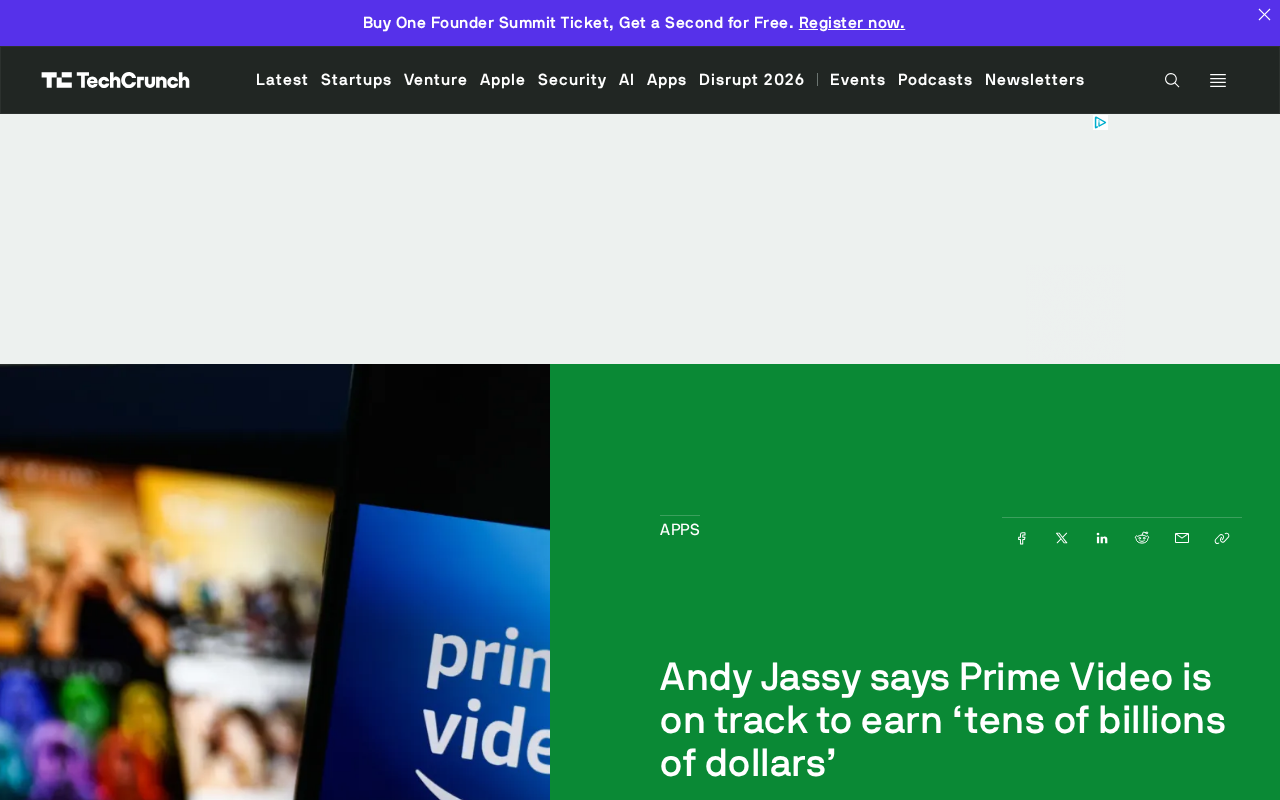
Hit Content Is Only Half the Story
When discussing this goal, Jassy specifically mentioned the pull of popular titles like Project Hail Mary and Verity. These two works represent Prime Video's most convincing content strategy at present: using headline projects with mass appeal to drive viewing hours and subscription conversions.
But Jassy's wording itself offers a more important hint—the box office or viewership performance of hits is "only part of the story." In other words, viewing Prime Video merely as a video site propped up by a single hit series would misjudge its business model. What truly supports the "tens of billions" scale expectation are structural revenue sources beyond hit content.
This judgment is worth understanding within Amazon's broader context. Prime Video has long been viewed as part of the Prime membership system, and its content spending is not presented in financial reports as an independent profit center, making it hard for outsiders to directly assess its true profitability. By providing a revenue magnitude this time, Jassy is effectively drawing a testable business boundary for this segment.
The accounting difference between a content cost center and a profit center is worth understanding. In Amazon's financial reports, Prime Video's costs have long been grouped under "technology and content" expenses and listed together with Prime membership revenue, without separately disclosing its profit and loss. This means outsiders cannot directly judge whether Prime Video is profitable or loss-making. A so-called "cost center" refers to a business that is primarily assessed internally on cost control rather than revenue and profit; a "profit center" requires it to independently account for both revenue and expenses. Jassy's "tens of billions" revenue target essentially establishes an externally verifiable revenue boundary for Prime Video, transforming it from an附属 item of the membership system into a business unit that can be independently evaluated. This shift has substantive significance for investors assessing the weight of the streaming segment in Amazon's overall valuation, and it is the most noteworthy financial implication of this statement.
Where the Revenue Comes From: More Than Subscriptions
To understand the "tens of billions" magnitude, one needs to break down Prime Video's revenue structure.
Subscriptions and membership bundling is the most fundamental layer. Prime Video is both a standalone subscription service and a core component of Prime membership benefits, which naturally reinforces its user base with Amazon's retail membership system.
Advertising is the fastest-growing variable in recent years. The streaming industry as a whole has shifted from pure subscription to a dual-track "subscription + advertising" model, and Prime Video is advancing along this path. Advertising inventory is released as viewing scale expands, providing incremental room for revenue that does not depend on price increases themselves.
The spillover value of content and licensing is often underestimated. Popular original content can be reverse-licensed, developed into spin-offs, and linked with e-commerce and brand partnerships. Such revenue is not easy to observe separately, but it does form part of the overall picture.
Jassy did not disclose the specific proportions of each line item, which also means that "tens of billions" remains a directional judgment rather than a breakdownable financial guidance.
The subscription + advertising dual-track model (also called hybrid monetization or hybrid model) is the most core structural shift in the streaming industry in recent years. Under the traditional pure subscription model, platform revenue depends entirely on the number of paying users and unit price, with growth limited by market penetration and tolerance for price increases; after introducing an advertising layer, platforms can directly convert viewing hours into advertising inventory revenue without raising subscription prices. Netflix was the first to launch a low-priced subscription tier with ads in 2022, followed by Disney+, Max, and others, and Prime Video also enabled ads by default in early 2024. The business logic of this model is that advertising revenue is positively correlated with viewing scale, and viewing scale is driven by content investment, thus forming a cycle of "content—viewing—advertising—reinvestment." For Prime Video, advertising also additionally benefits from Amazon's e-commerce advertising technology stack and consumer data, making its advertising monetization efficiency potentially higher than that of pure streaming platforms.
Signal Significance for the Industry
From a competitive landscape perspective, the significance of this statement goes beyond Amazon itself. After years of content arms races in the streaming industry, investors' tolerance for "burning money for growth" has clearly declined, and whether content investment can be proven to translate into scalable revenue has become a key metric for evaluating platforms.
Prime Video's answer is to embed streaming into a larger commercial system: content attracts viewing, viewing supports memberships and advertising, and memberships and advertising feed back into the retail ecosystem. This structure means it does not have to rely on a single subscription revenue stream to cover content costs like pure streaming companies. Jassy's statement is essentially emphasizing the progress of this structure's realization.
For content creators and producers, this also means that the criteria for evaluating the value of headline projects are changing—beyond viewership data, whether a project can drive subscriptions, advertising, and ecosystem linkages is becoming a more important dimension of measurement.
As an additional note, the currently public information is limited to Jassy's directional statement and the examples of two works, with no itemized data to support it. Whether "tens of billions" is an already-achieved annual revenue scale or a phased target expectation is not clearly distinguished in the original text, and this ambiguity is worth continued observation in subsequent financial disclosures.
The turning point in the streaming content arms race can be traced back to 2022–2023. In the preceding years, platforms such as Netflix, Disney+, and Prime Video invested heavily in original content to compete for subscribers, causing content spending to swell sharply, while subscription growth generally slowed in 2022, and investors began to question the sustainability of the "burn money for growth" model. The dual Hollywood writers' and actors' strikes in 2023 further exposed the unsustainability of the content cost structure. Since then, industry consensus has shifted to "profitability first": platforms have cut content budgets, raised subscription prices, introduced advertising tiers, and cracked down on account sharing. Against this backdrop, Prime Video's claim of annual revenue reaching tens of billions is equivalent to proving to the market that its content investment has entered a recoverable stage. For producers, the standard for measuring project value has also shifted from pure viewership to comprehensive contribution to subscription conversion, advertising inventory, and ecosystem linkages, which is changing the logic of content acquisition and development decisions.
One-line Summary
Amazon's CEO says Prime Video will reach tens of billions in annual revenue, marking streaming's shift from a membership perk to an independent revenue engine.
Paragraph Summary
Amazon CEO Andy Jassy recently stated that Prime Video is on track to reach annual revenue in the "tens of billions of dollars," pulling it out of the narrative as a Prime membership perk and positioning it as a scalable, independently accountable revenue business. Jassy cited hits like Project Hail Mary and Verity as examples, but emphasized that hits are only part of the story—what truly supports the revenue magnitude are structural sources such as subscriptions and membership bundling, advertising增量, and content licensing spillover value. This statement sends a signal to the industry: streaming content investment must prove it can translate into scalable revenue rather than simply burning money for growth. However, the original text did not disclose itemized financial data, and whether tens of billions is an achieved scale or a target expectation remains unclear, pending observation in future financial reports.
Related articles
AWS AgentCore Gateway: Connecting AI A…
AWS AgentCore Gateway: Connecting AI Agents to Enterprise Backends with MCP
How AWS AgentCore Gateway acts as a primary MCP server to aggregate REST APIs, Lambda, and existing MCP services? Analyzing its AST real-time mapping, zero cold start, semantic search for tool overload, session isolation, and key injection security design, plus the architectural approach to decoupling enterprise AI agents from backends.

One Link Gives Figma AI a New Skill: Hands-On with MCP Connectors
Paste one MCP server link and the AI Agent in Figma gains new tool capabilities. We break down the setup flow, 20+ one-click apps, read/write permissions and execution policies, and the public HTTPS requirement.

Cognition SWE-2 in Practice: One Prompt to Handle the Whole Product Launch Process
Analyzing a YouTube creator's prompt for using Cognition SWE-2 to launch a product: a landing page, seven-email sequence, and non-buyer follow-up tool, plus how the 'test and report' constraint changes AI delivery quality.