Java + AI: A Practical Path for Programmers to Break Through the Age-35 Career Crisis

Java programmers should stack AI skills onto their existing foundation to build a career moat.
The article argues that Java programmers shouldn't switch to AI careers but should instead stack AI capabilities on their existing Java foundation. AI learning is divided into four levels, and most Java developers only need to reach the large model deployment and fine-tuning layer to significantly boost their competitiveness. The Java + AI combination offers exceptional ROI — one month of spare-time learning can double your market value, and the current talent gap makes now the ideal time to enter.
Introduction: Programmer Anxiety in the AI Era
The age-35 career crisis is a shadow that looms over nearly every IT professional. As industry competition intensifies and job markets become increasingly cutthroat, how can programmers build a sustainable career moat? Ma Shibing, a tech educator with a Tsinghua background, offered a pragmatic suggestion during a livestream: Don't treat AI as a replacement — treat it as an amplifier for your existing skills.
The core idea is simple — Java + AI (or C/C++ + AI). By dedicating just one month of your spare time to mastering AI application-layer skills, you can double your market competitiveness. Is this claim credible? Let's dive deeper.
Four Levels of AI Learning: Which Level Should Java Programmers Target?
Ma Shibing categorizes AI practitioners into four levels — a framework that's highly valuable for Java developers planning their AI learning path:
- Tool Application Layer: Learn to use various AI tools (such as Coze) to improve daily work efficiency
- Agent Development Layer: Design and develop intelligent agents
- Large Model Deployment & Fine-tuning Layer: Master skills in deploying, fine-tuning, and exposing model APIs
- Algorithm Engineer Layer: Deep dive into algorithm principles for model R&D and optimization
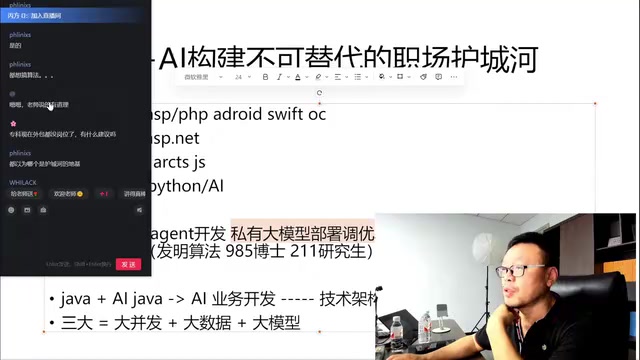
This four-level framework aligns closely with the actual division of labor in the AI industry. From an industry structure perspective, algorithm engineers (Level 4) correspond to model pre-training and architecture research — globally, fewer than tens of thousands of engineers work in this area, with domestic efforts concentrated in teams like Baidu's ERNIE, Alibaba's Tongyi, and Huawei's Pangu. Level 3 — large model deployment and fine-tuning — corresponds to the rapidly emerging field of MLOps (Machine Learning Operations), involving model quantization, inference acceleration, API gateway setup, and other engineering work that bridges algorithm research and business implementation.
The key insight: Most Java programmers only need to reach Level 3 to become highly sought after in the market. Level 4 — algorithm engineering — not only demands extremely high academic credentials (typically requiring top-tier university degrees) but is also concentrated in major companies like Huawei and Tencent, with extremely high barriers to entry. It's simply not suitable for most people.
This layered approach shatters the common misconception that "AI = algorithms." In reality, enterprise demand for AI talent is multi-layered, and engineers who can handle large model deployment and application development are equally scarce resources in the market.
Why "Java + AI" Instead of Switching Directly to AI
This is one of the most valuable insights from the entire session. Ma Shibing repeatedly emphasized not "switching careers to AI," but rather stacking AI capabilities on top of your existing Java technical foundation.
Foundation Thinking: The Natural Advantage of Java Developers
Since its birth in 1995, Java has remained a mainstream language for enterprise development. According to the TIOBE Programming Language Index, Java consistently ranks in the top three. Its core strength lies in the maturity of the JVM (Java Virtual Machine) ecosystem — enterprise frameworks like Spring Boot, MyBatis, Kafka, and Elasticsearch form the technical foundation of the vast majority of internet companies in China. Especially in the digital transformation of traditional industries like finance, government, and manufacturing, the installed base of Java systems is enormous. This means the Java developer job market has strong geographic dispersion, unlike AI algorithm positions that are highly concentrated in first-tier city tech giants.
Having a "foundation skill" like Java means you can find abundant job opportunities even in third and fourth-tier cities. If you've only learned large model-related skills, your employment options may be limited to first and second-tier cities with limited opportunities.
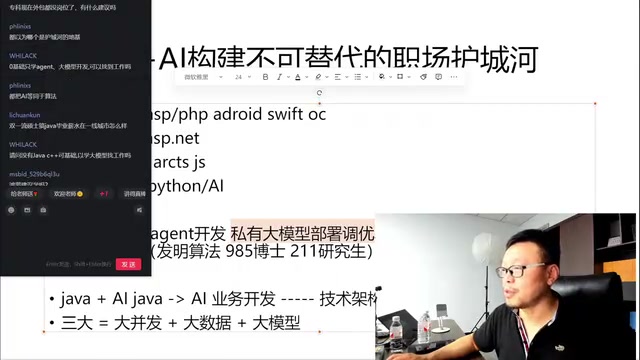
Specifically:
- Java developers with added AI skills may go from being wanted by 100 companies to being wanted by 200
- Salary-wise, positions that previously paid 20,000 RMB could increase to 25,000 RMB with AI capabilities
- The ROI is extremely high — one month of spare-time learning investment yields a significant boost in competitiveness
Java and Python Technology Stack Synergy
In real-world AI projects, Java and Python are often used collaboratively:
- Large model deployment, fine-tuning, and Agent development primarily use Python
- At the business application layer, once models are deployed and APIs are exposed, Java, Go, and other languages can all make calls
- Essentially, Python handles the AI infrastructure while Java solves business problems
It's worth noting that the Agent development layer has rapidly gained traction in the past two years with the rise of frameworks like LangChain and AutoGPT. The core concept of Agents (intelligent agents) is giving large models the cyclical capability of "planning → tool invocation → feedback," upgrading them from simple Q&A systems to autonomous agents capable of completing multi-step tasks. Domestic platforms like Coze (ByteDance), Baidu's ERNIE Bot agents, and Alibaba Cloud's Bailian are essentially lowering the barrier to Agent development. For Java developers, understanding the workflow design logic of Agents, combined with Java ecosystem frameworks like Spring AI, allows you to build enterprise-grade AI applications directly within your familiar tech stack without completely switching to a Python environment.
This "bilingual" capability combination is precisely the composite talent profile most in demand in today's market.
The Transition Time Window: Why You Must Act Now
Ma Shibing repeatedly emphasized urgency during the livestream — a point worth taking seriously.

Large model deployment and fine-tuning (Level 3) encompasses a technology stack that's far more engineering-oriented than academic. Core skills include: deploying open-source models (such as Llama, Qwen, DeepSeek) locally or on private clouds using frameworks like Ollama and vLLM; adapting models to specific domains through parameter-efficient fine-tuning methods like LoRA and QLoRA; combining enterprise private knowledge bases with large models using RAG (Retrieval-Augmented Generation) technology; and exposing model capabilities to business systems via FastAPI or OpenAI-compatible interfaces. The learning curve for these skills is far gentler than training a large model from scratch, and market demand is strong — the vast majority of small and medium enterprises need engineers who can "put open-source models to use," not scientists who can "build them from scratch."
The talent gap in AI application-layer skills still exists today. Not many people have mastered Level 3 skills (large model deployment and fine-tuning), which means entering now still allows you to achieve a "dimensional advantage" over the competition.
Related articles
 Tutorials
ChatGPT Plus Subscription Guide: Are GPT-5.5, image-2, and Codex Worth the Upgrade?
A detailed look at ChatGPT Plus features — GPT-5.5, image-2, and Codex — with a Plus vs Pro comparison and a complete step-by-step subscription guide for users outside the US.
 Tutorials
Harness AI Engineering in Practice: Using Claude Code to Master Enterprise-Level E-Commerce Development
Deep dive into Harness AI Engineering: master enterprise e-commerce development with Claude Code using the Rules, Skills, Wiki, and Changes framework.
 Tutorials
Cursor + Codex Dual-IDE Collaboration: A Practical Methodology for Open-Source Project Customization
A complete methodology for open-source project customization based on real-world experience, detailing the Cursor+Codex dual-IDE workflow, seven-stage process, MVP validation, and AI source code reading techniques.