Java Developers Transitioning to AI: A Practical Guide to Building RAG Knowledge Bases

A practical guide for Java developers transitioning to AI via RAG knowledge base development.
This guide outlines the best path for Java developers entering the AI field: becoming an AI Application Engineer. It explains why RAG knowledge bases are the ideal hands-on project, covers the technical foundations of vector embeddings and semantic search, and highlights the enterprise-grade challenges — like chunking strategy, hallucination suppression, and retrieval precision — that truly matter in interviews.
For many Java developers, competition for traditional Java roles is intensifying while demand for AI application development positions is rising rapidly. How to pivot into the AI space while building on an existing tech stack has become a top concern for backend engineers. Bilibili tech instructor "Xu Shu" systematically outlines this transition path in his Java+AI tutorial series. This article is based on that content, with additional analysis and context.
Three Paths for Java Developers Entering AI
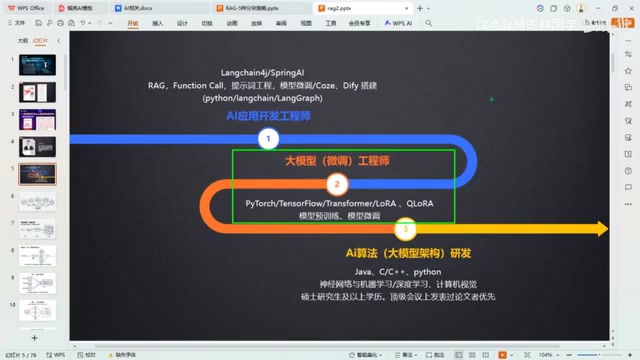
The instructor begins by clarifying three main directions for developers entering the AI field, with clear recommendations on each.
Directions Not Recommended for Most Developers
AI Algorithm Engineer is the first direction — and one the instructor explicitly advises against for most developers. The reason is straightforward: the core responsibility of this role is training large models from scratch. Globally, the number of teams actually doing this is extremely small, and open positions are scarce. Pre-training a large model requires thousands of high-end GPUs (such as A100/H100) running in parallel for months, with a single training run costing anywhere from millions to tens of millions of dollars. Models like GPT-4, LLaMA, and Qwen represent massive compute investments from institutions like OpenAI, Meta, and Alibaba. The ongoing open-source movement — led by Meta's LLaMA series and Alibaba's Qwen series — has made high-quality foundation models freely available, further reducing the business case for training models in-house. Unless you're a graduate student at a top-tier research institution, the return on investment simply isn't there.
Large Model Fine-tuning Engineer is the second direction. When a large model lacks domain-specific business knowledge, fine-tuning is one solution. Fine-tuning involves taking a pre-trained model and continuing training on domain-specific data to adapt it for a particular task. LoRA (Low-Rank Adaptation) is currently the dominant parameter-efficient fine-tuning algorithm — it inserts low-rank matrices into attention layers to drastically reduce the number of trainable parameters, but still requires multiple GPUs and hands-on experience with PyTorch or TensorFlow. Fine-tuning presents two major barriers: it is computationally expensive, and its results are unstable, with significant human and time costs. As a result, small and mid-sized companies rarely build their own fine-tuning pipelines. This path also demands proficiency in Python, PyTorch, TensorFlow, Transformer architecture fundamentals (the core architecture of modern LLMs, introduced by Google in 2017, whose self-attention mechanism is the foundation of semantic understanding), and fine-tuning algorithms like LoRA — a steep learning curve by any measure.
The Best Path for Java Developers
AI Application Engineer is the direction the instructor most strongly recommends for career transitions. The core logic: Java developers don't need to abandon their existing tech stack — they simply layer AI-related frameworks on top of what they already know. This is also the job category with the highest market demand right now.
Even more importantly, Java has a natural advantage in enterprise environments — roughly 70–80% of enterprise systems are built on Java. When a company needs to add AI capabilities to an existing system, those AI applications still require microservice architecture, performance optimization, data access control, and integration with existing infrastructure like Redis and message queues. In this context, Java actually has a stronger case than Python for continuity and engineering rigor.
The Java AI Ecosystem Has Matured
Two or three years ago, building AI applications was almost entirely dependent on the Python ecosystem (LangChain, LangGraph, etc.). That gap no longer exists — the Java AI development ecosystem has fully caught up.
For single-Agent or standard conversational AI applications, Java developers can use LangChain4j or Spring AI, combined with Tools, Function Calling, MCP, and RAG, to build applications like intelligent customer service agents and RAG knowledge bases. LangChain4j is a Java port of LangChain, offering chained calls, memory management, and tool integration. Spring AI is the official AI integration framework from Pivotal, deeply integrated with the Spring Boot ecosystem. MCP (Model Context Protocol) is an open protocol proposed by Anthropic to standardize how large models interact with external tools and data sources — it has become a key piece of infrastructure in the Agent ecosystem. Function Calling is the ability for large models to proactively invoke external functions or APIs, and together with RAG, it forms the core capability layer of most AI applications.
For multi-agent (Agentic) applications — characterized by a model autonomously planning, self-reflecting, breaking down tasks, and executing them — the same can be achieved using Java-based frameworks like Spring AI Alibaba Agent Framework and Alibaba's AgentScope. Spring AI Alibaba is Alibaba's extension of Spring AI, with built-in integration for Qwen (Tongyi Qianwen) and other domestic model services, offering significant compliance and latency advantages for China-based deployments.
This means the Java ecosystem now has a complete, self-sufficient technology chain — no need to detour through Python.
Why a RAG Knowledge Base Is the Ideal Hands-On Project
The instructor recommends building a RAG knowledge base system as the go-to practical project. Its biggest advantage is universality — nearly any developer from any background can include it in their resume, unlike projects tied to specific large companies or unique personal circumstances.
RAG (Retrieval-Augmented Generation) was introduced by Meta AI Research in 2020. Its core idea is to decouple external knowledge retrieval from the generation model — the model doesn't need to "memorize" all knowledge; instead, it dynamically retrieves relevant context at inference time. Compared to fine-tuning, RAG requires no model retraining, supports real-time knowledge updates, and provides source traceability. It is the mainstream engineering solution for addressing LLMs' knowledge cutoff and hallucination problems.
The Evolution from Traditional Knowledge Bases to RAG
Before RAG, enterprise knowledge bases evolved through two stages:
Stage 1: Pure document storage. HR departments maintained attendance and financial process manuals, business teams maintained product catalogs, and engineering teams maintained requirements documents — essentially centralized file storage that required manual searching.
Stage 2: Keyword search with Elasticsearch (ES). But ES has obvious limitations: it can only do keyword matching. For example, if a sales rep encounters a customer saying "your product is too expensive" and searches with that phrase, the results are rarely useful and require extensive manual filtering.
The Qualitative Leap RAG Brings
With AI and RAG, when a user asks a vague question like "the product is too expensive," the AI can autonomously analyze competitor reports, market research data, and sales script templates to generate a ready-to-use response. For new sales hires unfamiliar with the product, this is a concrete productivity gain.
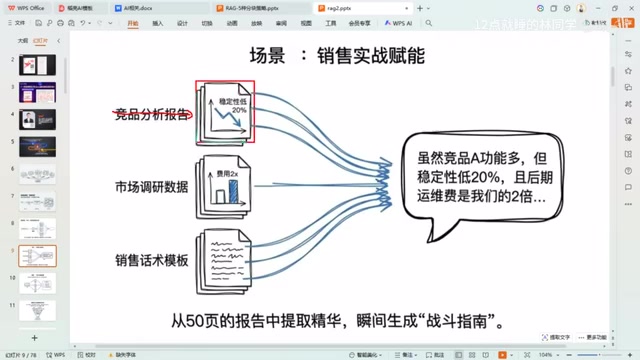
The same value applies in engineering contexts. When a developer joins a new project and isn't familiar with the business requirements, they can query the knowledge base directly — the AI retrieves existing product requirement documents and provides answers, dramatically shortening the onboarding cycle. This cross-industry applicability is precisely why virtually every company has a valid use case for building a RAG knowledge base.
The Technical Foundation of RAG: Vectors and Vector Databases
To understand RAG's semantic retrieval capabilities, you need to grasp three core concepts: vectors, embedding models, and vector databases.
Vectors and Embedding Models
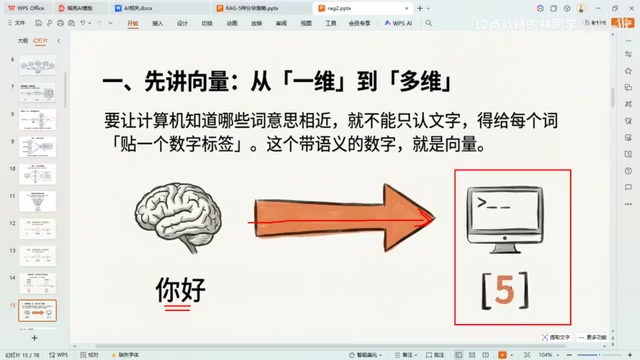
Unlike relational databases that perform exact matching, vector databases excel at similarity search. They don't store raw text — they store the vector coordinates that correspond to that text.
The process of converting text into vectors is called Embedding, and the model that performs this transformation is called an Embedding model — a separate system from the LLM used for conversational generation. Popular open-source embedding models include Alibaba's text-embedding-v3, BAAI's BGE series, and OpenAI's text-embedding-ada. A vector is simply a set of numerical coordinates produced by an embedding model from a piece of text, typically ranging from 768 to 4,096 dimensions. Higher dimensionality yields stronger expressive power at the cost of greater storage and compute overhead. Texts with similar meanings (e.g., "Good morning," "Hello," "Hey there") produce coordinates that cluster together, while semantically distant texts produce coordinates that are far apart. By measuring the distance between coordinates, the system can perform semantic similarity search. Common vector databases include Milvus, Weaviate, Qdrant, and pgvector (a PostgreSQL extension), each with different trade-offs in performance, scalability, and deployment convenience.
Dimensionality Determines Retrieval Precision
Simple words can be represented in one dimension, but complex semantic objects require far more. Describing a dog, for instance, might require dimensions for size, coat type, temperament, color, shedding level, and so on.
The more feature dimensions captured, the higher the precision of similarity search. Matching on a single dimension is prone to false positives, while combining many dimensions produces coordinate points in high-dimensional space that more accurately reflect true semantic similarity.
Cosine Similarity
Vector databases use cosine similarity to perform retrieval: the angle between two vectors is calculated, with a smaller angle indicating higher similarity and a larger angle indicating lower similarity. Cosine similarity scores range from -1 to 1, with values closer to 1 indicating stronger semantic similarity. In high-dimensional space, cosine similarity is more stable than Euclidean distance and is the standard metric for text semantic search. To handle retrieval efficiency at scale, vector databases typically use ANN (Approximate Nearest Neighbor) algorithms such as HNSW (Hierarchical Navigable Small World graphs) and IVF (Inverted File Index), reducing retrieval latency to milliseconds while maintaining strong recall rates.
The full RAG retrieval pipeline can be summarized as: raw documents are converted into vectors by an embedding model → stored in a vector database → when a user asks a question, the query is also converted to a vector → cosine similarity is used to retrieve the most semantically relevant text chunks → the retrieved context is passed to a large model to generate the final answer.
The Real Challenges of Enterprise-Grade RAG
Understanding the fundamentals is just the starting point. What makes a resume truly competitive is the ability to solve real enterprise-level problems in production. Interviewers typically probe deeply into challenges encountered during development, such as:
- How to go beyond the TopK retrieval limit to improve recall quality (TopK retrieval returns the K most similar text chunks from the vector database; a fixed K can result in insufficient recall or too much noise — in practice, a Reranker model is often used for secondary filtering)
- What chunking strategy was used and why (common approaches include fixed-size chunking, semantic chunking, paragraph-based chunking, and sliding window; chunk granularity directly affects the balance between retrieval quality and context completeness)
- How to enable more accurate answers when dealing with structured data
- How to implement file traceability and incremental updates
- How to suppress hallucinations (where the model generates content inconsistent with facts) and ensure answers are faithful to the source documents (common techniques include Prompt constraints, citation annotation, and answer verification)
- How to systematically improve overall RAG retrieval accuracy
- How to handle images and tables in documents (requiring OCR, table parsing, or multimodal models like GPT-4V to extract structured content)
These are the questions that separate those who "understand the concept" from those who have "actually shipped it" — and they are the core evaluation criteria in Java AI engineering interviews.
Summary
For Java developers, AI application engineering offers the highest return on investment for a career pivot right now. Given Java's dominance in enterprise systems and the maturity of frameworks like Spring AI, LangChain4j, and Spring AI Alibaba, Java is fully capable of supporting AI application development across the spectrum from single-Agent to multi-agent systems.
The RAG knowledge base, as the most representative and reusable production use case, serves as both the ideal entry point and a powerful showcase of engineering depth. Real competitive differentiation doesn't come from knowing how to call APIs through a framework — it comes from the ability to systematically solve enterprise-grade challenges like retrieval precision, hallucination control, and document traceability. That's what interviewers actually want to see.
Key Takeaways
Related articles

Older Google Home Gets Gemini Live Upgrade: Conditions and Experience Fully Explained
Google is rolling out Gemini Live conversational AI to older Google Home speakers, but subscription or plan requirements may apply. Here's what you need to know.

Older Google Home Gets Gemini Live Upgrade: Complete Breakdown of Requirements and Experience
Google is rolling out Gemini Live conversational AI to older Google Home speakers, but subscription or plan restrictions may apply. Full breakdown of the upgrade details and impact.

GPT-5.6 Hands-On Review: Analyzing the Agent Capabilities Behind Its #1 Ranking on the Frontend Development Leaderboard
GPT-5.6 SoulX High tops the frontend dev leaderboard at 1636 points with Agent Arena rank #2. Hands-on tests of portfolio pages and mystery games reveal its task decomposition and self-correction capabilities.