Java Programmers Transitioning to AI Large Model Development: A Zero-Basics Practical Guide

A learning path and course breakdown for Java programmers entering AI large model application development.
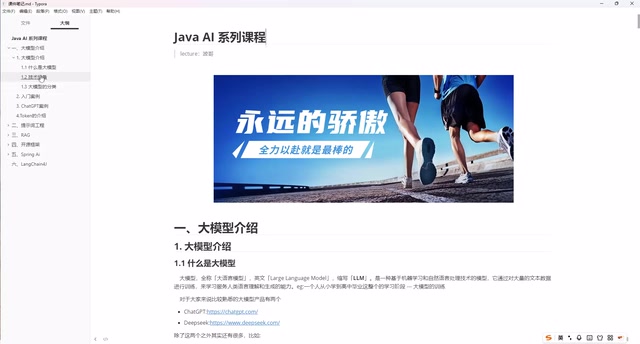
Based on Bilibili creator Boge's Java AI large model course, the article addresses Java programmers' confusion about whether to switch to Python when facing the AI wave. The author notes that there is also a large demand for large model integration in the Java ecosystem, and frameworks like Spring AI are responding to this trend. The course has four progressive modules: large model fundamentals and direct Java API connection, prompt engineering, RAG from-scratch hand-written implementation (including ChromaDB and Milvus vector databases), and Spring AI and LangChain4j framework applications, plus vibecoding project practice. The article extracts key learning advice such as Token cost awareness, vector database selection, and hand-writing before frameworks, and explains that the course targets developers with Java fundamentals and no need for Python or machine learning background.
In an era where AI large models are sweeping across industries, Java programmers face an unavoidable challenge and opportunity. Most AI large model courses on the market are Python-focused, leaving many Java developers in a dilemma: should they switch languages, or give up on this technological dividend?
Recently, Bilibili creator Boge released a series of courses on AI large model application development for Java programmers, attempting to answer this question. The course is designed for zero-basics beginners, covering everything from large model fundamentals to RAG, LangChain, Spring AI, Agent development, and other core topics, and includes vibecoding project practice. This article is based on the course introduction video and, combined with the current state of the Java AI ecosystem, outlines a practical learning path.
Why Java Programmers Should Pay Attention to AI Large Model Development
At the beginning of the course, Boge points out that the first concern Java programmers have when facing the AI wave is often "should I switch languages?" His judgment is that switching languages itself is not very difficult, and there is also a large demand for AI large model-related work in the Java ecosystem. This means Java developers don't have to abandon their existing tech stack; they can enter AI application development within a familiar language environment.
This judgment aligns with the reality of current enterprise tech stacks. A large number of backend systems, microservice architectures, and enterprise-level applications run on Java, and integrating large model capabilities into these systems naturally requires Java-side solutions. The emergence of frameworks like Spring AI is precisely a response to this demand.
Course Content Breakdown: From API Calls to RAG and Framework Applications
Boge divides the course into four progressive modules, with an overall design following the logic of "understand the principles first, then hand-write the implementation, and finally use frameworks for efficiency."
Module 1: Large Model Fundamentals and Direct Java API Connection
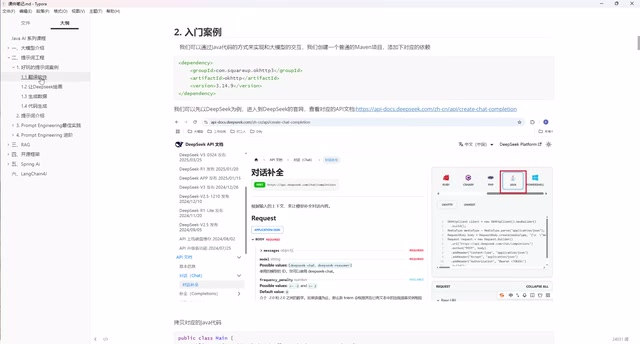
The course first introduces large model fundamentals, then implements interaction with large models through a pure Java project combined with APIs. This stage covers communication with ChatGPT, Token concept explanation, and more. For zero-basics learners, this part is key to building intuitive understanding—getting one request to run successfully is more important than understanding all the theory.
Module 2: Prompt Engineering
Boge particularly emphasizes the importance of prompts, believing that "using prompts well can significantly improve the effectiveness of large model applications." This module explains prompt design and optimization methods in detail. In actual development, prompts are often the key variable determining application effectiveness, and are worth investing time to study systematically.
Module 3: RAG from Scratch
RAG (Retrieval-Augmented Generation) is described by Boge as "a relatively common and low-cost solution in enterprises." The course guides learners to fully implement the RAG process with Java code: text loading, text splitting, vector computation, vector database storage (involving ChromaDB, Milvus, etc.), and finally combining RAG with large models.
The value of this module is that learners not only learn to use ready-made tools but also understand the engineering details of each step in RAG. The selection and use of vector databases is a common decision point when enterprises implement RAG, and mastering it in advance helps with technology selection in actual projects.
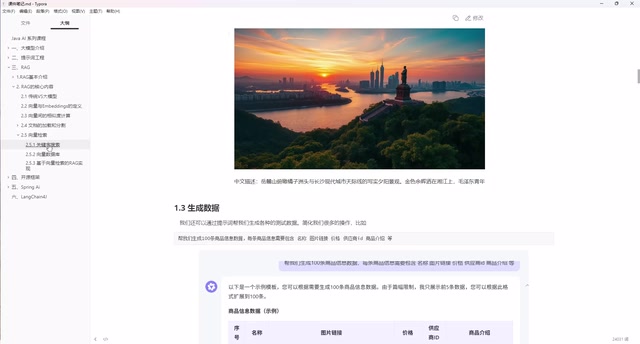
RAG (Retrieval-Augmented Generation) is a technical architecture that combines external knowledge retrieval with large model generation. Its core process is: first split documents into chunks and convert them into vectors stored in a vector database; when a user asks a question, the system also converts the question into a vector, retrieves the most relevant chunks from the database, then concatenates these chunks as context into the prompt, and hands it to the large model to generate an answer. RAG can effectively alleviate the knowledge cutoff and hallucination problems of large models, and does not require retraining the model, making it a lower-cost, faster-results solution for enterprises implementing large model applications.
Vector Database is a database system specifically designed for storing and retrieving high-dimensional vectors. In the RAG process, text is converted into vectors by an embedding model and stored, and during queries, approximate nearest neighbor (ANN) algorithms are used to quickly find semantically similar vectors. ChromaDB is a lightweight, easy-to-embed vector library suitable for prototyping and small-to-medium-scale scenarios; Milvus is a distributed vector database for production environments, supporting billion-level vector scale and high-concurrency retrieval. The two differ significantly in deployment complexity, performance, and operational cost, and selection should be based on a comprehensive judgment of data scale, latency requirements, and team operational capabilities.
Module 4: Open-Source Frameworks Spring AI and LangChain4j
Building on manual implementation, the course finally introduces two popular open-source frameworks: Spring AI and LangChain4j (pronounced "Lunchen 4G" in the original narration). Boge's goal is for learners to use frameworks to quickly solve large model needs in enterprises, rather than reinventing the wheel.
Spring AI provides the Java ecosystem with an AI capability abstraction that integrates seamlessly with Spring Boot, while LangChain4j is the Java-side implementation of the LangChain philosophy. Each has its own focus, and the course compares and introduces their application methods.
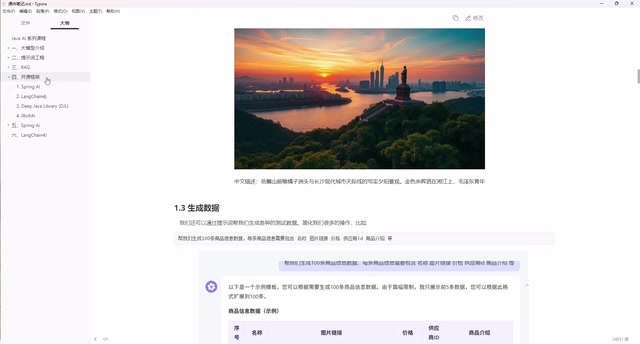
Spring AI is the official AI application development framework launched by Spring, providing Java developers with an AI capability abstraction layer that integrates seamlessly with Spring Boot. It shields differences between large model providers through unified interfaces such as ChatClient and EmbeddingClient, and includes built-in features like prompt templates, structured output, RAG support, and tool calling. LangChain4j is an independent Java-side implementation of the LangChain philosophy, providing components such as chained calls, memory management, Agents, and RAG. Spring AI is more aligned with the habits of the Spring ecosystem, while LangChain4j is more flexible with richer components; the two can complement each other.
Key Technical Points and Learning Advice for Java AI Development
From the course structure, several technical points worth重点关注 for Java developers can be extracted:
Token and cost awareness. Understanding Tokens is the foundation for understanding large model billing and context limits. Java developers need to factor Token consumption into their API call layer design.
Vector database selection. ChromaDB is lightweight and easy to get started with, while Milvus suits large-scale scenarios. The course covers both, helping learners build selection judgment.
Equal emphasis on frameworks and hand-writing. First hand-write RAG to understand the principles, then use Spring AI or LangChain4j for efficiency. This learning order avoids the trap of "only knowing how to call APIs without understanding the underlying logic."
Start with vibecoding projects. The course includes vibecoding project practice, emphasizing hands-on coding, suitable for consolidating what is learned in a project-driven way.
Who Should Learn, and What Prerequisites Are Needed
This course is positioned as a zero-basics introduction, aimed at programmers with Java fundamentals but lacking AI large model development experience. Learners need basic Java programming ability; familiarity with the Spring ecosystem is helpful but Python or machine learning theory is not required beforehand.
The AI programming tools mentioned in the course narration, such as Claude Code, Cursor, and Codex, as well as SDD (Specification-Driven Development)-related content, are not elaborated much in the original introduction and may appear as auxiliary tools in the vibecoding project in the actual course. For developers who want to learn about AI-assisted programming, the actual usage demonstrations of these tools are worth watching.
vibecoding refers to a programming approach where intent is described in natural language and an AI programming assistant generates or completes code, emphasizing collaboration between developers and AI for rapid iteration rather than line-by-line hand-writing. SDD (Specification-Driven Development) is a practice that drives AI code generation with structured specification documents: first clarify the requirement specifications, then have AI produce the implementation. The Claude Code, Cursor, and Codex mentioned in the article all belong to this category of AI programming tools, and are often used as auxiliary means in vibecoding projects to help learners quickly build prototypes and understand code structure.
Summary
The path for Java programmers to enter AI large model development is now much clearer than it was two years ago: start with API calls, understand prompts and RAG, then use frameworks like Spring AI and LangChain4j to implement enterprise needs. Boge's course provides a structured introductory framework, and its "hand-write first, framework later" design philosophy has practical value for building solid engineering skills. What truly determines learning outcomes is still hands-on completion of the code practice for each module.
One-line Summary
A learning path and course breakdown for AI large model application development aimed at Java programmers.
Paragraph Summary
Based on the introduction to Bilibili creator Boge's Java AI large model course, the article addresses Java programmers' confusion about whether to switch to Python when facing the AI wave. The author points out that there is also a large demand for large model integration in the Java ecosystem, and frameworks like Spring AI are responding to this trend. The course is divided into four progressive modules: large model fundamentals and direct Java API connection, prompt engineering, RAG from-scratch hand-written implementation (including ChromaDB and Milvus vector databases), and application of Spring AI and LangChain4j frameworks, and includes vibecoding project practice. The article extracts key learning advice such as Token cost awareness, vector database selection, and hand-writing before frameworks, and explains that the course is aimed at developers with Java fundamentals and no need for Python or machine learning background.
Related articles

Connecting Dify to WeCom Customer Service: A Plugin-Based Runner in Practice
LangBot 4.11 reduces connecting Dify to WeCom Customer Service to three steps: install the Dify Agent plugin, create an Agent processor, and bind the message.received event route.

Building Daily Healthy Habits with AI Wellness Tools: From Tracking to Personalized Insights
How do AI wellness tools help build daily health habits? This article analyzes small-goal tracking, personalized health insights, and routine embedding logic, using Healnova as an example to discuss the auxiliary role and boundaries of such tools.

Agent Says "Done" But Produces Nothing: Verification Is Not Delivery
Agent says done but produces nothing? This article dissects AI Agents' most common fake-delivery trap: passing off verified existing state as completed work, with three key questions, strong check examples, and creation-ID principles to help developers identify and prevent the "verify-not-produce" problem and build more reliable Agent acceptance workflows.